Trump hails ‘great day for the world’ as DRC, Rwanda finalise peace deal
 04 December 2025
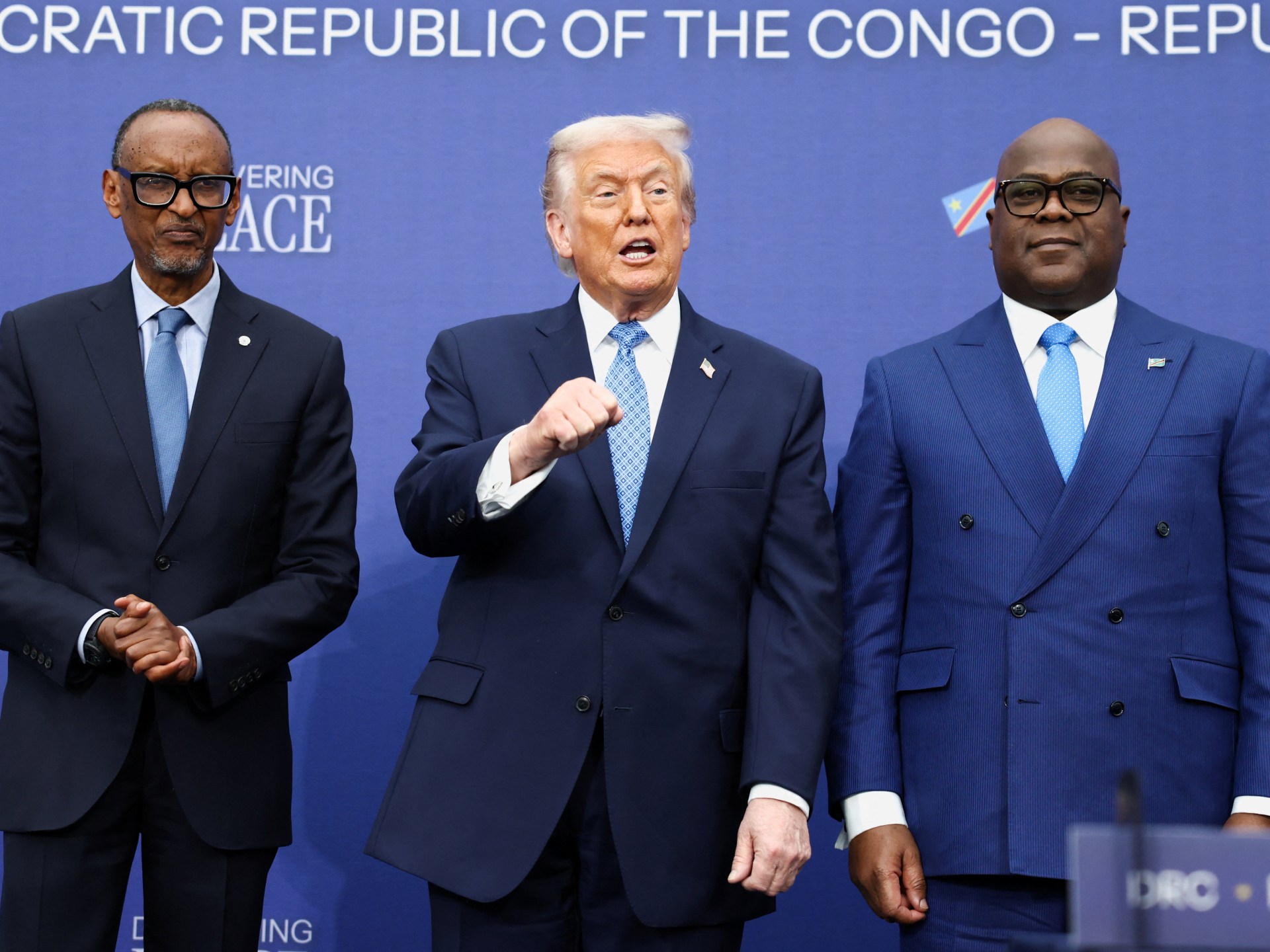

United States President Donald Trump has hosted the leaders of Rwanda and the Democratic Republic of the Congo to sign a peace deal that could end the conflict between the two countries.
Although the violence on the ground has not stopped, Trump hailed the US-brokered deal on Thursday as a new chapter for the region.
- list 1 of 3Putin challenges US pressure on India over Russian oil during state visit
- list 2 of 3US authorities arrest suspect in 2021 Washington, DC, pipe bomb case
- list 3 of 3Last foreign carriers halt flights to Venezuela after Trump’s airspace ban
end of list
“It is an amazing day: great day for Africa, great day for the world and for these two countries,” Trump said. “And they have so much to be proud of.”
The agreement was originally reached in June. DRC President Felix Tshisekedi and his Rwandan counterpart Paul Kagame had met in Qatar in March, initiating the talks that led to the deal.
Thursday’s ceremony finalises the accords.
The agreement has sparked hopes of ending the conflict in the DRC, where the March 23 Movement (M23), a Rwanda-backed armed group, has been advancing deeper into the resource-rich east of the country.
The renewed violence had raised fears of a full-blown conflict, akin to the wars that the DRC endured in the late 1990s, which involved several African countries and killed millions of people.
Rwanda’s main grievance with the DRC focuses on accusations that the Central African country has been harbouring ethnic Hutu militias linked to the 1994 Rwanda genocide, which targeted the country’s Tutsi population.
The Trump-backed peace deal stipulates that Rwanda will end its support for M23 and the DRC will help “neutralise” Hutu militias — namely, the Democratic Forces for the Liberation of Rwanda.
Advertisement
It also requires both countries to respect each other’s territorial integrity.
On Thursday, the DRC’s Tshisekedi said the agreement’s terms mark a “turning point” for the region.
“They bring together, under a coherent architecture, a declaration of principles of a peace agreement and also the regional economic integration framework to provide to the peoples of the region a new perspective, a new outlook,” Tshisekedi said.
He added that the deal would “begin a new era of friendship, cooperation and prosperity”.
For his part, Rwanda’s Kagame said the success of the pact depends on the two countries themselves.
“There will be ups and downs on the road ahead. There’s no doubt about it,” Kagame explained. “Rwanda will not be found wanting, I can assure you of that.”
Reporting from Washington, DC, Al Jazeera’s Alan Fisher said the leaders of the DRC and Rwanda appeared to acknowledge that it will take more than a signing ceremony for the agreement to stick.
The conflict, Fisher explained, “is a lot more ingrained, a lot more developed, a lot more aggressive than many people have assumed”.
“So the pressure is on the United States, on the African leaders and, of course, on the two countries to make sure that what develops from here is something that can develop into a lasting peace.”
The DRC had signed a separate deal with M23 in July. Still, the fighting in the eastern parts of the country has persisted.
“We are still at war,” Amani Chibalonza Edith, a 32-year-old resident of Goma, a key city captured by M23 early this year, told The Associated Press news agency.
“There can be no peace as long as the front lines remain active.”
But in Washington, DC, on Thursday, Trump appeared optimistic about the prospects for peace.
“We’ll see how it all works out, but I think it’s going to work out really great,” the US president said.
Trump also announced that the US will be signing bilateral deals with the DRC and Rwanda to buy rare earth minerals from the two countries.
“We’ll be involved with sending some of our biggest and greatest companies over to the two countries,” Trump added.
“And we’re going to take out some of the rare earth, take out some of the assets and pay. Everybody is going to make a lot of money.”
Rare earth minerals are used in emerging technologies, energy production and medical devices.
Trump has openly campaigned for the Nobel Peace Prize, claiming he has resolved eight world conflicts, though that number is disputed.
During Thursday’s signing ceremony at the US Institute for Peace, a think tank, he heaped praise onto the DRC and Rwanda. But his embrace of the countries’ two leaders drew a stark contrast with his insulting remarks towards another war-torn African country: Somalia.
Advertisement
Two days before hosting the ceremonial signing, Trump hurled insults at Somalia, describing it as “hell” and saying that “it stinks”.
He also called the Somali community in the US “garbage”.
Related News
Death toll from Sria Lanka landslides and floods rises to 56
Tight special election race in deep-red Tennessee concerns US Republicans

Eurovision organisers debate whether Israel should be barred from contest