Trump signs executive order labeling fentanyl ‘weapon of mass destruction’
 15 December 2025
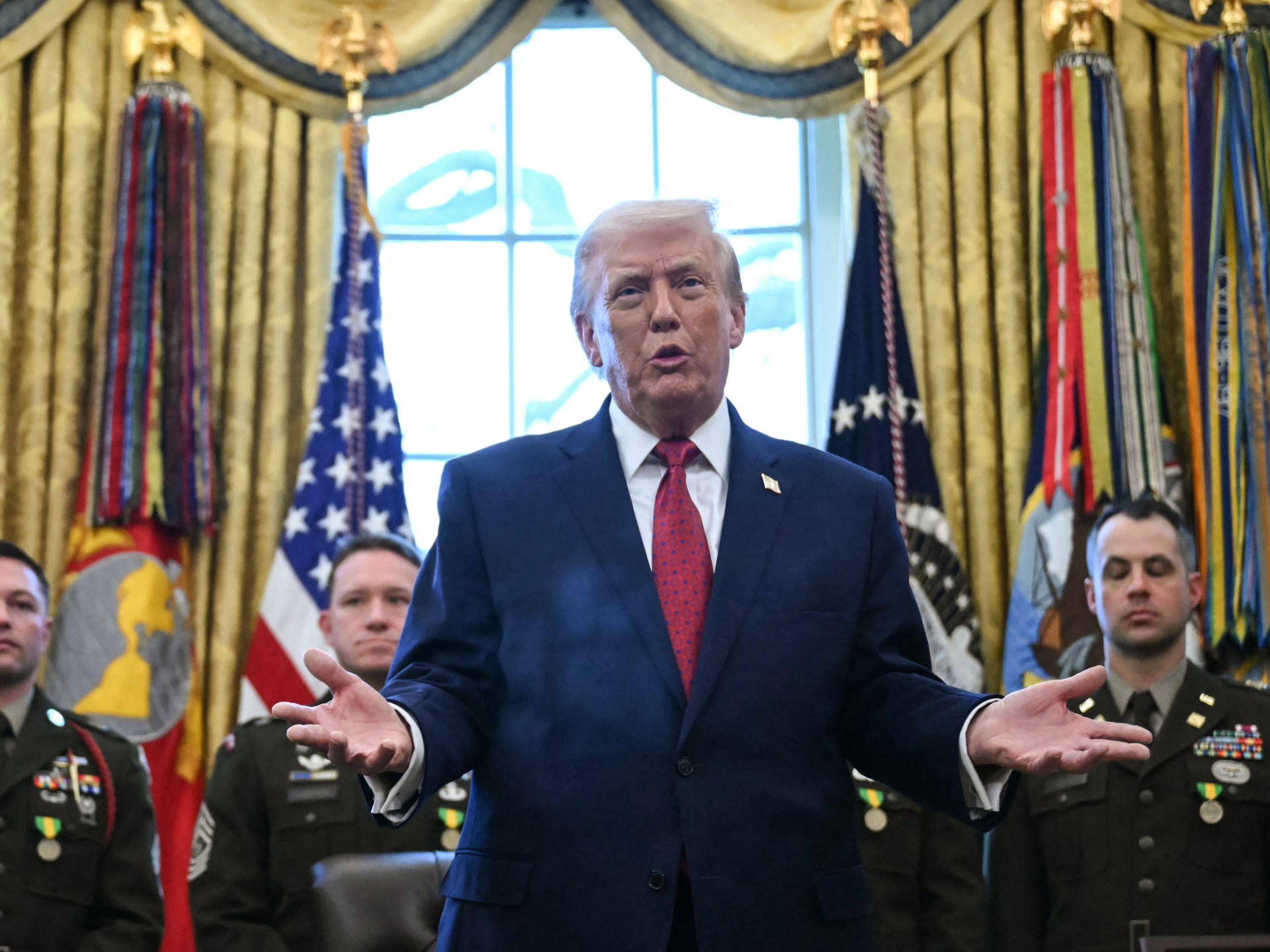

Washington, DC – United States President Donald Trump has said he will sign an executive order labelling fentanyl, and its core precursors, as a “weapon of mass destruction” (WMD), in the latest instance of his administration using increasingly militarised language to justify its operations against drug cartels and smugglers.
The announcement on Monday comes after the Trump administration’s repeated references to drug smugglers as “narco-terrorists” and its designation of Latin American cartels as “foreign terrorist organisations”.
- list 1 of 3Venezuela: A not-so-covert CIA disaster in the making
- list 2 of 3‘Maduro will leave power’: Machado vows Venezuela leadership change
- list 3 of 3Why the US is targeting Venezuela
end of list
The administration has repeatedly claimed that international drug smuggling groups are not criminal networks bent on profit, but organisations aimed at destabilising the US.
“There’s no doubt that America’s adversaries are trafficking fentanyl into the United States, in part because they want to kill Americans,” Trump said on Monday during a White House event.
“That’s why today, I’m taking one more step to protect Americans from the scourge of deadly fentanyl flooding into our country,” he added.
“With this historic executive order I will sign today, we’re formally classifying fentanyl as a weapon of mass destruction.”
It was not immediately clear if the label would have any practical impact, or what bearing it would have on fentanyl legally bought for medical use.
The executive order called simply for a series of actions from the heads of executive agencies to “eliminate the threat of illicit fentanyl and its core precursor chemicals to the United States”.
Advertisement
Under current US law, which the president cannot unilaterally change, a weapon of mass destruction is defined as “any weapon that is designed or intended to cause death or serious bodily injury through the release, dissemination, or impact of toxic or poisonous chemicals, or their precursors”.
The definition includes “any weapon involving a biological agent, toxin, or vector”, as well as “any weapon that is designed to release radiation or radioactivity at a level dangerous to human life”.
It also defines a WMD as any “destructive device”, including traditional bombs, missiles, grenades or items that can be converted to expel a projectile.
The Trump administration has used efforts to mitigate fentanyl smuggling as a pretext for increasing tariffs on Mexico and China.
The administration has also used its wider campaign against drugs to justify strikes on alleged drug smuggling boats in the Caribbean and eastern Pacific – in what rights groups say could amount to extrajudicial killings – and to justify surging military assets off the coast of Venezuela.
Trump has repeatedly threatened to begin land attacks on Venezuelan territory to counter drug smuggling.
He repeated the threat on Monday. “We’re going to start hitting them on land, which is a lot easier to do, frankly,” he said.
Venezuelan leader Nicolas Maduro has maintained that the US pressure campaign is aimed at toppling his government.
Despite the heightened rhetoric against Venezuela, regional experts have noted that the country, and South America, are not known hubs for fentanyl production or exports.
“To be perfectly clear, there is no fentanyl coming from Venezuela or elsewhere in South America,” John Walsh, director for drug policy and the Andes at the Washington Office on Latin America (WOLA) said during an expert briefing earlier this month.
Some critics have likened Trump’s pressure campaign against Venezuela to the buildup of the 2003 US invasion of Iraq, which was premised on the false finding that the government of Saddam Hussein was developing WMDs.
Related News
UK announces independent probe into foreign interference in politics

Brown University in US reports ‘active shooter’ situation on campus
Why are conservationists alarmed about Botswana’s biggest elephant hunt?