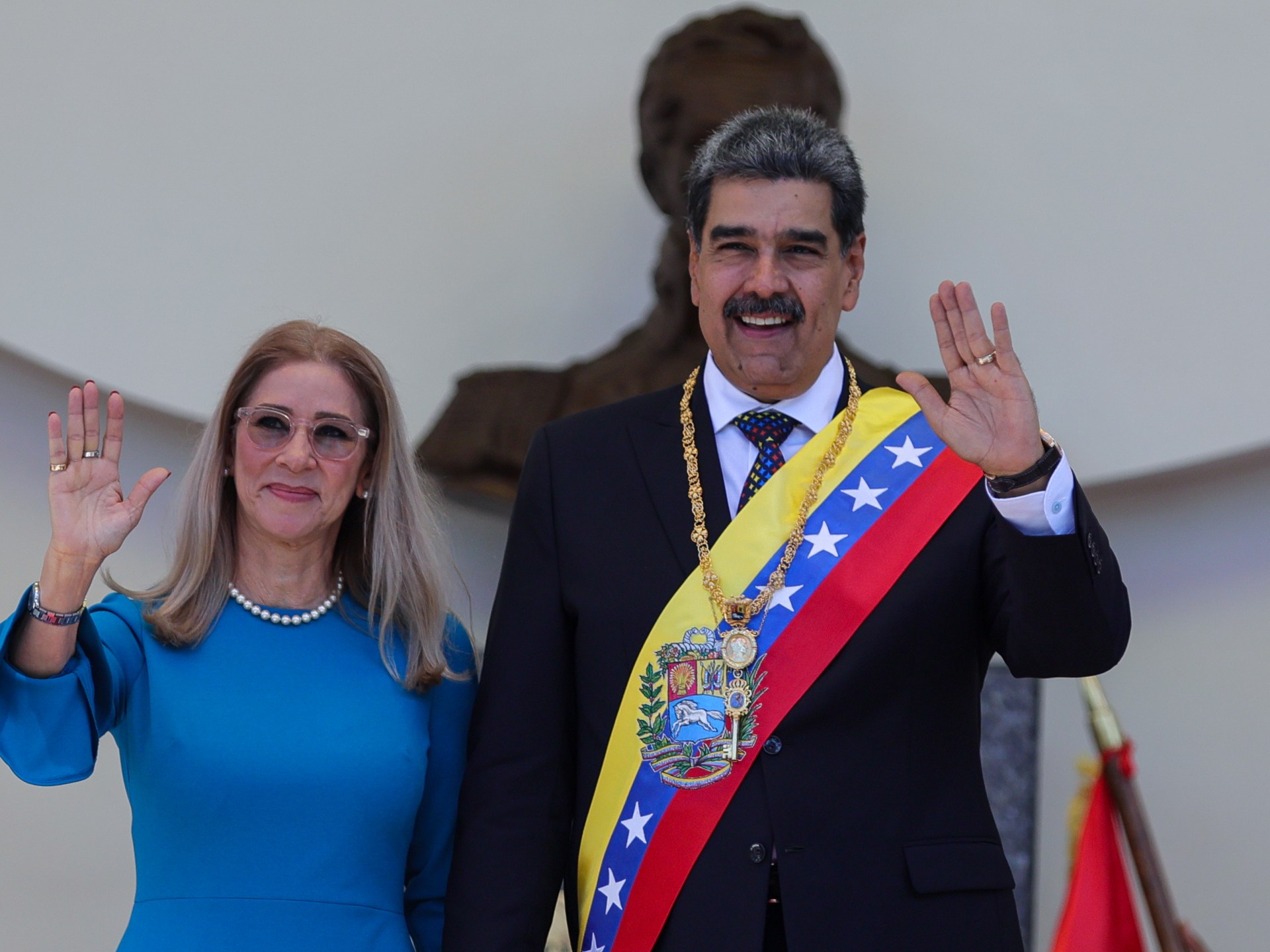

The United States Department of the Treasury has announced new sanctions on several family members and associates of Venezuelan President Nicolas Maduro, as the Trump administration increases pressure on Caracas and continues to build up US forces on Venezuela’s borders.
The sanctions announced on Friday come as the US military continues attacks on boats off the country’s coast, which have killed more than 100 people. The US military has also seized a Venezuelan oil tanker and imposed a naval blockade on all vessels arriving and departing from Venezuelan ports that are under US sanctions.
- list 1 of 4Five killed as US military destroys two more vessels in Pacific Ocean
- list 2 of 4Which countries, besides Russia, have assets frozen by the EU?
- list 3 of 4Julian Assange files complaint against Nobel Foundation over Machado prize
- list 4 of 4Five key takeaways from US State Secretary Rubio’s year-end briefing
end of list
Announcing the new sanctions, US Secretary of the Treasury Scott Bessent said in a statement that “Maduro and his criminal accomplices threaten our hemisphere’s peace and stability”.
“The Trump Administration will continue targeting the networks that prop up his illegitimate dictatorship,” Bessent added.
The new sanctions target seven people who are family members or associates of Malpica Flores, a nephew of Maduro, and Panamanian businessman Ramon Carretero, who were named in an earlier round of US sanctions that also targeted six Venezuela-flagged oil tankers and shipping firms, on December 11.
Flores, who is one of three of Maduro’s nephews by marriage, dubbed “narco-nephews” by the US Treasury Department, is wanted because he “has been repeatedly linked to corruption at Venezuela’s state-run oil company, Petroleos de Venezuela, SA”, the Treasury said in a statement.
It was not immediately clear how Flores’s role in Venezuela’s state-run oil company related to “propping up Nicolas Maduro’s rogue narco-state”, which Bessent said in his statement was the reason for widening sanctions to additional family members and associates of the president.
Advertisement
The US has claimed that tackling drug trafficking is the primary reason for its military escalation in the region since September, including the strikes on vessels in the eastern Pacific and Caribbean, which international law experts say amount to extrajudicial killings.
Despite the Trump administration’s repeated references to drug trafficking, its actions and messaging appear increasingly focused on Venezuela’s oil reserves, which are the largest in the world. The reserves have remained relatively untapped since sanctions were imposed on the country by the US during the first Trump administration.
Homeland Security adviser and top Trump aide Stephen Miller said last week that Venezuela’s oil belongs to Washington.
“American sweat, ingenuity and toil created the oil industry in Venezuela,” Miller claimed on X. “Its tyrannical expropriation was the largest recorded theft of American wealth and property,” he added.
US sanctions, particularly those targeting Venezuela’s oil industry, have contributed to an economic crisis in the country and increased discontent with Maduro, who has governed Venezuela since 2013.
For his part, Maduro has accused the Trump administration of “fabricating a new eternal war” aimed at “regime change” and seizing Venezuela’s vast oil reserves.
The European Union has also imposed targeted sanctions on Venezuela, which it renewed last week until 2027.
The European sanctions, first introduced in 2017, include an embargo on arms shipments to Venezuela, as well as travel bans and asset freezes on individuals linked to state repression.

Related News
Morocco launches nationwide emergency relief after floods kill dozens
With flags and fireworks, Syrians celebrate one year since fall of al-Assad
How have India’s exports jumped 20 percent, despite Trump’s trade war?