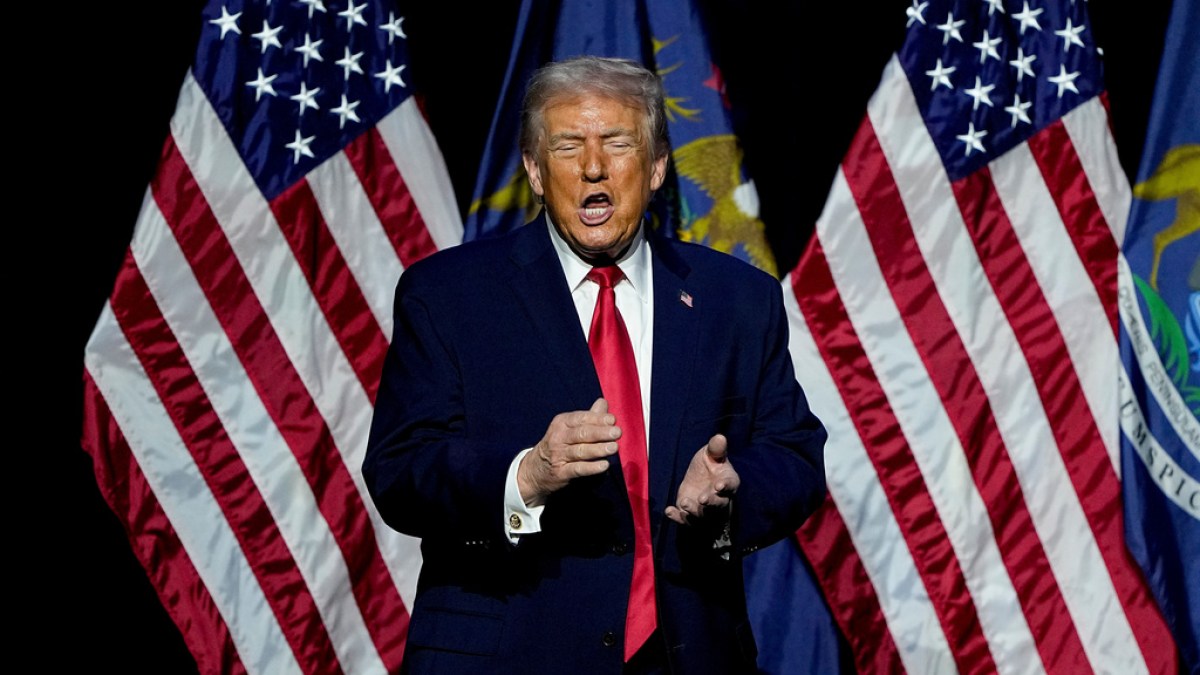

United States President Donald Trump has claimed that unearthing and ending fraud nationwide would eliminate the country’s deficit.
In particular, Trump has highlighted alleged public services fraud by Somalis in Minnesota and also said there is fraud in “many other places”.
“If we stop this fraud, this massive fraud, we’re going to have a balanced budget,” Trump said on Tuesday during a speech at the Detroit Economic Club.
In Minnesota, investigators have identified fraud involving federal money for housing programmes, autism services and child nutrition. Federal prosecutors charged dozens of defendants beginning in 2022 – before Trump’s current term – and have filed more charges since Trump took office a year ago.
So far, the Minnesota fraud charges involve a minimum of hundreds of millions of dollars. Assistant US Attorney Joe Thompson, who led Minnesota fraud prosecutions, said in December that Medicaid fraud in the state could reach $9bn although not all of that would be federal money. Thompson resigned on Tuesday.
But adding the dollars lost to fraud in Minnesota to federal losses elsewhere – which have been estimated as high as $521bn annually – would not bring the total close to the amount of the federal deficit. The fiscal year 2025 deficit – that year’s difference between revenues and spending – was $1.775 trillion.
“You can’t balance the books on waste, fraud and abuse,” said Steve Ellis, president of Taxpayers for Common Sense, a group that tracks the federal budget. “It’s important to root it out, but the only way you get anywhere close to a balanced budget is fiscal restraint.”
Advertisement
The White House did not immediately respond to an inquiry for this article.
Federal report in 2024 found hundreds of billions of dollars in fraud
In April 2024, during the tenure of former President Joe Biden, the Government Accountability Office (GAO) produced what it called a “first-of-its-kind, government-wide estimate of federal dollars lost to fraud”.
The office estimated $233bn to $521bn lost in fraud per year, based on 2018 to 2022 data from agency inspectors general and fraud reports submitted to the Office of Management and Budget.
The GAO’s topline figure included not only official fraud findings from legal proceedings but also estimates based on individual agencies’ findings of fraud. The agency also extrapolated figures it believed represented undetected fraud.
The estimated annual losses amounted to 3 percent to 7 percent of what the government spent on average in those years.
Joshua Sewell, director of research and policy at Taxpayers for Common Sense, previously cautioned that the GAO report is filled with caveats, including its overlap with the COVID-19 pandemic, which resulted in increased spending.
Still, “it’s very, very unlikely that there is enough fraud in the federal government to balance the budget,” said Chris Towner, policy director for the Committee for a Responsible Federal Budget, a fiscally hawkish group. “For the $1.775 trillion deficit for that year to have been due to fraud, it would mean that one-quarter of federal spending was fraudulent, or some combination of fraudulent lost tax revenue and federal outlays totalled that amount.”
Another challenge is that fraud is not easy to root out entirely. Historically, “only a small percentage of tax dollars lost to fraud are ever actually recovered by the government,” said Bob Westbrooks, a fraud and corruption risk expert who served as executive director of the federal government’s Pandemic Response Accountability Committee.
In recent weeks, Trump, a Republican, has spotlighted fraud in blue states, or states that generally vote Democratic, such as Minnesota. But there have been notable high-dollar fraud investigations in other states too.
In Mississippi, a solidly Republican state, a trial is under way in a welfare scandal that auditors said resulted in the loss of $100m in federal money from 2016 to 2020.
In 2024, the US Sentencing Commission pointed to the Southern District of Florida as the nation’s top district for fraud, adding that nationwide offences related to government benefits fraud had increased by 242 percent since 2020. Florida is also a red, or Republican, state.
Advertisement
This month, the US Department of Health and Human Services froze access to certain childcare and family assistance funds for California, Colorado, Illinois, Minnesota and New York – all blue states – saying it was related to fraud concerns. A federal judge blocked it temporarily.
Our ruling
Trump said: “If we stop this fraud, this massive fraud, we’re going to have a balanced budget.”
The amount of fraud committed against federal programmes is large, but the dollar amount does not come close to equalling the dollar amount of the federal deficit.
The highest nationwide fraud estimate puts fraud losses at $521bn. If all of that could be recouped, it would still be less than one-third of the 2025 deficit.
We rate the statement false.
Related News
Venezuela after Maduro: Oil, power and the limits of intervention
Iran accuses foreign intelligence behind protest movement
Is the US War Powers Act unconstitutional, as President Trump says?