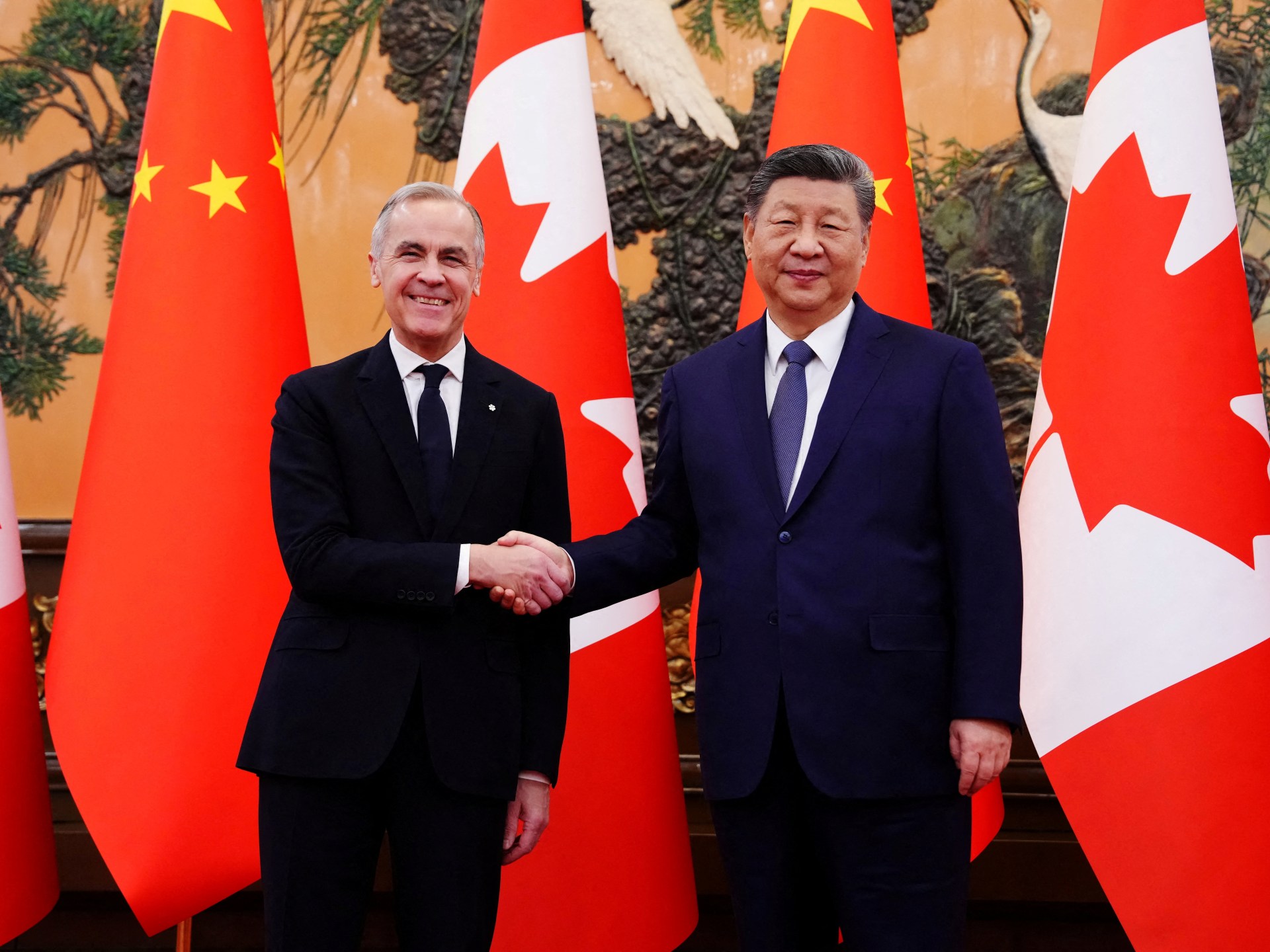

Faced with new global challenges, the leaders of China and Canada have pledged to improve relations between their two nations after years of acrimony.
Xi Jinping told visiting Prime Minister Mark Carney on Friday that he is willing to continue working to improve ties, noting that talks have been under way on restoring and restarting cooperation since the two held an initial meeting in October on the sidelines of a regional economic conference in South Korea.
- list 1 of 4China’s trade surplus hits new heights in 2025 despite US tariff war
- list 2 of 4Chinese app ‘Are You Dead?’ to change name after surge in popularity
- list 3 of 4Japan, Philippines sign new defence pacts amid surging China tensions
- list 4 of 4Fifteen former NCAA players charged in US-China basketball rigging case
end of list
“It can be said that our meeting last year opened a new chapter in turning China–Canada relations towards improvement,” China’s top leader said.
Carney, the first Canadian prime minister to visit China in eight years, said better relations would help improve a global governance system that he described as “under great strain”.
Addressing Xi in the Great Hall of the People, Carney said that “together we can build on the best of what this relationship has been in the past to create a new one adapted to new global realities”.
Engagement and cooperation would be “the foundation of our new strategic partnership”, he said.
“Agriculture, energy, finance, that’s where we can make the most immediate progress.”
The reference to new realities reflects in large part the so-called “America First” approach of United States President Donald Trump.
The tariffs he has imposed have hit both the Canadian and Chinese economies. Carney, who has met with several leading Chinese companies in Beijing, said ahead of his trip that his government is focused on building an economy less reliant on the US at what he called “a time of global trade disruption”.
No announcement was made on tariffs between China and Canada, which is a sticking point in the relationship.
Advertisement
Canada followed the US in putting tariffs of 100 percent on EVs from China and 25 percent on steel and aluminium under former Prime Minister Justin Trudeau, Carney’s predecessor.
China responded by imposing duties of 100 percent on Canadian canola oil and meal and 25 percent on pork and seafood. It added a 75.8 percent tariff on canola seeds last August. Collectively, the import taxes effectively closed the Chinese market to Canadian canola, an industry group has said.
China is hoping Trump’s pressure tactics on allies such as Canada will drive them to pursue a foreign policy that is less aligned with the US.
Trump has suggested on several occasions that Canada could become the US’s 51st state.
Related News

US slams Russia’s ‘dangerous escalation’ in Ukraine amid new deadly strikes

Americans evenly split on Maduro’s abduction, poll shows
Saudi-led coalition targets Yemen separatists after leader skips talks