
Above the runway: How Bruno Magras keeps Saint-Barthélemy connected – StMaartenNews.com – News Views Reviews
 20 January 2026

Advertisement
From our St. Barths Correspondent
He retired from politics three years ago, bringing to a close a career that shaped public life in Saint-Barthélemy for nearly half a century. Retirement, however, did not mean withdrawal. Bruno Magras has remained closely connected to the island’s daily rhythm. At 74, the co-founder of St. Barth Commuter—an airline that marked its 30th anniversary in 2025—continues to play an active role in public life, focusing on aviation while also offering political advice and commentary when called upon.
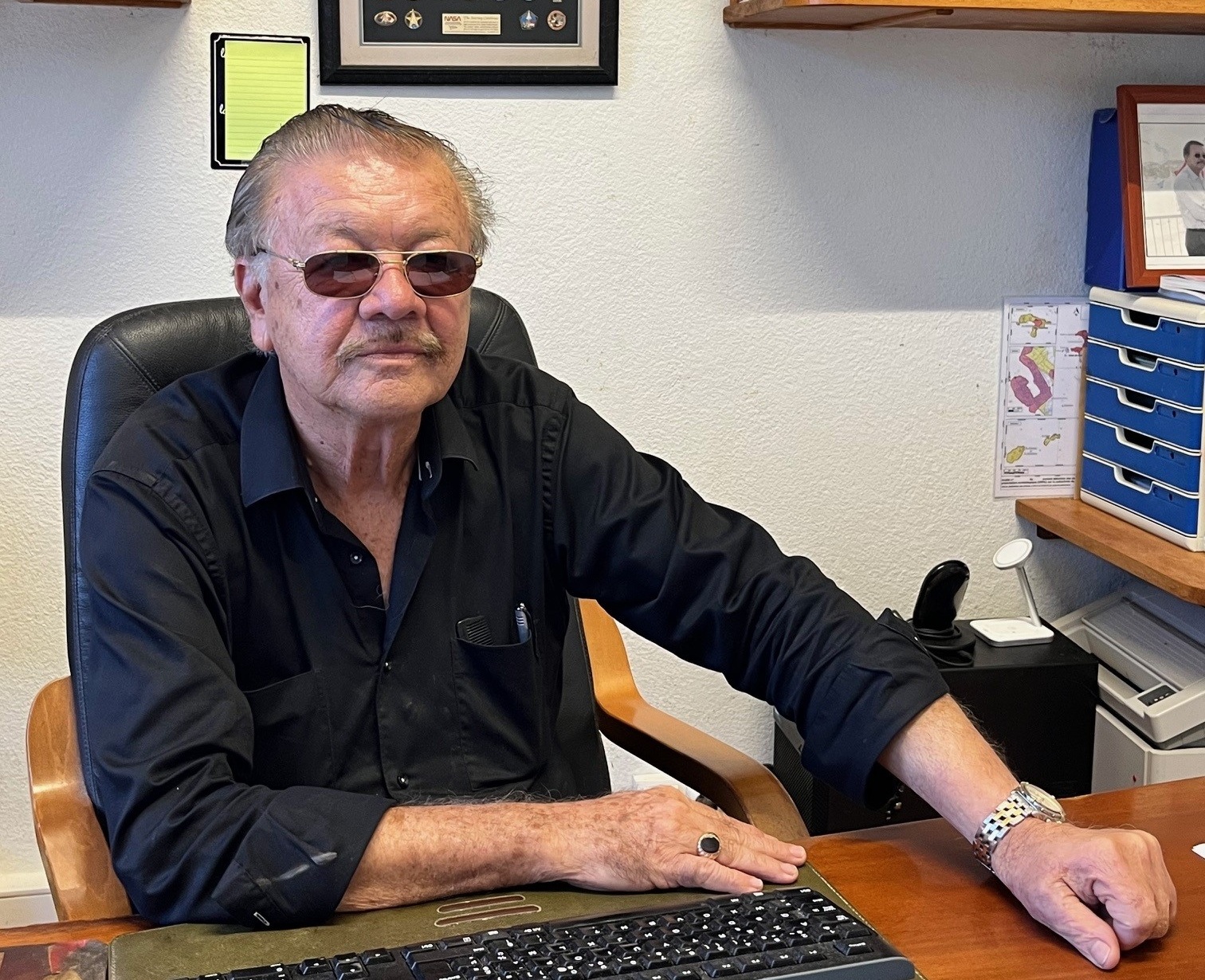
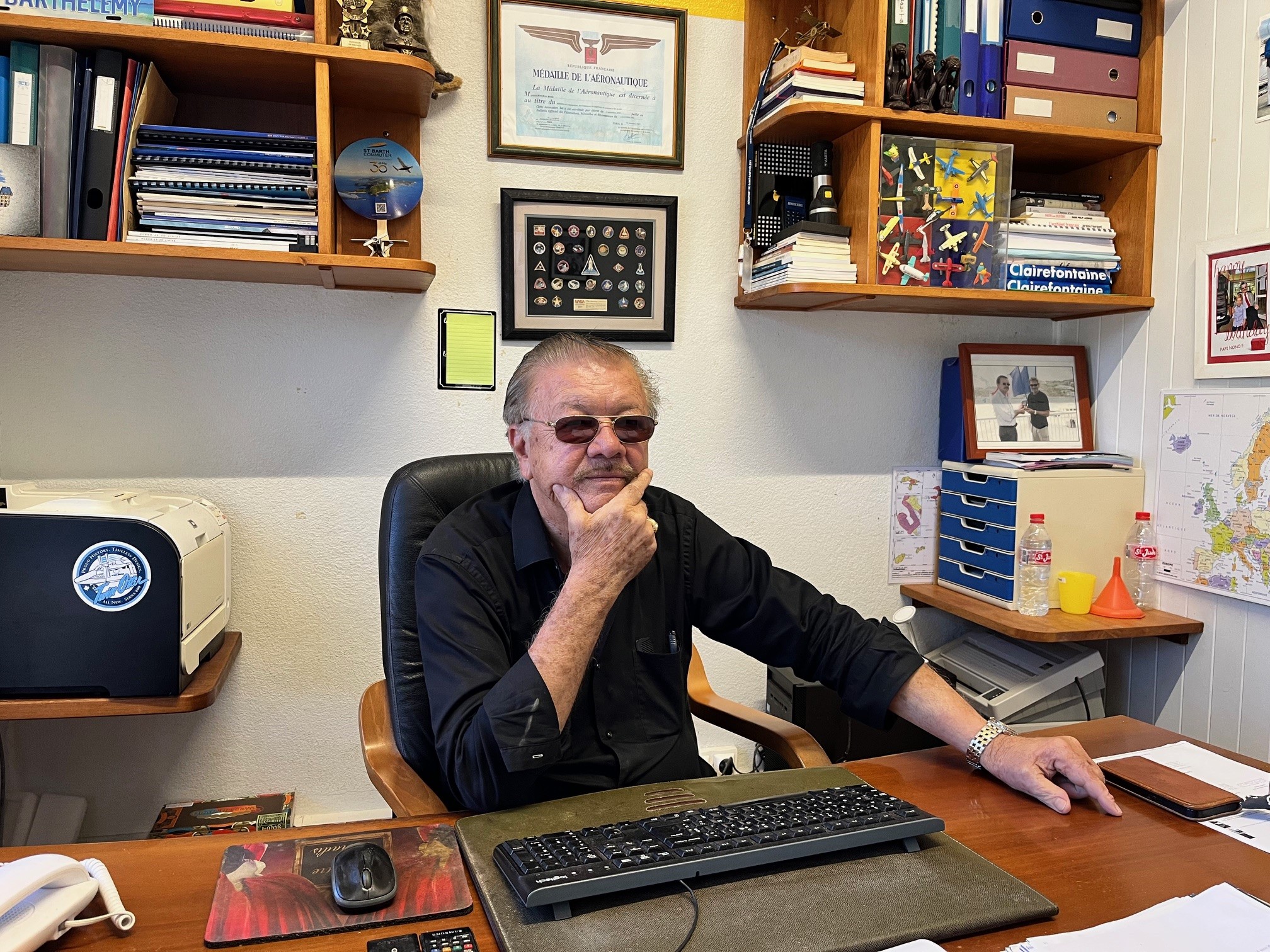
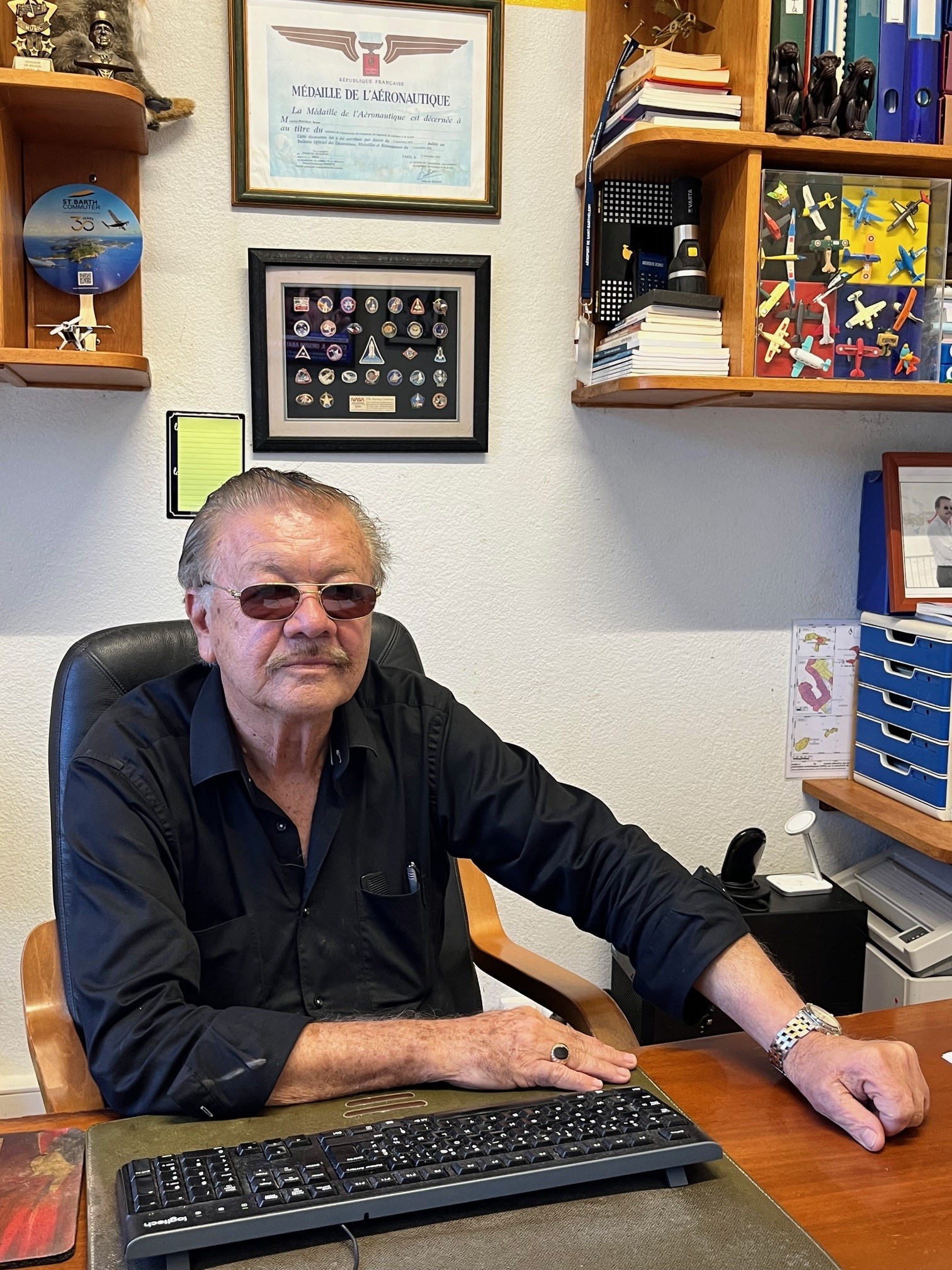
From his office at Rémy de Haenen Airport, Magras looks out over the runway where St. Barth Commuter aircraft land and take off in steady succession. A wooden desk anchors the room, topped by a vintage brass propeller repurposed as a pen holder. In a glass display case, miniature aircraft are arranged in quiet formation. Next to the desk is his guitar, his favorite instrument among many he knows how to play.
The white walls are lined with photographs of friends and family: astronaut Thomas Pesquet, Johnny Hallyday, Magras’ own band dressed in blue uniforms, and his grandchildren smiling into the camera. There is also a portrait of legendary World War II fighter pilot José Dormoy—pipe in hand—an old friend from his early aviation years.
Magras is largely self-taught. As a teenager, he was inquisitive and eager to learn, but growing up in the household of a sailor, his path to formal education was limited. “My father did not have the money to continue paying for my schooling,” he recalled. “There were very few job opportunities on Saint-Barth at the time, so I had to look elsewhere.” At the age of sixteen, he left the island for St. Thomas in the U.S. Virgin Islands.
 While working at a gas station and later as a mechanic assistant, the young Magras dreamt of becoming a pilot. That ambition began to take flight after he was drafted into the army. In 1973, at the age of 21, he achieved his goal, earning his pilot’s license under the French Civil Aviation Authority in Guadeloupe.
~ That is when you met José Dormoy, Captain Pipe?
Magras: “Yes, I met him in the early Seventies, and we became good friends. I flew for 35 years and even acquired my own aircraft. I had wanted to become a professional pilot, but I could not achieve that because of a problem with my eye. Still, I am proud that for over 30 years, St. Barth Commuter has been flying.”
~ Your political career spans even longer than that.
Magras: “I was first elected on January 11, 1976. At the time, Rémy de Haenen was still mayor, having served since 1962. I was part of the opposition, and we won the election in 1977. I stepped away from politics in 1989 to focus on business, then returned in 1995 after St. Barth Commuter received its Air Operator Certificate. I was elected mayor for two consecutive terms, and after the establishment of the new French Overseas Collectivité, I was elected president three times. In total, I served in public office for over 40 years and led the island for 27 years.”
~ You are like Fleming on Saint Martin?
Magras: (laughs) “We both served our islands for a very long time. In 2022, I was 71, and the next candidate was 40. I could not expect him to think the way I think, nor could I think the way he does. I chose to step aside and let the younger generation take over. That’s life. But I remain quite busy, investing in Gustavia, developing several buildings.”
~ Do you mean these are your personal investments?
Magras: “Well, it’s all family business, just like St. Barth Commuter. Everything I do, I do with my children. My son Bertrand attended Embry-Riddle Aeronautical University and is a licensed commercial pilot in the United States. My daughter Stéphanie studied in Toulouse, where she earned a Master’s degree in Air Transport Management from the French National Civil Aviation School. They both now run the company, which employs 35 people. We have six aircraft, five of which are currently in operation.”
~ What do you consider the biggest challenge for your airline?
Magras: “Before we started in 1994, there was another company, Air Saint-Barthélemy, which went bankrupt. It left a gap in the market, and I was convinced there was a need for a local airline. We began with two Britten-Norman BN-2A Islander aircraft and soon expanded to six. Later, I sold those and replaced them with Cessna 208B Grand Caravans, which are turbine-powered aircraft—more powerful, faster, and capable of carrying heavier loads. I am very satisfied with these turbine planes. All maintenance is carried out here at our airport, with most of the technicians flying in from France. Our focus is always on safety first.”
~ What does putting safety first look like in practice?
Magras: “We replace the turbine engines at mid-life. These engines are designed with a typical ‘time-between-overhaul’ (TBO) of about 3,600 flight hours, but there is a hot-section inspection after 1,800 hours. We made an agreement with Pratt & Whitney Canada to exchange the turboprop engines at 2,000 hours, after their inspection confirmed that our aircraft are exceptionally well maintained. It costs a bit more than running the engines to 3,600 hours, but for safety reasons, I prefer this arrangement. Up to now, we have never had any problems, and we’ve been flying the Caravans since 2009.”
~ On another note, it is surprising to see you performing on stage. I heard your band play zouk music. When did you start playing?
Magras: “Music has always been my passion. When I was young in St. Thomas, I had an uncle who played the guitar. Through him, I was introduced to country music. I began watching how he played and eventually bought my first guitar. But I’m left-handed. When I got home with the instrument, I realized that guitars are meant to be played right-handed. I was determined to learn, so I first had to teach myself to become right-handed. That wasn’t easy. Still, I taught myself to play, and by the time I left St. Thomas at the age of 20, I could play. I’ve continued ever since.”
~ You love country music, yet we’ve never seen you wearing a cowboy hat.
Magras: (laughs) “Maybe one day—after I’ve lost my hair—I’ll start wearing a cowboy hat.”
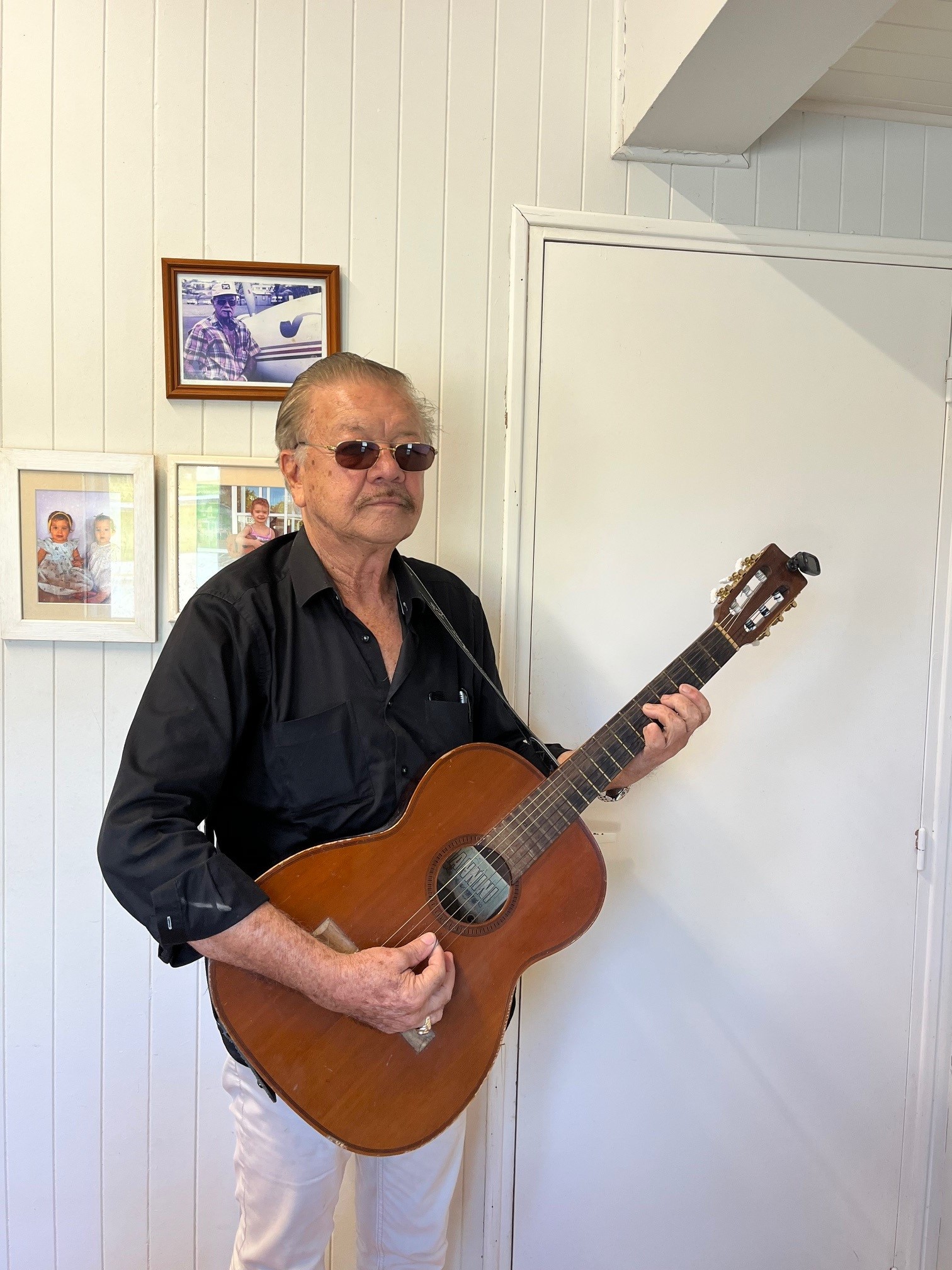
Photo 1 – Top
From his office at Rémy de Haenen Airport, Bruno Magras looks out over the runway where his St. Barth Commuter aircraft land and take off in steady succession.
Photo 2
Now 74, Magras remains active in public life and, with his children, invests in real estate and development projects.
Photo 3
Music has always played an important role in Magras’ life, especially country music.
Article & Photos by Erwin Dormoy
###
ADVERTISEMENT

Related News
Matouba et Papaye, deux sections rurales potentiellement enclavées
Grève de la police municipale : les agents demandent une rencontre avec le maire
« La colonisation est un sujet majeur de nos identités collectives »
