Minister Tackling: Government remains liable for Justice Workers despite insurance gaps – StMaartenNews.com – News Views Reviews
 28 January 2026

Advertisement

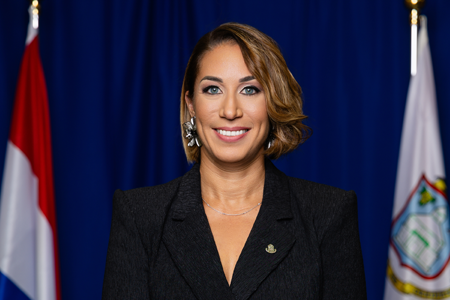
PHILIPSBURG — Minister of Justice Nathalie Tackling, representing the Soualiga Action Movement (SAM party), told Parliament on Wednesday that the Government of St. Maarten remains legally responsible for compensating justice workers injured or killed in the line of duty, regardless of the current absence of a comprehensive insurance policy.
Responding to questions during a Central Committee meeting, Tackling addressed long-standing concerns from unions and Members of Parliament regarding insurance coverage, payroll delays, and communication between the Ministry of Justice and labor representatives.
Legal duty of care
The minister emphasized that compensation rights for police officers are grounded in law, not insurance policies. Referring to Chapter 10, Article 114 of the Rechtspositiebesluit Politie, which came into effect on December 22, 2023, Tackling said the government is legally obligated to compensate police officers who are injured or killed while lawfully performing their duties.
“This duty applies at all times, regardless of whether an insurance policy exists,” she said, stressing that insurance serves only as a financial risk-management tool to ensure timely payouts.
Chapter 10 applies directly to the police force KPSM, the former Landsrecherche, and the Border Control Division of IBP. Other justice personnel — including prison staff, customs officers, probation officers, judicial bailiffs, and Coast Guard personnel — are not explicitly covered under the same regulation.
However, Tackling noted that under the National Ordinance on Civil Servants (LMA), the government still has a general duty of care toward all civil servants. “The absence of a specific provision does not remove the government’s liability,” she said.
Insurance lapse
Tackling outlined the history of the insurance issue, noting that from October 2016 a group life insurance policy for police officers was funded through a monthly 20-guilder salary deduction. That arrangement ended following a Council of Ministers decision on October 13, 2022, which narrowed coverage to frontline personnel and shifted the full cost of insurance to government.
A public tender for new coverage was initiated but stalled due to conflicts between the Council decision and draft legislation governing legal positions within the police force. Final alignment with unions through the CCSU was only reached in the third quarter of 2023, after the previous policy had already expired.
Subsequent delays arose due to rejected funding proposals, budget re-allocations, and exchanges with the Governor’s Cabinet. As a result, the ministry decided to focus on developing a new, properly tendered insurance framework for implementation in 2026.
Expanded coverage planned
The minister confirmed that future insurance coverage will be based on risk exposure rather than uniformed status, extending protection to all frontline justice workers facing occupational hazards. Coverage is expected to include accidental death, disability, and serious injury.
Currently, the ministry is working with SOAB to define policy objectives, identify eligible frontline positions, assess risk exposure, estimate personnel numbers, and determine budgetary requirements in compliance with existing legislation.
Tackling reiterated that formal communication with unions takes place through the Committee of Civil Servants Unions (CCSU), which includes representation from WICSU, NAPB, and ABVO. She said this ensures equal access to information and structured dialogue.
While no fixed meeting schedule exists, meetings are convened as needed, and union correspondence is answered promptly. Tackling added that informal communication also remains open.
Payroll updates
The minister also provided updates on outstanding payroll matters. Phase one of the salary update process was completed in December 2025. Batches 14 and 15 were paid in January, while batches 16 and 17 are awaiting the Governor’s signature.
A final batch 18, affecting approximately 20 individuals, remains pending due to discrepancies linked to outdated job classifications and errors in the function book. Corrective work is underway with support from Paymaster Central.
Legislation enabling Phase Two of the Loonruimte process was approved by the Council of Ministers last week and is currently with the Governor for signature.
Outstanding payments
Tackling reported that progress has been made in settling overdue payments within the justice sector. According to the minister, 35 stand-by duty payments for KPSM personnel have been processed, totaling XCg 754,000, while 12 jubilee payments amounting to XCg 118,769 have also been completed.
In addition, jubilee and overtime payments for staff within KPSM, the Prison, Immigration, and other justice departments remain pending at various stages of processing. Tackling emphasized that while the Ministry of Justice prepares and approves the payment advices, the actual execution of payments is the responsibility of the Ministry of Finance.
Concluding her remarks, Tackling said the Ministry of Justice remains committed to transparency, accountability, and regular updates to Parliament, unions, and the public. “We have nothing to hide,” she said. “We are not afraid of questions from Parliament or the press.”
###
ADVERTISEMENT