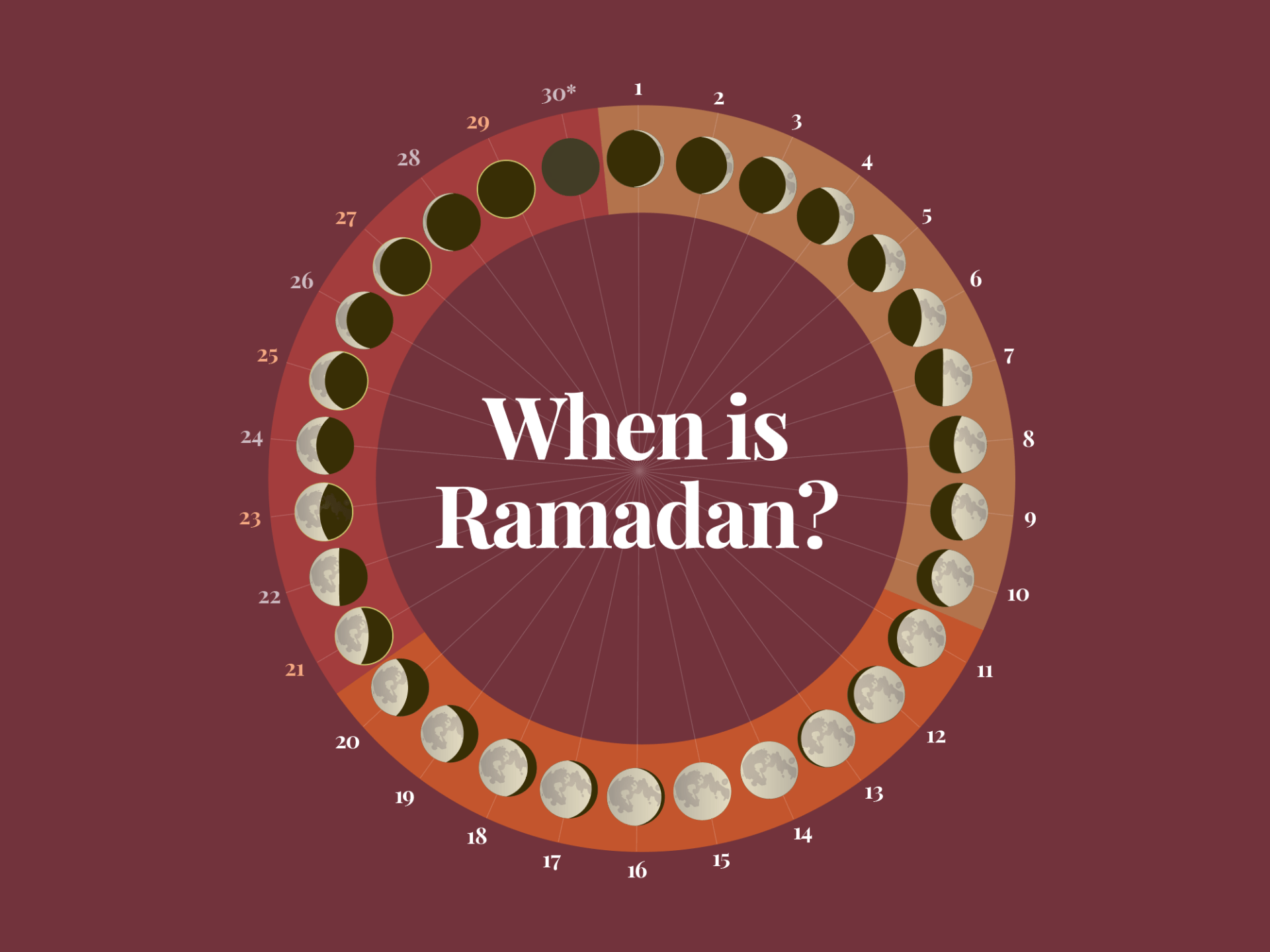

The first day of fasting for the Muslim holy month of Ramadan in Mecca, Saudi Arabia will be either Wednesday, February 18 or Thursday, February 19, depending on the sighting of the new moon.
Other countries follow their own moon sightings. Some use astronomical calculations for lunar phases, while others rely on traditional local sightings to confirm the start of the new month.
- list 1 of 3Ramadan 2026: Fasting hours, suhoor and iftar times around the world
- list 2 of 3Anxiety, anger, and hope in Syria’s Damascus after SDF ceasefire
- list 3 of 3Who is part of Trump’s ‘Board of Peace’ for Gaza?
end of list
Ramadan is determined by the Islamic lunar calendar, which begins with the sighting of the crescent moon. Saudi Arabia and other Muslim-majority countries rely on the testimonies of moon sighters to determine the start of the month.
How is the Ramadan moon sighted?
For the moon to be visible, the crescent must set after the sun. This allows the sky to be dark enough to spot the small sliver of the new moon.
After the sun sets on the night of February 17, the 29th day of the month of Shaban in the Hijri calendar, moon sighters face west with a clear view of the horizon for a first glimpse of the crescent moon.
If the moon is sighted, the month of Ramadan begins, with the first day of fasting being February 18. Otherwise, Shaban will complete 30 days, and the first fasting day will be February 19.
In Saudi Arabia, testimonies of people who have spotted the moon are recorded, and the Supreme Court makes a decision on when Ramadan should begin.

In order to view the moon at sunset time, there are three important factors astronomers look for:
Elongation: The moon needs to be far enough from the sun to ensure its light is not drowned out. For a reliable naked-eye sighting, the moon must be 10-12 degrees away from the sun. If it is closer than 7 degrees, then the crescent may be physically too thin to reflect enough light for the human eye to see.
Advertisement
Altitude: The higher the moon is at sunset, the less it has to compete with the thick, hazy atmosphere and the glow of the sky near the horizon. An altitude of 10 degrees is typically sufficient for clear naked-eye visibility, while lower altitudes of 3 to 5 degrees may be adequate with the help of optical aids.
Lag time: This is the time between sunset and moonset. For reliable naked-eye viewing, there usually needs to be at least 45 minutes for the sky to darken enough to see the moon. Longer durations are even better.
When does Ramadan begin in different countries?
According to Crescent Moon Watch, a moon tracker run by the United Kingdom’s Nautical Almanac Office, Ramadan’s new moon will begin on February 17 at 3:01pm Mecca time (12:01 GMT).
On that night in Mecca, the sun will set at 6:19pm (15:19 GMT), and the moon will be visible for only three minutes, setting at 6:22pm (15:22 GMT). With the new moon only three hours and 18 minutes old, it is very unlikely that anyone across the globe will see the crescent moon that evening, meaning the first day of Ramadan will begin on February 19.

On the evening of February 18, the new moon should be visible in most parts of the world. By that time, the moon will be nearly 26 hours old. It will be higher in the sky and remain visible for much longer after sunset, making it easily observable to the public.
North America
The Fiqh Council of North America (FCNA) and the Islamic Society of North America (ISNA), both of which follow astronomical calculations, have officially announced that Ramadan will begin on February 18, 2026. Their calculations state that, at sunset somewhere on the globe, the elongation of the moon should be at least 8 degrees, and the moon must be at least 5 degrees above the horizon for it to be visible.
Europe
The European Council for Fatwa and Research (ECFR) has declared that Thursday, February 19, will be the first day of Ramadan. ECFR notes that while the astronomical birth of the moon occurs on Tuesday, it will be impossible to see that evening either with the naked eye or through telescopes and observational instruments. Turkiye has also declared February 19 as the first day of the holy month of Ramadan, for the same reasons.
Middle East
Most Middle Eastern nations, led by Saudi Arabia, will not make a final announcement until the evening of Tuesday, February 17. If the Saudi Supreme Court receives a testimony of a sighting on Tuesday night, it may declare Wednesday as the first day of Ramadan. But this is very unlikely for the reasons mentioned above.
Advertisement
Asia
Across Asia, the start of Ramadan 2026 will most likely be Thursday, February 19, as the moon will set before the sun in that part of the world on Tuesday night.
Singapore has officially confirmed the start of Ramadan to be on Thursday, while countries in South Asia including India and Pakistan have forecast Thursday, February 19 as the first day of fasting.
Africa
In Africa, the start of Ramadan follows a similar pattern to the rest of the world, with most countries anticipating it to begin on Thursday, February 19.
Oceania
The Australian National Imams Council have announced that Ramadan will commence on February 19.

Muslims believe that Ramadan is the month when the first verses of the Quran were revealed to the Prophet Muhammad nearly 1,450 years ago.
Throughout the month, observing Muslims fast from just before the sunrise prayer, Fajr, to the sunset prayer, Maghrib.
The fast entails abstinence from eating, drinking, smoking, and sexual relations to achieve greater “taqwa”, or consciousness of God.
Fasting is one of the five pillars of Islam, along with the Muslim declaration of faith, daily prayers, charity, and performing the Hajj pilgrimage to Mecca if physically and financially capable.
In many Muslim-majority countries, working hours are reduced, and most restaurants are closed during the fasting hours.

Ramadan greetings in different languages
Various Muslim-majority nations have a personalised greeting in their native languages. “Ramadan Mubarak” and “Ramadan Kareem” are common greetings exchanged over the month, wishing the recipient a blessed and generous month, respectively.

Related News
Kosovo’s parliament approves new gov’t ending yearlong political deadlock

Trump endorses Prime Minister Viktor Orban for Hungary’s April election

New Yemen government formed with Shaya Mohsin al-Zindani as prime minister