Judge orders Trump administration to restore Philadelphia slavery exhibit
 17 February 2026
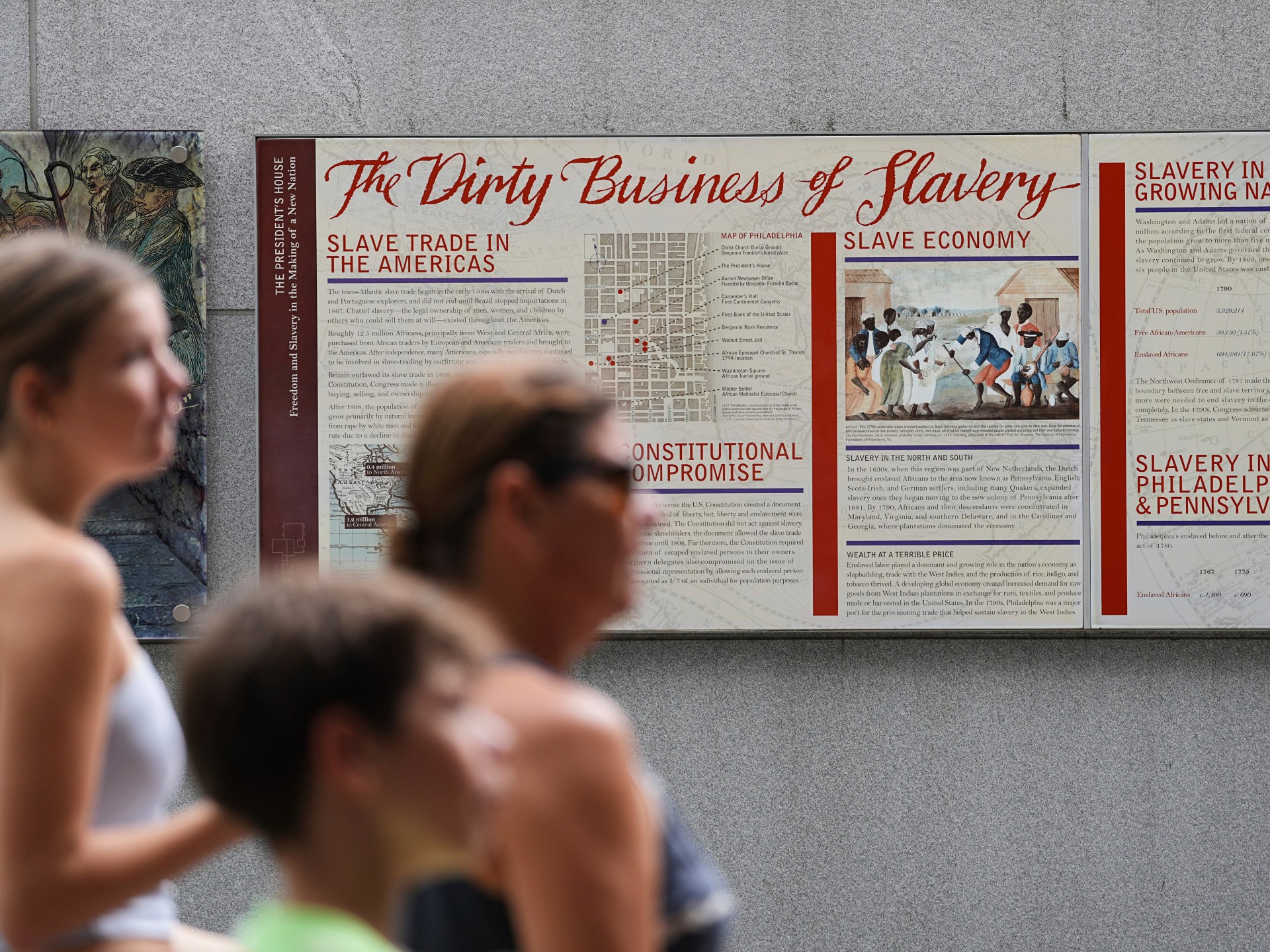

A judge in the United States has ordered the National Park Service (NPS) to restore an exhibit about nine people who were enslaved by former President George Washington at a historical site in the city of Philadelphia.
The ruling on Monday came after Philadelphia sued President Donald Trump’s administration over the takedown of several explanatory panels at the Independence National Historical Park, the site where Washington lived with his wife in the 1790s.
- list 1 of 4Russia-Ukraine war: List of key events, day 1,454
- list 2 of 4Two killed, 3 critical after shooting at hockey rink in US’s Rhode Island
- list 3 of 4Lebanon sets four months for second phase of Hezbollah disarmament
- list 4 of 4Hyatt Hotels chairman Thomas Pritzker steps down over Epstein ties
end of list
The removal came in response to a Trump executive order to restore “truth and sanity to American history” at the nation’s museums, parks and landmarks. It directed the Interior Department to ensure the sites do not display elements that “inappropriately disparage Americans past or living”.
US District Judge Cynthia Rufe ruled that all materials must be restored in their original condition while the lawsuit challenging the removal’s legality plays out. She prohibited Trump officials from installing replacements that explain the history differently.
In her scathing 40-page decision, Rufe accused the federal government of trying to erase US history, much like the fictional authoritarian regime that ruled George Orwell’s dystopian novel 1984.
“As if the Ministry of Truth in George Orwell’s 1984 now existed, with its motto ‘Ignorance is Strength,’ this Court is now asked to determine whether the federal government has the power it claims – to dissemble and disassemble historical truths when it has some domain over historical facts,” Rufe wrote. “It does not.”
Rufe had warned Trump administration lawyers during a hearing in January that they were making “dangerous” and “horrifying” statements when they said government officials could choose which parts of US history to display at NPS sites.
Advertisement
There was no immediate comment from the Trump administration.
The historical site is among several where the Trump administration has quietly removed content about the history of enslaved people and Native Americans. This included signage at the Grand Canyon National Park, which said settlers pushed Native American tribes “off their land” for the park to be established and “exploited” the landscape for mining and grazing.
Trump’s orders have also led to the restoration of Confederate statues and other moves that civil rights advocates say could reverse decades of social progress and undermine the acknowledgment of critical phases of US history.
The Philadelphia exhibit, created two decades ago in a partnership between the city and federal officials, included biographical details about each of the nine people enslaved by the Washingtons at the home, including two who escaped.
Several local politicians and Black community leaders celebrated the ruling, which came while many were out rallying at the site for its restoration.
State Representative Malcolm Kenyatta, a Philadelphia Democrat, said the community had prevailed against an attempt by the Trump administration to “whitewash our history”.
“Philadelphians fought back, and I could not be more proud of how we stood together,” he said.
State Representative Brendan Boyle, who also represents Philadelphia, welcomed the ruling.
“I’m proud of our country and its founding ideals. That means we tell the full truth about our history, the good and the bad,” he said.
Related News
Trump is the ‘elephant in the room’ as the African Union holds new summit

US imposes new Hezbollah sanctions targeting gold exchange firm

Sudan protecting Africa from foreign interference in war with RSF, says FM