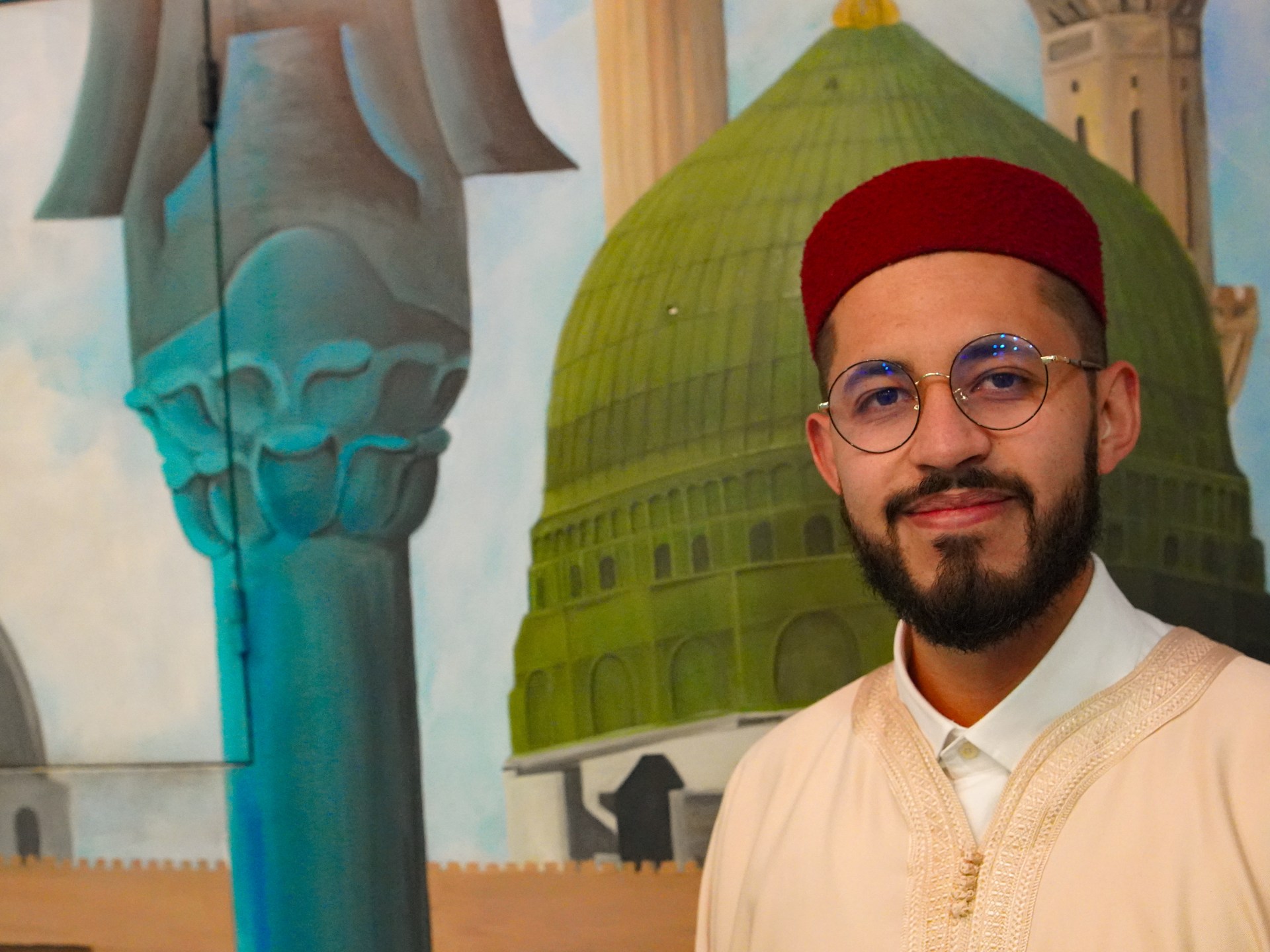

Medellin, Colombia – Ziauddin Yahya Iqbal Sandoval, known to his friends as Zia, observes Ramadan with quiet conviction.
The 14-year-old was born and raised in Colombia, where Christianity remains dominant. Nearly 63 percent of the population identifies as Catholic.
- list 1 of 3Colombia to resume peace talks with ECG after temporary suspension
- list 2 of 3Venezuela’s Rodriguez, Colombia’s Petro say they will meet ‘soon’
- list 3 of 3‘A Colombian Wild West’: Inside Maicao’s Arab community
end of list
But Zia is one of an estimated 85,000 to 100,000 Muslims in Colombia, comprising less than 0.2 percent of the country’s population.
Within that community, though, is a prism of diverse backgrounds and experiences. Some of Colombia’s Muslims reflect a rich history of migration to the region. Others are converts.
“The Colombian Islamic community is a small one but enjoys more on account of its diversity,” Zia said, as he took a break from serving tea in his uncle Zaheer’s restaurant in the upscale Poblado neighbourhood of Medellin.
On the eve of Ramadan, Muslim communities in cities like Bogota and Medellin prepared for the coming festivities with decorations and prayer.
Golden, glittering letters spelled out wishes for “Ramadan Karim” — or a “generous Ramadan” — above a modest mosque in Belen, on the outskirts of Medellin.
Inside, shoes were lined neatly along the wall. In a small, square prayer room, about eight men of different ages and nationalities stood shoulder to shoulder, bowing in unison.
“The majority of those who come to the mosque are Colombians, but we see people from Trinidad and Tobago, Tunisia, Pakistan and other Arab countries,” said Mu’tasem Abdo, the mosque’s imam who came to Medellin from Egypt four years ago.

He explained how, because Colombia’s Muslim community is relatively small, newcomers sometimes find themselves aching for the festive experience they remember from home.
Advertisement
“A native from a Muslim country can miss the grandeur of Ramadan as experienced back home,” Abdo explained.
Pakistani immigrant Rana Arif Mohammad remembers arriving in Colombia 23 years ago with dreams of adventuring through Latin America. But he too felt isolation as a Muslim in the country.
He settled in Medellin and founded a restaurant where he serves Pakistani and Arabic specialities in his Belen restaurant. But fellow Muslims were few and far between, and he remembers struggling to find a mosque.
“Twenty-three years ago, I met just four to five Muslims, just a few from Lebanon and Turkiye,” Mohammad said.
But Mohammad and others have observed Muslim visibility on the rise in Colombia.
In 2020, for instance, Colombia elected its first Muslim mayor in the border city of Maicao. And Mohammad explained that there are now more Islamic cultural centres and places of worship.
“Today, Medellin has five mosques,” he said, counting the ones he knows.

The Muslim population in Latin America first surged after the collapse of the Ottoman Empire in the early 20th century. There have been several waves of migration in the century since.
In Colombia, one of the most significant came during Lebanon’s civil war in the 1970s. The conflict triggered an exodus of nearly one million Lebanese people that included many Muslims and Christians.
Some settled in cities like Maicao, where one of the largest mosques in Latin America was built and completed in 1997.
The continued migration into Colombia has contributed to the diversity of its Muslim community.
In Bogota, Sheikh Ahmad Qurtubi speaks proudly of the range of nationalities in his jamaat, or congregation, at the Qurtubi Islamic Centre in the west of the city.
“There are people of different nationalities, approximately 10 or 15 different countries, and we find great diversity in this centre,” Qurtubi explained after delivering the Taraweeh prayer marking the first night of Ramadan.
Though there are no official statistics on the origins of Colombia’s Muslim population, Qurtubi has noticed an increase in Muslim converts.
He estimates that roughly 100 to 200 worshippers in his jamaat are new to the religion. It can be a struggle, though, to build a sense of cohesion, given the different backgrounds of the worshippers.
“The biggest challenge in Colombia is maintaining a stable community that has an impact on society and a common identity,” he said.
Advertisement
“In a community where most people have converted due to different circumstances that led them to Islam, it can be a little more complicated to achieve.”

But Qurtubi said the diversity of his congregation has led to celebrations that embrace the spectrum of Colombia’s Muslim identity.
He described how, on each night of Ramadan, a different family volunteers to cook food for the Iftar, the breaking of the fast.
“The food options can be very varied. Why? Because it depends on each person’s culture and background,” he explained. “For example, I can offer Moroccan food, one person can offer Pakistani food, others Colombian food.”
He believes community events like Ramadan create an opportunity for Colombia’s Muslims to embrace their differences and build communal understanding.
“Knowledge is what allows a community to grow, to flourish … and to have the opportunity to prosper and put down roots here in Colombia,” he said.
Related News

Photos: Kim Jong Un unveils homes for families of fallen soldiers
In Ukraine, deaths from hypothermia rise as Russia attacks energy system
New Mexico reopens criminal probe related to Jeffrey Epstein’s Zorro Ranch