
Iran has begun 40 days of mourning after Supreme Leader Ayatollah Ali Khamenei was killed in ongoing attacks by the United States and Israel, according to Iranian state media.
Top security officials were also killed in Saturday’s strikes, along with Khamenei’s daughter, son-in-law and grandson. The killings mark one of the most significant blows to Iran’s leadership since the 1979 Islamic revolution.
- list 1 of 4New Yorkers protest US strikes on Iran
- list 2 of 4US strikes on Iran trigger renewed demands for war powers legislation
- list 3 of 4Netanyahu’s war? Analysts say Trump’s Iran strikes benefit Israel, not US
- list 4 of 4Despite antiwar MAGA wing, Trump gets Republican support for Iran strikes
end of list
President Masoud Pezeshkian condemned the killing as “a great crime”, according to a statement from his office. He also declared seven days of public holidays in addition to the 40-day mourning period.
Reporting from Tehran, Al Jazeera’s Tohid Asadi said people were pouring into the streets of the capital following the news of Khamenei’s killing.
“There will be expected ceremonies,” he said, noting they would likely take place amid continuing bombardment across the country.

Protests denouncing Khamenei’s killing were also reported elsewhere, including Shiraz, Yasuj and Lorestan.
“There will be expected ceremonies,” he said, noting they would likely take place amid continuing bombardment across the country.
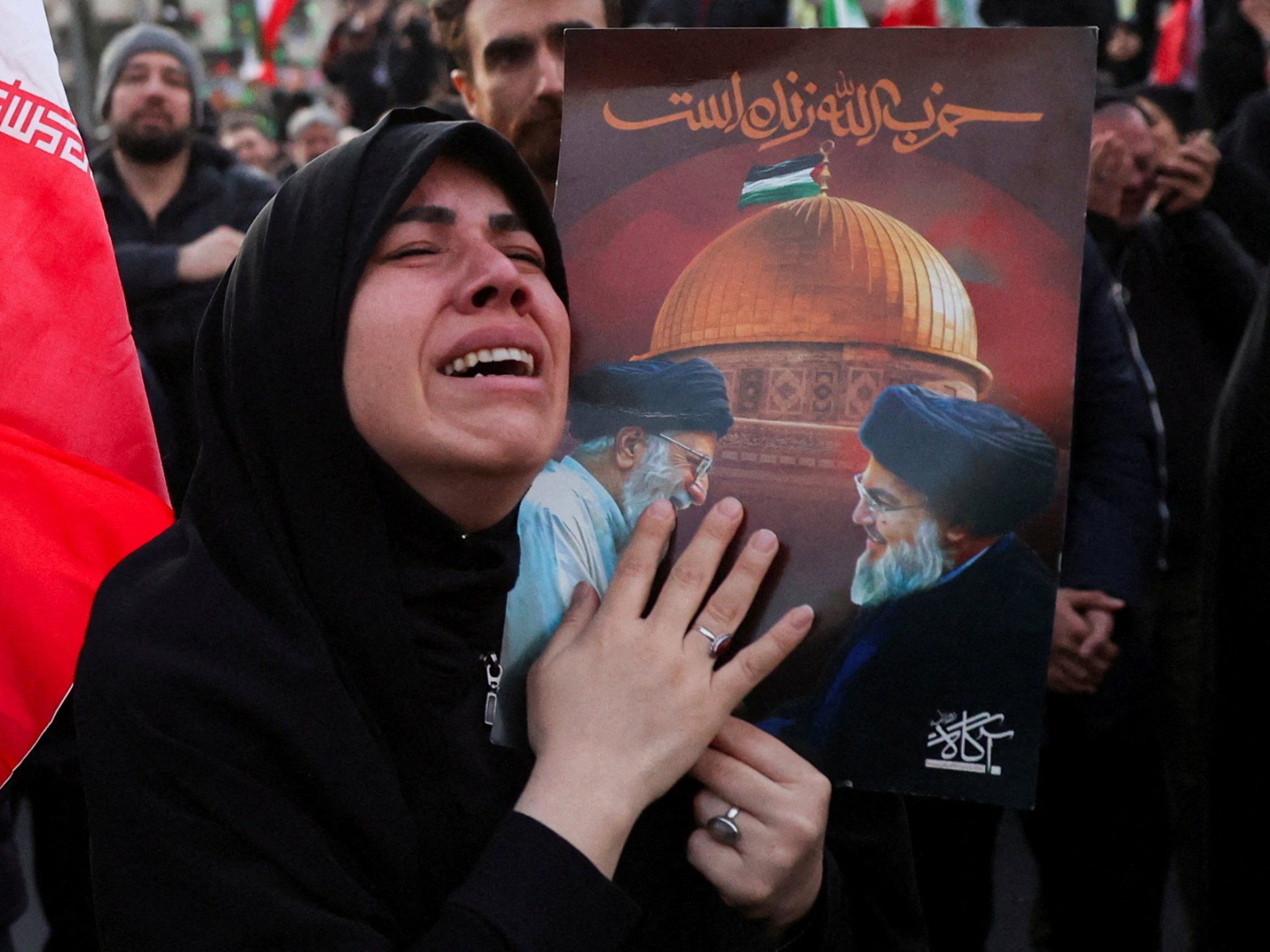
Footage aired by Iranian state media showed supporters mourning at the shrine of Imam Reza in Mashhad, with several people seen crying and collapsing in grief.
The killing also led to protests in neighbouring Iraq, which declared three days of public mourning. In Baghdad, protesters confronted security forces in the heavily fortified Green Zone, which houses Iraqi government buildings and foreign embassies.
Advertisement
Videos verified by Al Jazeera showed demonstrators waving flags and shouting slogans, with witnesses saying some were attempting to mobilise towards the US Embassy. Footage also showed protesters blocking vehicles at a roundabout near one of the entrances to the area.

There was also a protest in the Pakistani city of Karachi, where footage, verified by Al Jazeera, showed people setting fire to and smashing the windows of the US consulate.
However, there have also been reports of celebrations in Iran, with the Reuters news agency quoting witnesses as saying some people had taken to the streets in Tehran, the nearby city of Karaj and the central city of Isfahan.
Meanwhile, the official IRNA news agency reported that a three-person council, consisting of the country’s president, the chief of the judiciary, and one of the jurists of the Guardian Council, will temporarily assume all leadership duties in the country. The body will temporarily oversee the country until a new supreme leader is elected.
Khamenei assumed leadership of Iran in 1989 following the death of Ayatollah Ruhollah Khomeini, who had led the Islamic revolution a decade earlier.
While Khomeini was regarded as the ideological force behind the revolution that ended the Pahlavi monarchy, Khamenei went on to shape Iran’s military and paramilitary apparatus, strengthening both its domestic control and its regional influence.
Meanwhile, the Islamic Revolutionary Guard Corps (IRGC) pledged revenge and said it had launched strikes on 27 bases hosting US troops in the region, as well as Israeli military facilities in Tel Aviv.
Explosions have continued to be reported in Qatar and the United Arab Emirates, while security alerts are in place in several countries across the region.
US President Donald Trump, in a social media post on Sunday, warned Iran that it would be hit “with a force that has never been seen before” if it retaliated.
Iran’s retaliatory attacks since Saturday have targeted Israel and US assets across multiple Middle East countries, including Qatar, the UAE, Kuwait, Bahrain, Jordan, Saudi Arabia and Iraq.
Harlan Ullman, chairman of the strategic advisory firm Killowen Group and an adviser to the Atlantic Council in Washington, DC, said the US may have made a “big mistake” by killing Khamenei.
Advertisement
“Decapitation only works when you get all the leaders, and I don’t think that we got all the leaders,” Ullman said, adding that the US should not expect Iran’s leadership to enter negotiations in the immediate aftermath.
Iranian state media reported on Saturday at least 201 people have been killed in the joint US-Israeli attacks across 24 provinces, citing the Red Crescent. In southern Iran, at least 148 people were killed and 95 wounded in a strike on an elementary girls’ school in Minab on Saturday, with the toll continuing to rise, according to state media.
Related News
‘Torture, threats, rape’: Palestinian journalists detail Israeli jail abuse

Hong Kong appeals court overturns Jimmy Lai’s fraud conviction
Kyrie Irving wears PRESS shirt for Gaza journalists at NBA All-Star Game