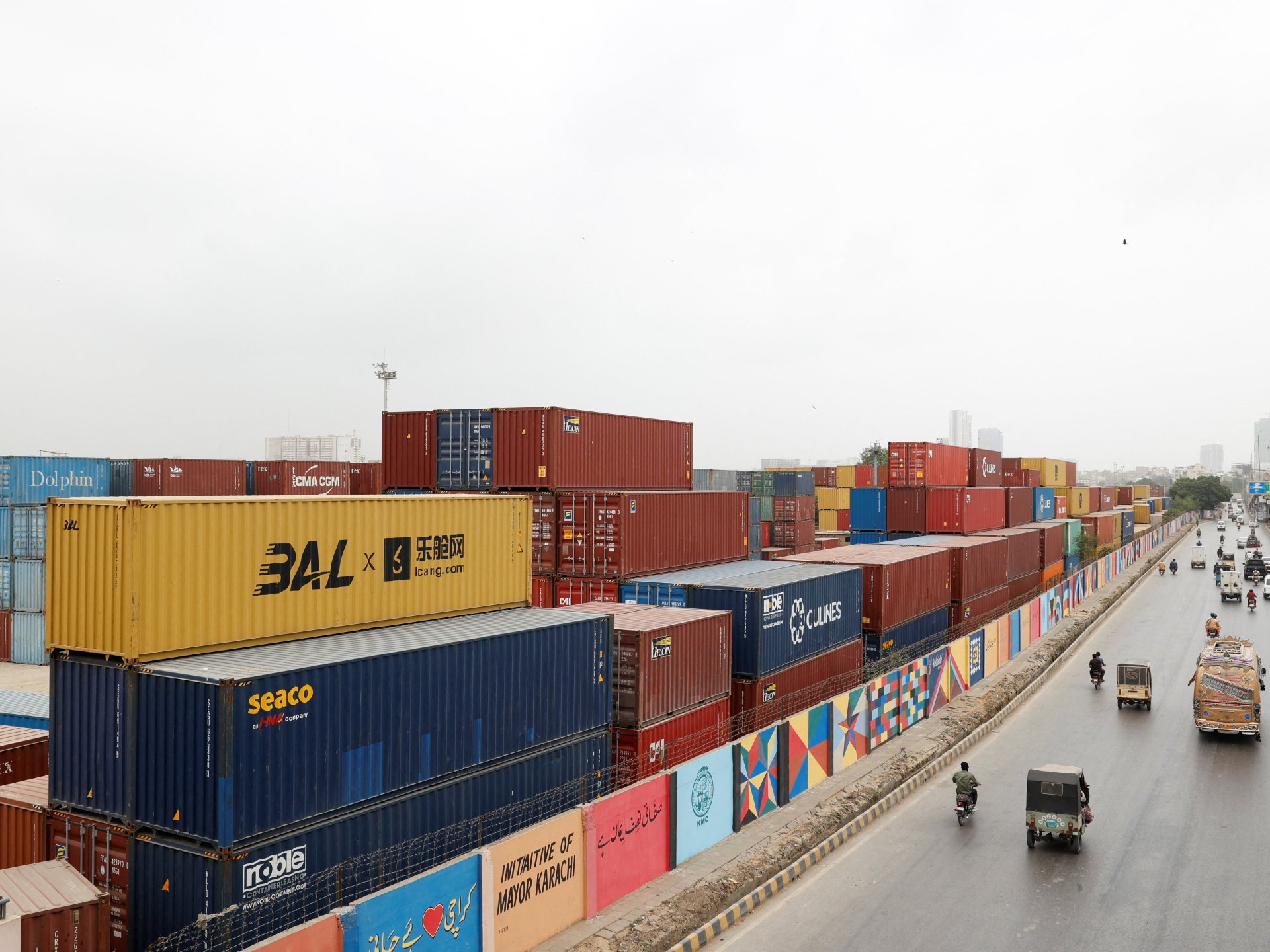

Islamabad, Pakistan – Pakistan has opened six overland transit routes for goods destined for Iran, formalising a road corridor through its territory as thousands of containers remain stranded at Karachi port because of the United States blockade of Iranian ports and ships trying to pass through the Strait of Hormuz.
The Ministry of Commerce issued the Transit of Goods through Territory of Pakistan Order 2026 on April 25, bringing it into immediate effect. The order allows goods originating from third countries to be transported through Pakistan and delivered to Iran by road.
- list 1 of 4With 3,000 containers stuck in Pakistan, Iran explores more land routes
- list 2 of 4Iran offers Hormuz deal without nuclear talks, as it seeks broader buy-in
- list 3 of 4Trump’s May 1 deadline: Can he continue war on Iran after that?
- list 4 of 4How Iran raised Hormuz stakes by capturing ships
end of list
The announcement coincided with Iranian Foreign Minister Abbas Araghchi’s visit to Islamabad for talks with Prime Minister Shehbaz Sharif and army chief Asim Munir, the latest in a series of diplomatic engagements as Pakistan seeks to mediate an end to the two-month war between Washington and Tehran.
Federal Minister for Commerce Jam Kamal Khan described the initiative as “a significant step toward promoting regional trade and enhancing Pakistan’s role as a key trade corridor”.
Iran has not publicly commented on the move, and Al Jazeera’s query to the Iranian embassy in Islamabad went unanswered.
The notification does not extend to Indian-origin goods. A separate Commerce Ministry order issued in May 2025, following the India-Pakistan aerial war that month, bans the transit of goods from India through Pakistan by any mode and remains in force.
Routes and regulations
The six designated routes link Pakistan’s main ports, Karachi, Port Qasim and Gwadar, with two Iranian border crossings, Gabd and Taftan, passing through Balochistan via Turbat, Panjgur, Khuzdar, Quetta and Dalbandin.
Advertisement
The shortest route, the Gwadar-Gabd corridor, reduces travel time to the Iranian border to between two and three hours, compared with the 16 to 18 hours it takes from Karachi – Pakistan’s biggest port – to the Iranian border. The Gwadar-Gabd route could cut transport costs by 45 to 55 percent compared with costs from Karachi port, according to officials.
But for Iran, firms sending their goods to the country, and transporters, all routes into Iranian territory today are viable options, with the principal maritime passage they have traditionally used – the Strait of Hormuz – blockaded by the US Navy.
Corridor shaped by conflict
The current US-Iran war began on February 28, when US and Israeli forces launched attacks on Iran.
In the weeks that followed, Iran restricted commercial navigation through the Strait of Hormuz, the narrow waterway through which roughly a fifth of the world’s oil and gas passes during peacetime, disrupting one of the most critical arteries of global trade.
Pakistan brokered a ceasefire on April 8 and hosted the first round of direct US-Iran talks on April 11, in Islamabad. The negotiations lasted nearly a day but ended without a deal. Two days later, Washington imposed a naval blockade on Iranian ports, throttling Tehran’s maritime access.
A second round of talks has since stalled. US President Donald Trump cancelled a planned visit to Islamabad by special envoys Steve Witkoff and Jared Kushner last weekend.
Iran has ruled out direct negotiations with Washington while the blockade remains in place, though Araghchi told Pakistani officials that Tehran would continue engaging with Islamabad’s mediation efforts “until a result is achieved”.
The transit order appears to be a direct economic response to that impasse.
More than 3,000 containers destined for Iran have been stuck at Karachi port for several days, with vessels unable to collect the cargo. War-risk insurance premiums have surged from about 0.12 percent of a vessel’s value before the conflict to roughly 5 percent, making shipping to the region too expensive for many operators.
Shifting regional dynamics
The corridor also signals a shift away from Afghanistan, whose relations with Pakistan have deteriorated sharply.
The two sides engaged in clashes in October 2025 and again in February and March this year, with skirmishes continuing along the northwestern and southwestern borders.
The Torkham and Chaman crossings have ceased to function as reliable commercial routes since tensions escalated, limiting Pakistan’s overland access to Central Asian markets.
Advertisement
“This is a paradigmatic shift. Pakistan’s relations with the Afghan Taliban, the de facto rulers in Kabul, have no reset switch,” Iftikhar Firdous, cofounder of The Khorasan Diary, told Al Jazeera.
“Kabul has been diversifying away from Pakistan towards Iran and Central Asia, but this move flips the equation. Pakistan can now bypass Afghanistan entirely for westbound trade. The impact on Kabul’s transit relevance and revenue is strategic, not immediate – but it is real.”
Firdous said the implications extend beyond bilateral ties.
“This corridor also reduces Pakistan’s reliance on longer maritime routes through the Gulf. Geopolitics, security, and infrastructure will ultimately determine which corridors dominate, but it places Pakistan as the main overland gateway for China-backed trade routes into West Asia and beyond,” he said.
Minhas Majeed Marwat, a Peshawar-based academic and geopolitical analyst, urged caution. “A cornered Afghanistan is a destabilised Afghanistan, and Pakistan knows better than most what that costs,” she wrote on X on April 27.
“The opportunity here is real. So is the risk. Security on the northwestern and southwestern borders remains the variable that could unravel everything. Pakistan is positioned well. It is not yet positioned safely. Those are different things.”
Related News
Can fish hook voters in India’s West Bengal elections?
UK expels Russian diplomat in tit-for-tat move
Indonesian soldiers accused of acid attack. What happened and why?