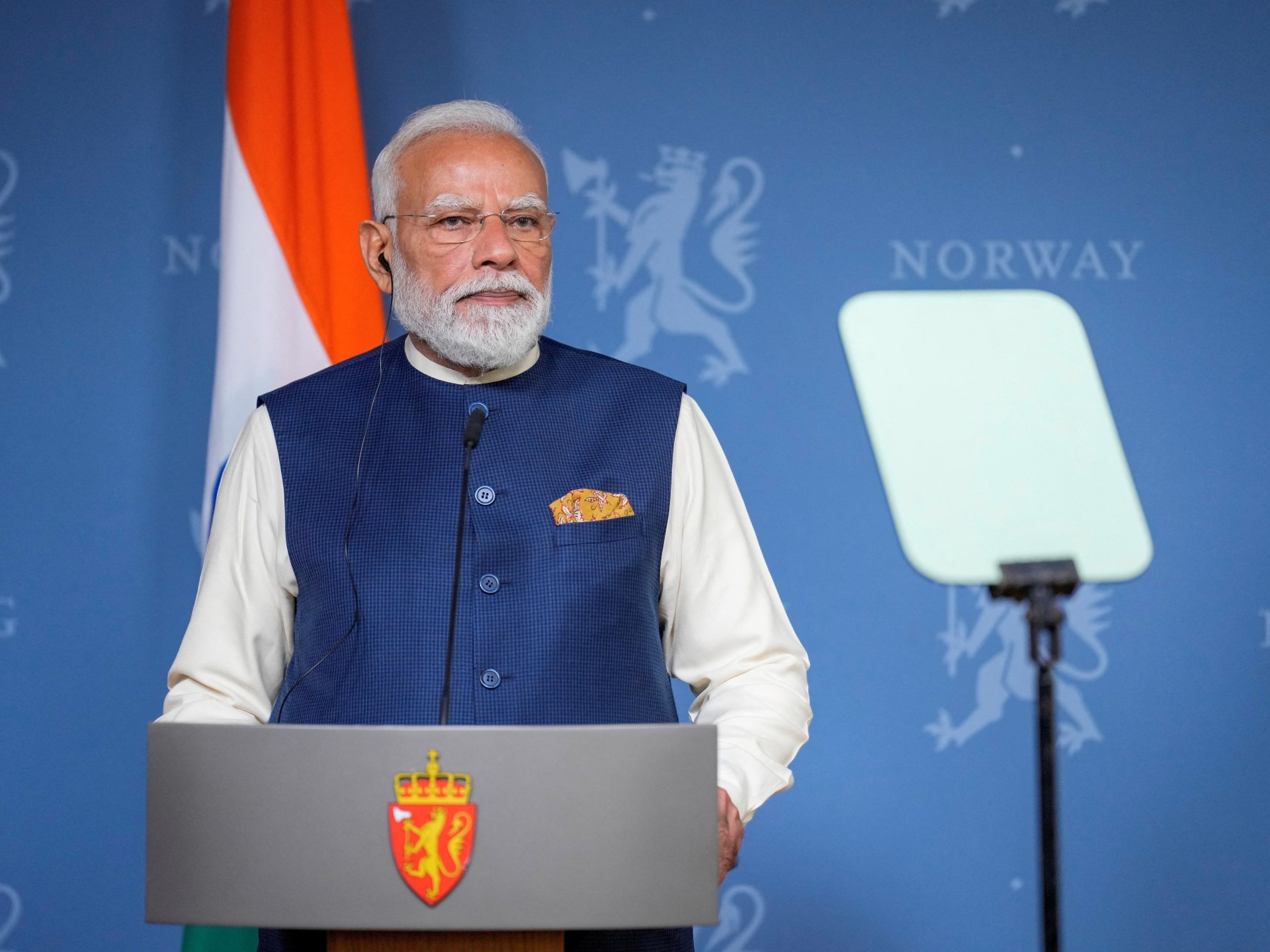

India and the five Nordic countries of Norway, Sweden, Finland, Iceland and Denmark are holding a top-level summit in Oslo, seeking to beef up strategic and trade ties.
The India-Nordic summit on Tuesday is the meeting’s third edition. It comes just months after India and the European Union signed a free trade agreement and a year after India signed a trade and economic partnership agreement with Iceland, Liechtenstein, Norway and Switzerland.
- list 1 of 3India and UAE sign defence pacts, as Iran war tensions simmer
- list 2 of 3‘Hindu order runs India’: Court declares another medieval mosque a temple
- list 3 of 3Tata-ASML deal: How significant is it for India’s semiconductor push?
end of list
Russia’s ongoing war on Ukraine, United States President Donald Trump’s tariffs on global imports and the US-Israel war on Iran have all impacted India’s economy and energy security, and New Delhi has been trying to widen its relations with many other countries in the West.
The first edition of the India-Nordic Summit took place in Sweden’s capital Stockholm in 2018, and the second took place in Denmark’s capital Copenhagen in 2022.
What’s on this year’s summit agenda and why is it significant?
Here’s what we know:
Who is attending the summit?
Indian Prime Minister Narendra Modi, Norwegian Prime Minister Jonas Gahr Store, Danish Prime Minister Mette Frederiksen, Finnish Prime Minister Petteri Orpo, Icelandic Prime Minister Kristrún Frostadottir, and Swedish Prime Minister Ulf Kristersson will be at the summit.
Modi’s attendance at the summit also marks the first visit by an Indian prime minister to Norway in 43 years, since Indira Gandhi in 1983.
What is on the summit’s agenda?
Trade, climate change, energy security and geopolitical issues – especially Russia’s war on Ukraine and the economic impacts of the US-Israel war on Iran – are among the key topics leaders are expected to discuss at the summit.
Advertisement
According to a May 11 statement by India’s Ministry of External Affairs, the summit will “impart a more strategic dimension to India’s relationship with the Nordic countries, especially in technology and innovation, green transition and renewable energy, sustainability, blue economy, defence, space and the Arctic”.
Nordic exports of green technology, renewable energy, and industrial machinery to India, and Indian exports of pharmaceuticals, machinery and consumer goods like textiles to the Nordic nations are expected to figure in the talks.
India’s trade with Nordic nations collectively stood at $19bn in 2024. Several companies from the region, like Finland’s Nokia and Sweden’s Volvo and IKEA, have a significant presence in India. In addition, Indian shipyards are building vessels that account for about 11 percent of the Norwegian Shipowners’ Association’s order book.
“The visit [Modi’s] will also provide an impetus to India’s bilateral trade and investment ties with Nordic countries as well as help build resilient supply chains following the India-EU FTA (Free Trade Agreement) and India-EFTA TEPA (a trade and economic partnership agreement between India and Iceland, Liechtenstein, Norway, and Switzerland),” India’s External Ministry added.
Shairee Malhotra, deputy director at the Observer Research Foundation (ORF) think tank in New Delhi, told Al Jazeera that India will look to capitalise on the unique capabilities of each of the Nordic countries during the summit, from Iceland’s expertise in geothermal energy, Norway’s strengths in the so-called “blue economy” and shipping, and Sweden’s in industrial and defence innovation.
“The Nordics are a very advanced regional bloc of five small countries with a combined gross domestic product of around $2 trillion,” she said. “They are world leaders in domains such as digital innovation, sustainability, green transition, clean energy, and climate and maritime solutions that align closely with India’s development priorities and strategic ambitions.”
Malhotra added that New Delhi is also eager to deepen trade and investment linkages.
“In addition to the EU-India FTA that was signed earlier this year, last year, India’s FTA with the EFTA bloc of non-EU nations, comprising Norway, Iceland, Switzerland and Liechtenstein, also entered into force. This includes a commitment to mobilise $100bn in FDI [foreign direct investment] into India over a 15-year period and potentially create a million jobs, contributing to Make in India investment flows,” she noted.
Advertisement
Garima Mohan, a Brussels-based senior fellow in the Indo-Pacific programme at the German Marshall Fund, where she also heads the group’s India initiative, told Al Jazeera that the focus of this summit will also be on green technologies and innovation, especially given the crisis in the Strait of Hormuz. These are areas of strength for the Nordic nations.
“The war on Iran has created a major economic security and energy crisis impacting both Europe and India, and managing its impacts will certainly be a big part of the discussions during PM Modi’s trip,” she said.
Will India look to strengthen its foothold in the Arctic?
India does not share a land or maritime border with any Arctic nation. Yet, it has been engaged in the region since February 1920, when it signed the Svalbard Treaty. Under this treaty, Norway has complete sovereignty over Svalbard and can grant signatories of the treaty access to fishing, hunting, industrial mining, commercial operations and owning property, including mineral rights in Svalbard.
India has benefitted from the treaty, which gives it access to carry out scientific research in the region. In 2007, India sent a scientific expedition to study the Arctic region, and in 2008, set up a research station named Himadri. In 2014, the subcontinent also deployed IndARC, the country’s first underwater moored observatory. It is anchored in the Kongsfjorden fjord in Svalbard, Norway, at a depth of about 180-192 metres (590-630ft) and studies the Arctic region’s climate and how ice melt in the region impacts India’s monsoon.
Besides carrying out scientific endeavours in the region, in recent years, India has been eager to expand its strategic and economic footprint in the Arctic, which is rich in natural gas, hydrocarbons and minerals.
According to local media reports, at Tuesday’s summit, New Delhi hopes to establish an India-Nordic Arctic mechanism, since all Nordic nations are members of the Arctic Council. The Arctic Council is an intergovernmental forum which was established in 1996 to promote cooperation, coordination, and interaction among Arctic states and protect Indigenous communities and inhabitants.
In 2013, India was granted observer status in the Arctic Council, which allowed the country to participate in Arctic policy discussions. In March 2022, the subcontinent also released its own Arctic policy that, according to a statement by the Ministry of Earth Sciences, seeks to strengthen “India’s scientific research and cooperation, climate and environmental protection, economic and human development, transportation and connectivity, governance and international cooperation, and national capacity building in the Arctic region”.
The policy also described the Arctic as an “arena for power and competition” and highlighted that India’s observer status in the Arctic Council would help New Delhi improve its understanding of the complex governance structures, relevant international laws, and geopolitics in the Arctic.
Since 2022, the Arctic Council has faced security challenges due to Russia’s war in Ukraine, with Moscow beefing up its military capabilities and economic footprint near its border with Nordic countries like Norway and Finland. China has also been trying to increase its presence in the region through its “Polar Silk Road” initiative, which aims to develop new shipping routes and help Beijing secure control of natural resources in the Arctic.
Advertisement
To counter China’s influence in the Arctic region, India has also been focusing on its Eastern Maritime Corridor, which would integrate Arctic shipping routes. The route seeks to link the ports of Chennai, Visakhapatnam, and Kolkata in India with Vladivostok, Olga, and Vostochny in Russia.
Mohan said the Arctic will be a part of discussions at the India-Nordic Summit, especially since the region is of interest to New Delhi.
“But I don’t see any binding outputs coming out of this summit, since the Nordic countries are keen to keep these conversations a part of ‘official’ formats like the Arctic Council,” she added.
While Russia’s war on Ukraine is expected to be discussed at the summit, with Nordic nations having strongly condemned Moscow’s actions, it is not clear if Nordic nations will specifically address India’s current relations with Russia.
“There are always some differences around India’s relationship with Russia and the Nordic countries, for whom Russia is the primary threat. But these differences are being actively managed by both sides since the areas of convergence between Europe and India are greater and outweigh these differences,” Mohan said.
India has long had strong strategic ties with Russia, which was the predominant supplier of its military hardware during the Cold War. Over the past 35 years, it has dramatically strengthened ties with the US and other Western nations without giving up on relations with Russia.
On Russia’s actions in Ukraine, India has called for an end to the war but has refrained from firmly condemning Russia. It also significantly increased its purchases of Russian oil during the war, since these were being offered by Moscow at discount prices.
But after US President Donald Trump slapped an additional 25 percent trade tariff on India for buying Russian oil last year, India has looked to diversify its energy supplies, ramping up purchases from other regions.
Where else has Modi been in Europe?
Before the Nordic Summit, Prime Minister Modi held a bilateral meeting with Norwegian Prime Minister Store on May 18, where the two leaders discussed improving economic and trade ties and also upgraded relations to a “Green Strategic Partnership”.
After their talks, in a post on X, Modi said trade was key to India and Norway and added that he had invited Norway “to invest in India’s clean energy initiatives”. Store told journalists that India and Norway had differences but should unite against countries that “weaponise” diplomacy, trade and technology.
Before Norway, Modi visited Gothenburg in Sweden from May 17-18. Addressing a European CEO roundtable, Swedish Prime Minister Ulf Kristersson told journalists that Prime Minister Narendra Modi’s visit to Sweden marked a milestone in India-Sweden relations and said both countries shared the ambition of doubling bilateral trade and investment within five years.
Between May 15 and 17, Modi visited the Netherlands to beef up trade ties and also expand cooperation in defence and security. During his visit, India’s Tata Electronics signed a deal with Dutch technology giant ASML to build a major semiconductor plant in western India.
“My conversations with [Dutch] Prime Minister Rob Jetten were extensive and covered a wide range of topics,” Modi wrote on X. “One of them was defence and security. I spoke about the possibility of drawing up an action plan for the defence industry as quickly as possible. We can also collaborate in sectors such as space travel, maritime systems, and maritime security.”
Advertisement
Before his meeting with Prime Minister Modi, however, Dutch Prime Minister Jetten told local media that the Netherlands is concerned about certain developments in India.
“It is not only about press freedom, but also about the rights of minorities, who are under severe pressure. That applies in the first place to the Muslim community, but also to many other smaller communities,” Jetten said, according to Dutch publication de Volkskrant. “The concern is to what extent India remains an inclusive society where the same rights apply to everyone.” He also said these concerns were “regularly raised” with the Indian government.
Asked by journalists in The Hague about Jetten’s concerns, India’s External Affairs Secretary Sibi George said: “We face these kinds of questions basically because of the lack of understanding of the person who asks the question.”
After the Nordic Summit, Modi will head to Italy, where he will meet Prime Minister Giorgia Meloni in Rome.
Related News
Who is Zack Polanski, UK Greens leader and rising political star?
US charges alleged Iran-backed Kataib Hezbollah suspect
Israeli settlers set fire to homes and cars in violent West Bank raids