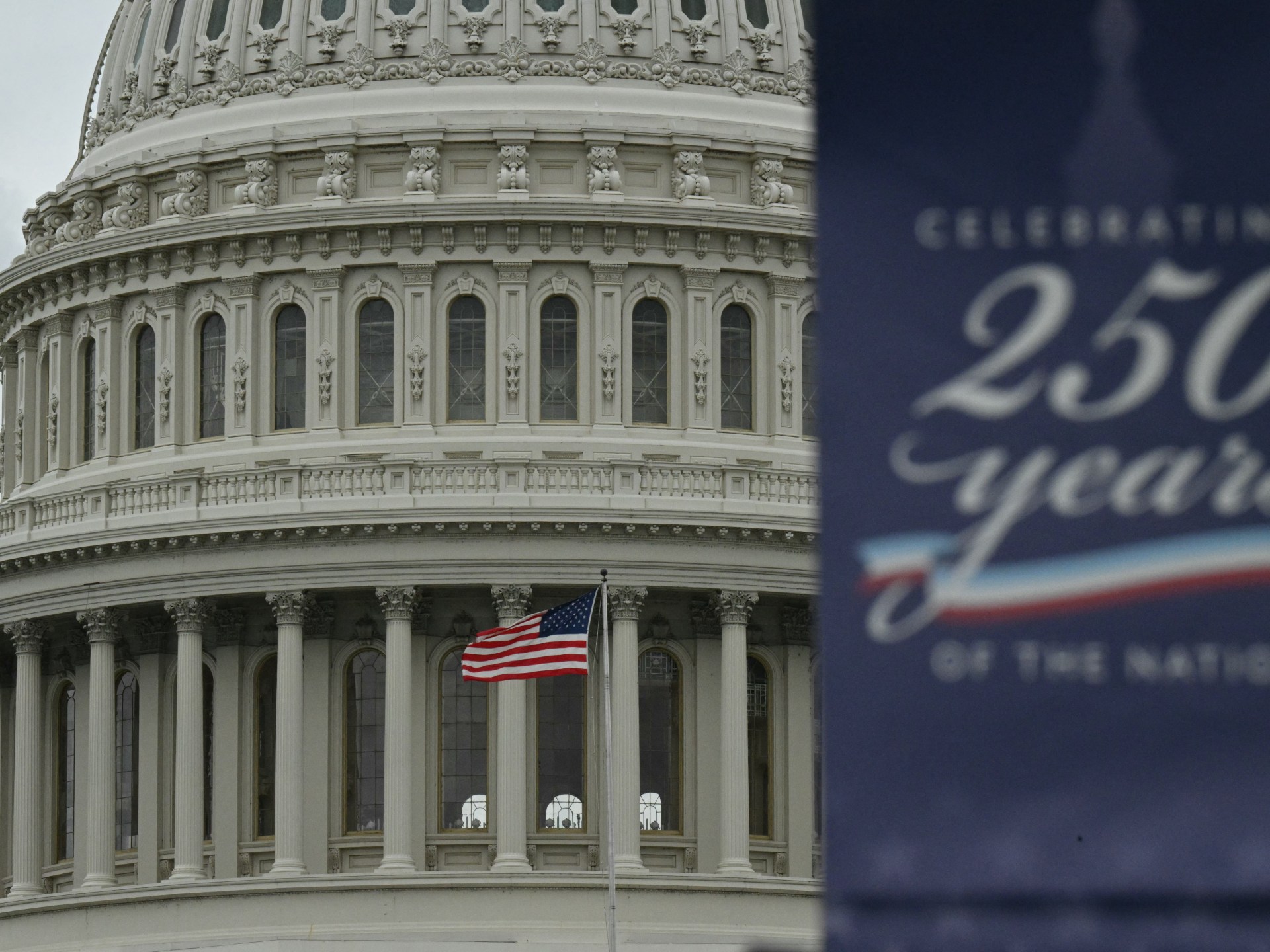

Senate Republicans in the United States have punted on a vote to fund immigration enforcement operations before a long holiday weekend, in a rare show of political backlash against President Donald Trump.
On Thursday, the Republican-led chamber had planned to vote on a $72bn funding bill to help fuel Trump’s mass deportation campaign.
- list 1 of 3Poll finds nearly three-quarters of Democratic voters oppose aid to Israel
- list 2 of 3Five key takeaways from Democrats’ autopsy report on Kamala Harris’s loss
- list 3 of 3US says it has not changed its stance on sanctioning Francesca Albanese
end of list
But two recent decisions from the Trump administration led to a pushback from within the president’s own party.
The first had to do with a newly unveiled “anti-weaponisation” fund that the Trump administration announced on Monday, as part of a lawsuit settlement.
Trump had sued the Internal Revenue Service (IRS), part of his own government, for the actions of a contractor who leaked his tax refunds around 2019.
Critics say the lawsuit posed a conflict of interest, with Trump empowered to resolve the complaint by negotiating with his own appointees.
Monday’s settlement put aside nearly $1.776bn to pay recipients deemed to have been treated unfairly by the government — an “anti-weaponisation” fund that opponents say would serve as a cash cow for Trump’s supporters.
Senate Republicans summoned acting Attorney General Todd Blanche to Capitol Hill on Thursday to question his decision to greenlight the settlement, which draws from Justice Department funds that ordinarily need no congressional approval.
Nebraska Senator Don Bacon later indicated to reporters that the issue had shaken Trump’s Republican backing.
“He’s lost some support in the Senate,” Bacon said, responding to Trump’s lawsuit. “He’s the plaintiff and the boss of the defendants. So just on the surface, it smells.”
Advertisement
Senator Thom Tillis, another Republican, likewise denounced the “anti-weaponisation” fund. He is not seeking re-election in November’s heated midterm elections, after clashing with Trump.
“I think it’s stupid on stilts,” Tillis told Spectrum News. “The American people are going to reject this out of hand.”
Another source of pushback came in the form of Trump’s request for $1bn in funds to build a White House ballroom.
Trump had previously pledged that no taxpayer funds would be needed to complete the ballroom. But in recent weeks, he has pushed to add the $1bn price tag to the immigration enforcement bill, arguing that the ballroom was necessary for national security.
But on Wednesday, the Senate’s Republican leadership indicated the ballroom tab would no longer be included.
Had it remained, the ballroom funds would have prevented Republicans from using a special legislative process — budget reconciliation — to pass the immigration enforcement bill with a simple majority.
“It was something that was supposed to be very narrow, targeted, focused, clean, straightforward, and it got a little bit more complicated this week,” Senate Majority Leader John Thune said of the bill and its add-on. “It makes everything way harder than it should be.”
The Senate will return from its recess in June. Thune indicated his party would “pick up where we left off” after the break.
Separately, the Republican leadership in the House of Representatives cancelled a vote on a war powers resolution designed to force Trump to seek congressional approval for the US-Israeli war against Iran.
A similar bill had passed the Senate earlier this week, and the House was expected to hold its own vote on Thursday afternoon. That vote has now been delayed until June, after the Memorial Day recess.
Democrats accused Republicans of political manoeuvring.
“We had the votes without question, and they knew it,” Representative Gregory Meeks, the top Democrat on the House Foreign Affairs Committee, told reporters after the vote was cancelled.
Related News
Iran war: Why the BRICS foreign ministers meeting in India matters
Syria sees first government reshuffle since al-Assad’s ouster: State media
Taiwan’s President Lai says he would be happy to speak with Donald Trump