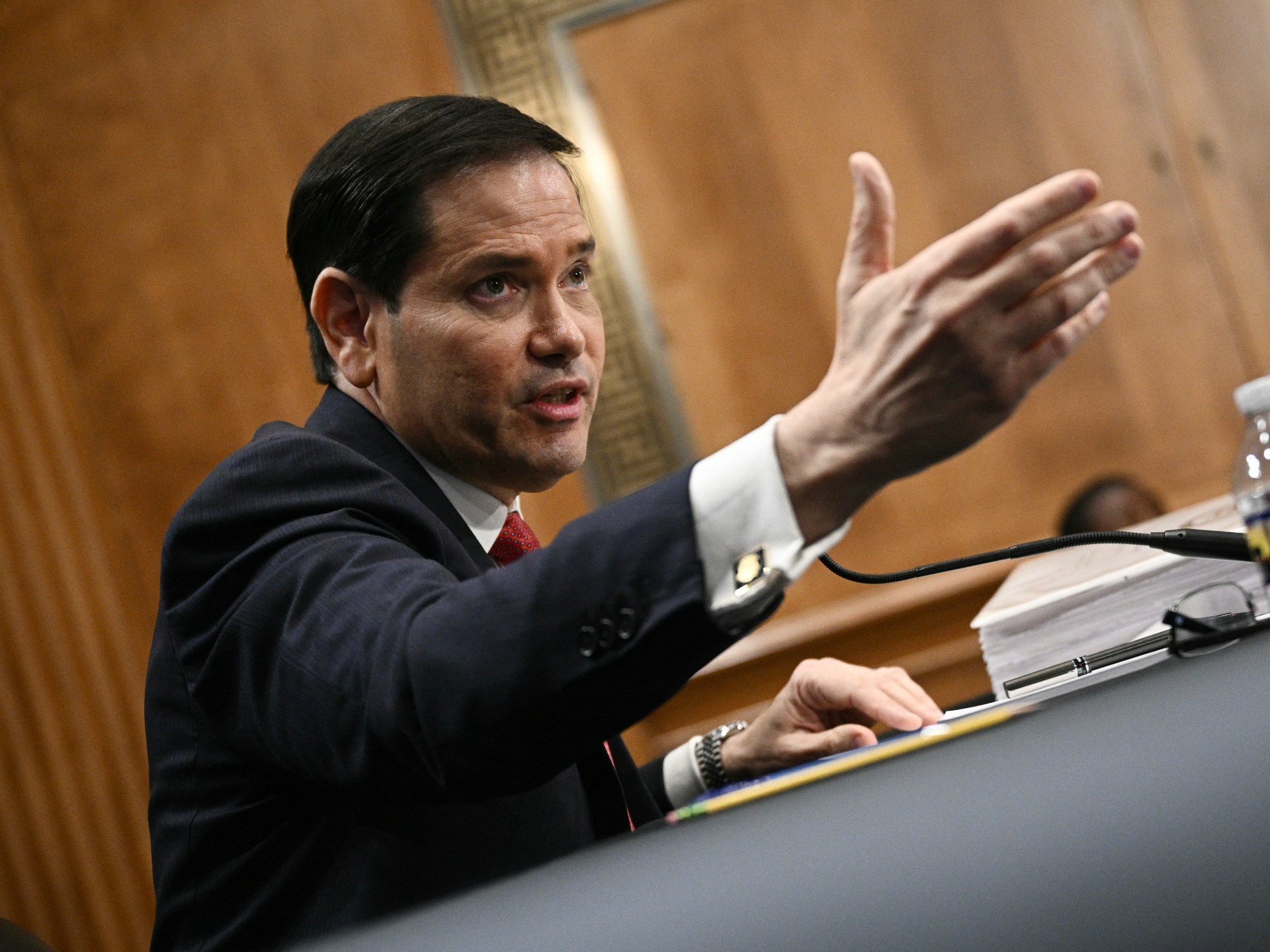

United States Secretary of State Marco Rubio has said Iran’s Supreme Leader Mojtaba Khamenei appears to be taking a more active role as negotiations between the two countries continue following an April 8 truce.
Testifying before the US’s Senate Foreign Relations Committee on Tuesday, Rubio said there are signs that Mojtaba Khamenei, who has not been seen publicly since US air strikes killed his father and predecessor on the first day of the war, is alive and more deeply engaged in the country’s affairs.
- list 1 of 3Iran warns Israeli attacks in Lebanon and Gaza threaten US ceasefire talks
- list 2 of 3Iran reinstates some internet access but restrictions remain for most
- list 3 of 3Iran restores some gas production at South Pars facility
end of list
“I think there are indications out there that he is increasingly engaging at some level, although all of his communications have been in writing and through intermediaries,” said the US’s top diplomat.
Rubio’s remarks come as Tehran is reviewing the latest version of a US proposal aimed at ending the war, which US President Donald Trump reportedly tightened the terms of in recent days.
Iran’s semi-official Mehr news agency cited a source close to the country’s negotiating team as saying Tehran is still studying the latest proposal and has not communicated with the US in several days. The official stressed Iran was taking a “stern” approach given what it sees as US non-compliance with the ceasefire and general mistrust.
Deal ‘could happen today, could happen next week’
Trump has said his priorities for any deal include Iran agreeing to never develop nuclear weapons and to reopen the Strait of Hormuz, through which about 20 percent of the world’s oil and liquefied natural gas supplies transited before the war. In a series of social media posts on Monday, Trump said that talks with Iran were progressing at a “rapid pace” and that “it will all work out well in the end”.
Advertisement
Addressing lawmakers, Rubio said the US talks with Iran may now include “aspects of their nuclear programme” the country was unwilling to discuss as recently as a month ago.
However, “that is not a guarantee it will ultimately lead to a deal that’s acceptable,” Rubio cautioned.
“There is the prospect before us, which could happen today, it could happen tomorrow, it could happen next week,” he added.
Rubio, who also serves as Trump’s national security adviser, said the first condition in the talks was that Iran opened the Strait of Hormuz, and it also had to commit to negotiations on its stock of highly enriched uranium.
Asked whether the US would lift sanctions on Iran in return for the country reopening the Strait of Hormuz, Rubio said that would not be sufficient.
“That’s not been discussed. That’s not been offered,” said Rubio, adding that sanctions relief would only come after significant concession on the nuclear programme and the enriched uranium.
Iran warns of ‘direct confrontation’ if Israel continues Lebanon ‘aggression’
The US-Israel war on Iran that began on February 28 has killed thousands of people, mainly in Iran and Lebanon. It has caused global pain by pushing up energy prices since Iran effectively closed the Strait of Hormuz, which previously carried about a fifth of global supplies of oil and liquefied natural gas.
It also triggered the latest round of conflict between Israel and Lebanese group Hezbollah, with Israel invading deep into Lebanon and even attacking parts of the capital Beirut.
On Tuesday, Israel kept up deadly strikes on a string of towns in southern Lebanon, despite a US-mediated partial ceasefire announced the day before.
The continuing Israeli attacks in Lebanon have become a major point of contention for Iran, which insists a full ceasefire in Lebanon must be part of any agreement with Washington
Iran’s parliament speaker and chief negotiator, Mohammad Bagher Ghalibaf, said he told Lebanon’s Parliament Speaker Nabih Berri if Israel’s “aggression against Lebanon continues”, Tehran “will not only halt the path of negotiations” with the US, “but we will also be in direct confrontation with the enemy.”
Related News
Rebuilding US weapons stockpile may ‘take years’ post-Iran war
‘Multipolar world’: What Xi and Putin announced after Beijing summit
Who will replace Newsom? What to know about California’s primary elections