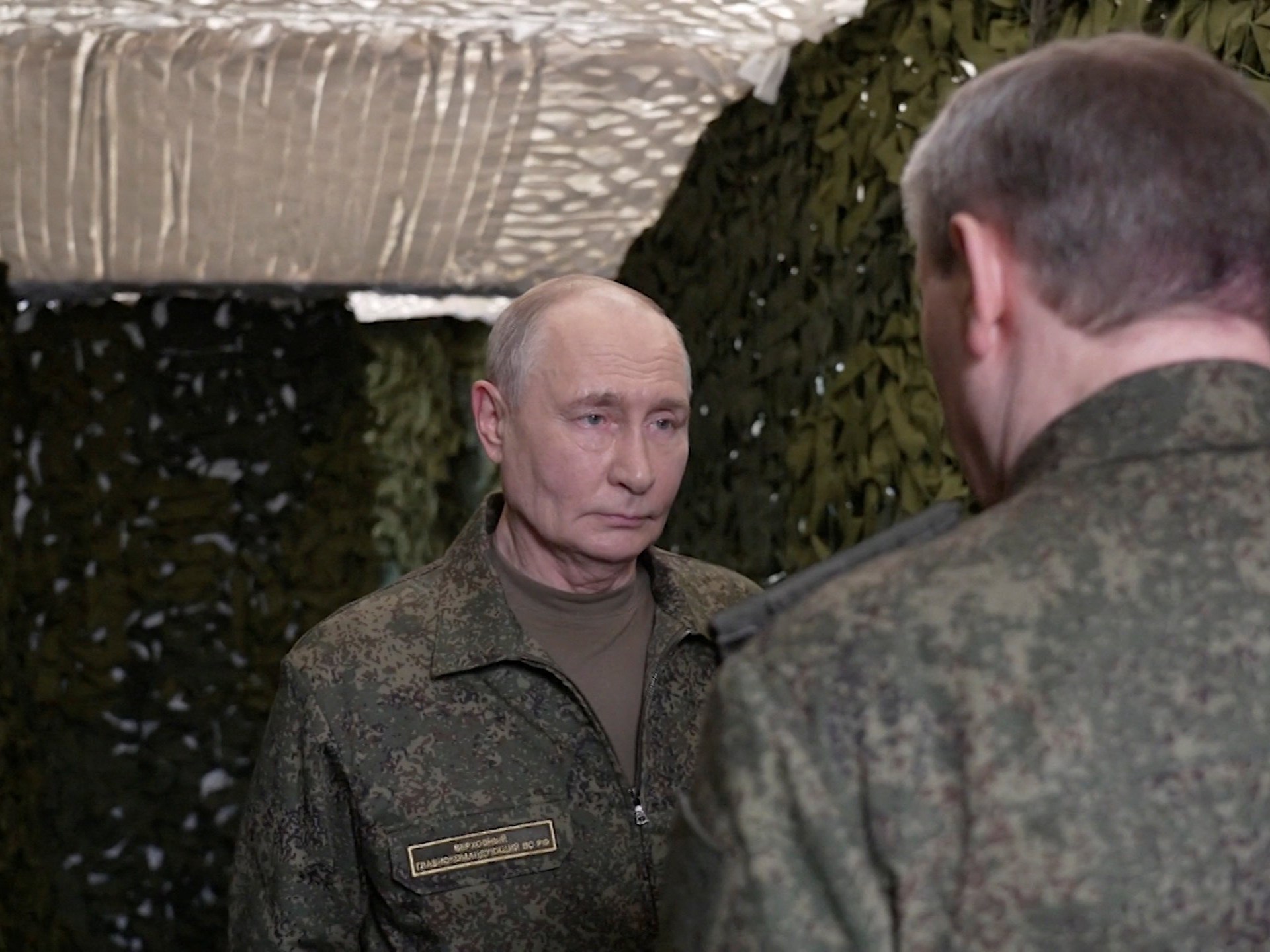

Kyiv, Ukraine – Clad in military fatigues, Russian President Vladimir Putin listened to his top general talk about Ukraine’s “Western sponsors”.
“Lacking success on the ground, the Kyiv regime is trying to convince its Western sponsors that it overtook the initiative and had significant battlefield gains,” Valery Gerasimov, chief of Russia’s General Staff of the Armed Forces, told Putin in televised remarks.
- list 1 of 4Russia’s triumphant tone shifts as Ukraine deploys ‘asymmetrical tactics’
- list 2 of 4Will economic pressure move the Kremlin towards talks with Kyiv?
- list 3 of 4Large-scale Russian attack on Ukraine before NATO summit
- list 4 of 4Is NATO at breaking point as it meets in Turkiye?
end of list
In response, Putin urged him to “continue analysing” the involvement of each Western nation in the war that has not gone according to Moscow’s battlefield plans and its wish to “demilitarise” Ukraine back in 2022.
“We’ll need this analysis for the possible making of responsible decisions in the future,” the Russian president said in the video broadcast, released at the beginning of a news cycle in the United States ahead of the Independence Day weekend.
To anyone familiar with the recent turn of hostilities, their conversation seemed staged and based on false information.
Putin claimed that his troops “completely liberated” the long-contested eastern city of Kostiantynivka, even though Ukrainians still control parts of it, and Ukrainian President Volodymyr Zelenskyy challenged Putin to meet him there to “find a diplomatic solution” to end the war.
Putin also purported that this year, Moscow seized more than 3,000 square kilometres (1,158 square miles) of “our land” in Ukraine.
But because of the shifting front lines and Ukraine’s counteroffensive, Moscow’s actual gains between January and July amounted to a mere 97 sq km (37.4 sq miles), according to the Institute for the Study of War, a US-based think tank that provides verified, geolocated data.
Advertisement
Instead of facing facts, Putin is creating a “constructed reality premised on a rejection of the tactical and operational developments,” it said.
“Putin’s control over the information space and his ability to shape and propagate narratives of Russian military success are critical to maintaining this false reality,” it said.
And Russia’s claims of seizing a town or a village are often based on missions by servicemen who are ordered to reach a central square or another landmark and send a photo of themselves planting a Russian flag.
“And then we kill them, and they never make it back,” Andriy, a Ukrainian serviceman who spent three years on the eastern frontline, told Al Jazeera, withholding his last name in accordance with wartime protocol.
To a four-star Ukrainian general, Putin’s goals are crystal clear – to convince the Russian public that it was NATO’s backing that turned Moscow’s blitzkrieg, dubbed a “special military operation”, into a full-scale “war with NATO” with no end in sight.
“The goal is to justify why the ‘special military operation’ has been lasting for the fifth year instead of months,” Lt. Gen. Ihor Romanenko, former deputy head of Ukraine’s general staff of armed forces, told Al Jazeera.
The Kremlin uses “such a propaganda approach as it needs to show why the war has to be scaled up, why this is happening, that this is a war already, and they’re at war not with Ukraine, but with all of NATO,” he said.

Amid daily Ukrainian strikes on occupied areas and mainland Russia from the Baltic to western Siberia, a growing fuel shortage and mounting economic problems, the Kremlin is warming Russians up to the idea of a wider mobilisation ostensibly planned for after the September 18-20 parliamentary vote.
“That’s why Russia is continuing active hostilities, it carries out strikes and will conduct at least a partial mobilisation that is planned for after the election,” Romanenko said.
Putin already declared a “partial mobilisation” in September 2022, but it has largely been put on hold amid efforts to lure “volunteers” with hefty sign-up bonuses and force migrants to enlist.
A day after Putin’s diatribe about “Western sponsors”, the Kremlin used the word “war”.
“There’s a war going on, a real war,” Kremlin spokesman Dmitry Peskov said on Sunday, using the once-banned term that thousands of Russians have been fined, arrested and jailed for.
“Do you know why it’s a war? Because everything began as a special military operation [but it] goes on like a war, because behind Kyiv stand Berlin, and Paris, and the Hague, and Oslo, and, unfortunately, Washington,” Peskov said in televised remarks.
Advertisement
It is easier to justify failures and if one is “fighting” that many enemies, a Kyiv-based analyst said.
“As soon as Russia has problems on the frontline, as soon as it faces more military failures, like these days, as soon as there are more strikes on the Russian territory, problems with Crimea, with the fuel crisis, it has to be justified, explained to their audience,” Volodymyr Fesenko, head of the Kyiv-based Penta think tank, told Al Jazeera.
“And it’s against their rules to explain it by saying that it is Ukraine that grew stronger and is more effective about the war with Russia. No, they have to show that they’re fighting the collective West, and that’s why they can’t triumph over Ukraine for more than four years,” he said.
‘Dragging NATO into a direct armed conflict’
One of Moscow’s most consistent narratives is the increased “integration” of Ukraine into NATO.
Moscow claims that NATO is “drifting towards a higher risk” of a war with Russia by “integrating” Ukraine into its structures and acquiring weapons for Kyiv’s conflict with Russia.
In a statement echoing the Kremlin’s earlier claims that the entire 32-nation bloc is “at war” with Russia, Foreign Ministry spokeswoman Maria Zakharova claimed on June 29 that NATO arms Ukraine with advanced, AI-driven weaponry to strike Russian airfields.
Zakharova also claimed that Kyiv is “dragging NATO into a direct armed conflict with Russia in the vain hope of saving its hopeless position on the battlefield.”
Ukrainian servicemen ridicule such claims.
“They want to save face by pretending that it’s not Ukrainians” who are succeeding on the frontlines, “that it’s the combined forces of the entire Western civilisation that wants to take away their oil and traditional values,” Ihor, a drone operator on leave from his service in eastern Ukraine, told Al Jazeera.
Related News
Belgium reach World Cup knockouts as New Zealand exit tournament
Trump flouts political risk to host Netanyahu’s seventh White House visit
Outrage in India over death of six-year-old ‘slapped’ by his teacher