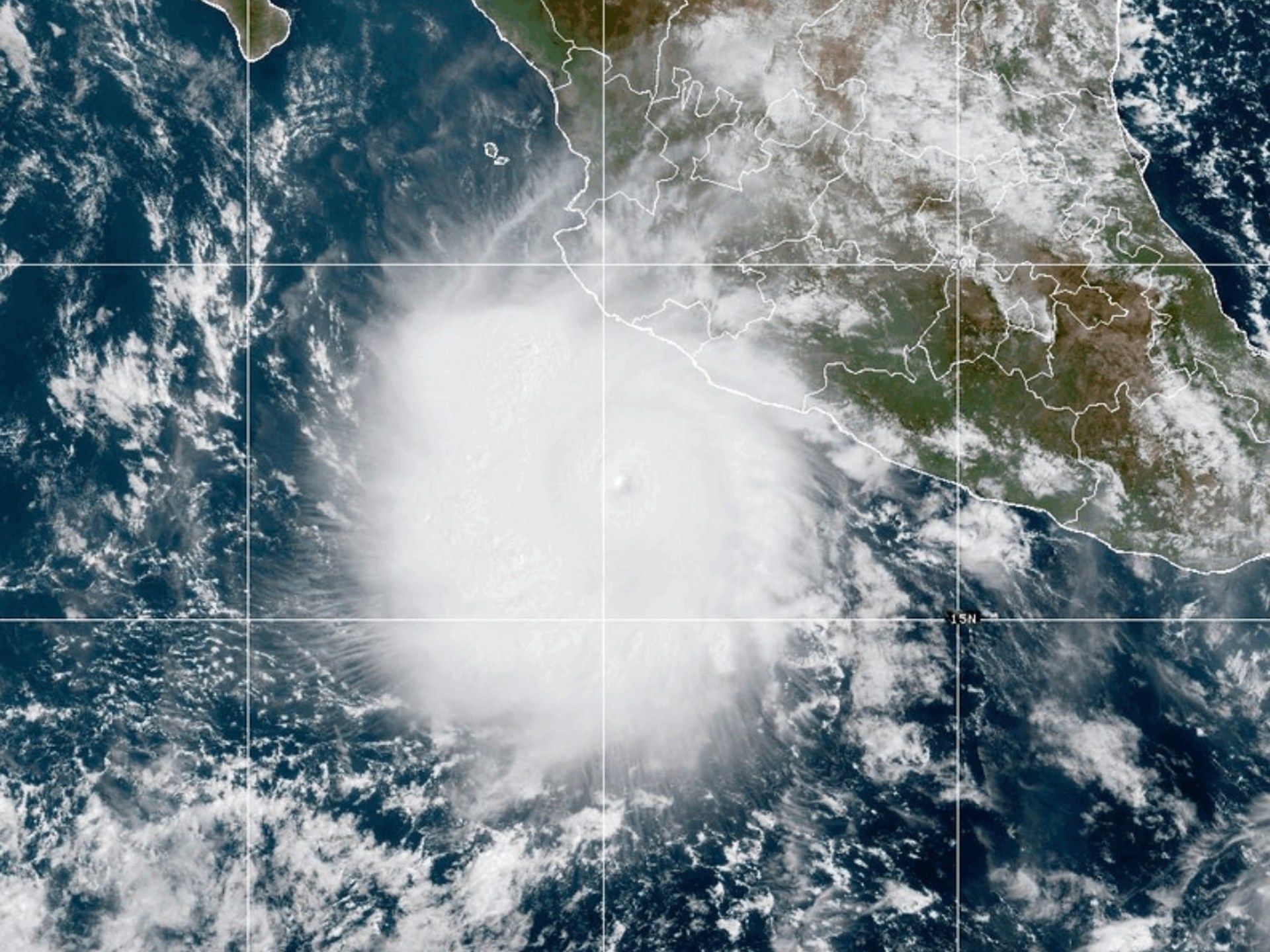

Two powerful storms have gained steam and are battering opposite sides of the Pacific this week, with Hurricane Polo lashing Mexico’s southwestern coast and Nolo strengthening into a hurricane as it bears down on Hawaii.
Nolo became a hurricane on Thursday night, according to the US National Hurricane Center (NHC). The hurricane is expected to strengthen further as it turns towards Hawaii’s Big Island.
- list 1 of 3Tropical Storm Moke advances towards Hawaii with heavy rain, strong winds
- list 2 of 3El Nino: A phenomenon supercharged by climate change
- list 3 of 3El Nino reaches super status: Where will it bring rain, drought and heat?
end of list
Forecasters warned the island could see 15 to 30 inches (38 to 76cm) of rain, with higher totals possible through Saturday, while the nearby island of Maui could also face life-threatening flooding.
The heaviest rain is expected to fall over the same southeastern part of the Big Island that was hit by Hurricane Lala in August, where the ground remains saturated from that earlier storm.
“There are several communities that were isolated, flooded, roads that were washed out,” said John Bravender, a warning coordination meteorologist with the National Weather Service in Honolulu. “It’s that same area that is most under threat.”
Hawaii has already been battered this year by major flooding in spring, an earthquake and two other hurricanes since mid-August. “In my 20 years of experience here, I’ve never seen three hurricane watches for the islands in the same year,” Bravender said.
Hawaii’s governor has issued an emergency proclamation, activating more than 230 members of the state’s National Guard, and schools have been closed for the rest of the week.
Hawaiian Electric, the state’s main power utility, said crews that had been restoring electricity on the island of Kauai after Hurricane Lowell earlier this month would move to Oahu, Maui and the Big Island to prepare for Nolo.
Advertisement
Meanwhile, Hurricane Polo has fluctuated between Category 4 and 5, the two most powerful levels on the Saffir-Simpson scale used to measure hurricane strength, as it moves along Mexico’s coast. The NHC said Polo was expected to regain Category 5 status on Friday.
In the port city of Lazaro Cardenas, in the southwestern state of Michoacan, seawater swept through homes on Thursday, leaving wooden planks and furniture scattered across the streets.
Restaurant owner Alicia Contreras said 15-foot (4.5-metre) waves had severely damaged her property. “This is huge because we have no other source of income. Now we’re just surviving,” she said.
Mexican authorities have deployed 15,000 security personnel along the coast, suspended schools and opened shelters, evacuating people from high-risk areas, though officials have not said how many.
Polo poses the greatest threat to Guerrero and Michoacan, two neighbouring states with long coastlines dotted with small ports, tourist towns and fishing villages, many of them poor communities that residents say are often left to fend for themselves during natural disasters.
Two other storms remain far from land: Hurricane Odalys in the Pacific and Tropical Storm Fay in the North Atlantic. Forecasters said a third storm, Tropical Storm Gonzalo, could pass near or over Cape Verde, an island nation off West Africa, on Friday.
The string of storms comes amid El Nino, a recurring climate pattern that warms parts of the Pacific Ocean and tends to fuel more tropical cyclone activity, while dampening the Atlantic hurricane season.
Related News
UK to refuel Saudi jets to help counter Houthi attacks

Russia warns it could target UK in response to Kyiv firing British missiles

EU states to raise game as Arctic becomes strategic geopolitical frontier