Los Angeles mayoral race points to growing sway of democratic socialists
 09 November 2026
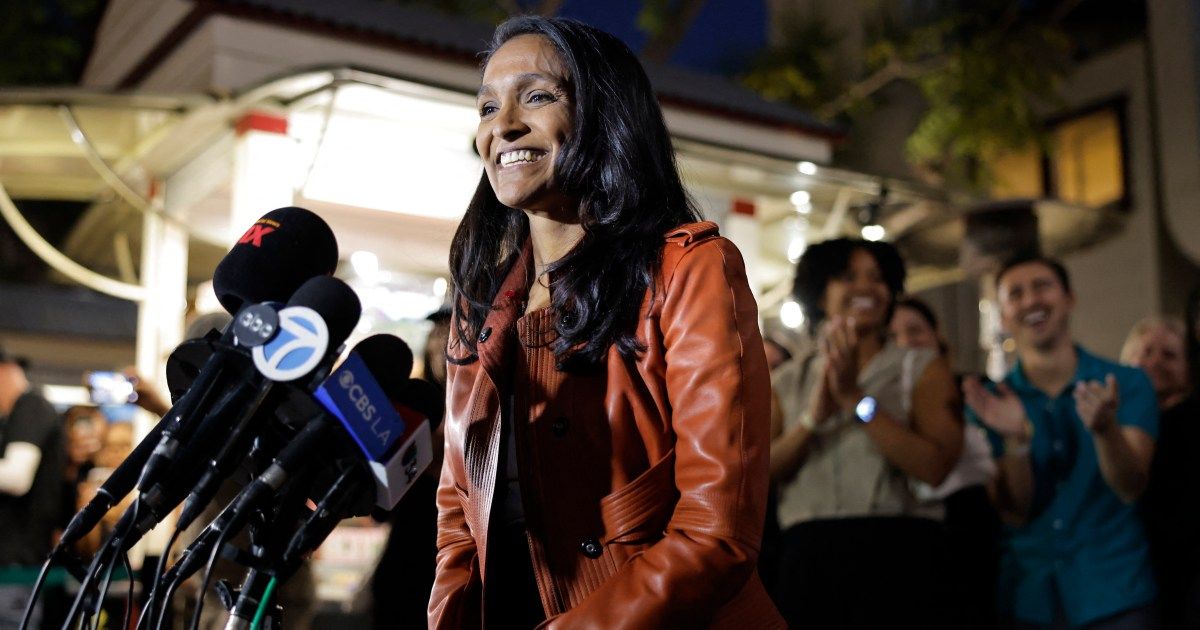

Los Angeles, United States – On November 5, Los Angeles City Council member Nithya Raman was declared the winner of the local mayoral race, defeating the incumbent, Karen Bass, with nearly 53 percent of the vote.
“Los Angeles, I am deeply honoured to be your next mayor,” Raman, 45, said in a video shared on social media after the results were announced.
- list 1 of 3‘City of immigrants’: Who is Nithya Raman, the Los Angeles mayor-elect?
- list 2 of 3Democratic Socialists of America see record wins in US midterm elections
- list 3 of 3Generation Z and young voters help redefine US politics after midterms
end of list
“I love this city. I believe in its people. The work ahead will be hard, and change will take time. And together, we are going to build a future as extraordinary as the city we call home.”
Raman’s victory is the latest example of a candidate who identifies as a democratic socialist notching a win in a major election.
When she takes office in December, Los Angeles will join an expanding list of cities overseen or soon to be led by democratic socialist mayors.
They include New York City; Seattle, Washington; Providence, Rhode Island; and the capital of the United States, Washington, DC.
Those successes have been fueled by a series of factors, including the popular belief that the political and economic status quo favours the wealthy.
“The idea that the economy is rigged is pretty common,” said Shawn Gude, author of the book American Socialist: The Life and Legacy of Eugene V Debs.
The book profiles Debs, a political leader and presidential candidate who helped galvanise a socialist movement in the US in the early 1900s. Gude explained that the struggle for common Americans to access basic services and necessities has long fuelled such movements.
Advertisement
“Democratic socialists have been effective at tapping into that anger and a desire for something better,” he said.
Raman’s victory was one of several results in the 2026 midterm elections that underscored the rise of democratic socialism — and its main organising body, the Democratic Socialists of America (DSA) — as a serious force in US politics.
“DSA has quadrupled our presence in the halls of Congress, sending a socialist bloc to DC that will fight to put people over profits,” the organisation said in a statement following the elections.
New York City Mayor Zohran Mamdani, a DSA member, was not on the ballot this year, but his focus on cost-of-living issues and affordability was adopted by other Democrats, including three congressional candidates he endorsed.
All three — Brad Lander, Claire Valdez and Darializa Avila Chevalier — won seats in Congress for the first time during this year’s midterms.
In Colorado, a 29-year-old Ethiopian immigrant named Melat Kiros also claimed victory in her congressional race with DSA support after toppling a Democratic incumbent in the party primary.
Los Angeles similarly saw democratic socialists score wins in municipal races and pick up a seat in California’s 34th Congressional District, where Angela Gonzales-Torres defeated Democratic incumbent Jimmy Gomez.
Critics say that establishment candidates often rely on an advantage in funding over socialist rivals.
But Leslie Chang, the cochair of the Los Angeles DSA, says the organisation tries to make up for those disadvantages with an enthusiasm and ground game that their opponents cannot match.
“DSA really leans heavily on our field operations. We bring people into our movement through face-to-face conversations at the doors,” Chang said.
While the number of democratic socialists in elected office remains relatively small in the US, the movement’s victories in recent years represent a remarkable shift.
When Senator Bernie Sanders launched his 2016 presidential run, he became the first major political figure in recent memory to test the viability of democratic socialism at the national level.
But critics dismissed his campaign as out of touch with political reality.
A decade later, even moderate candidates have adopted some of his rhetoric on issues such as corporate power and the corrosive effect of economic inequality on politics.
A YouGov poll released in October found that 50 percent of voters said they would be willing to cast a ballot for a democratic socialist. Other once-fringe left-wing positions, such as ending US support for Israel, have also become increasingly popular.
Advertisement
But that growth has also raised questions within the movement over how much compromise is acceptable to accommodate the demands of electoral politics.
Those questions have sometimes led to fractious internal debates.
A day before the November 3 election, for instance, a national DSA panel held a vote on whether to withdraw Raman’s endorsement over her past positions on Israel, including whether she had adequately supported the Boycott, Divestment and Sanctions (BDS) movement.
The vote failed by 14 to 13, narrowly avoiding what critics said would be an unforced error just days before the election.
One thread that connects many democratic socialists is a focus on good governance and municipal administration.
Raman certainly fits that mould. She previously worked as an urban planner and promised to bring her passion for policy details to issues such as housing and homelessness. Her campaign slogan promised, “a city that works”.
Chang says DSA’s interest in municipal administration continues beyond election day.
She hopes democratic socialists will stay engaged with constituents on larger issues as well as services like rubbish pick-up and infrastructure fixes.
“In four years, if we’re going to be knocking on doors and asking for these voters to support our candidate again, we don’t want to be in a situation where they say, ‘Well, I voted for you last time, and nothing got better,’” she said.
Gude said this focus was also shared by an earlier generation of socialists, who gained popularity in cities across the country through measures like bringing sewage systems to poor neighbourhoods and building public parks.
“Mamdani talks about pothole politics,” said Gude. “In the Debs era, this was called sewer socialism.”
“On a practical level, it’s about trying to deliver for working people directly and build the movement from the ground up,” he added. “It’s a way of showing people that they can trust you to make tangible improvements in their lives.”
Related News

Southern California wildfire engulfs homes, prompts evacuation orders

Activists accuse Israeli settlers of assault in occupied West Bank

Algeria’s military deployment to Niger: What’s behind the move?