
Washington, DC – As the global outcry over the US abduction of Venezuela’s President Nicolas Maduro continues to grow, officials in Washington are relying on the United States’ own criminal charges to justify its military operation.
But experts stress that countries cannot use their own indictments to attack another state, rejecting framing Maduro’s “capture” as a legal arrest.
- list 1 of 3Trump poses with ‘Make Iran Great Again’ hat after Maduro abduction
- list 2 of 3Trump says Venezuela to hand over up to 50 million barrels of oil to US
- list 3 of 3US seizes Venezuela-linked Russian oil tanker
end of list
“There’s a very clear limit on enforcement jurisdiction internationally, and that is that one state cannot enforce its law on the territory of another state unless that state gives its consent,” said Margaret Satterthwaite, United Nations special rapporteur on the independence of judges and lawyers.
“So if a state, for example, harboured someone that the US considered a fugitive, the US could approach that state and seek its consent to arrest them and bring them back to the US to stand trial. But it cannot go into another country without that state’s consent and grab up an individual, even if they are indicted properly by the US court system.”
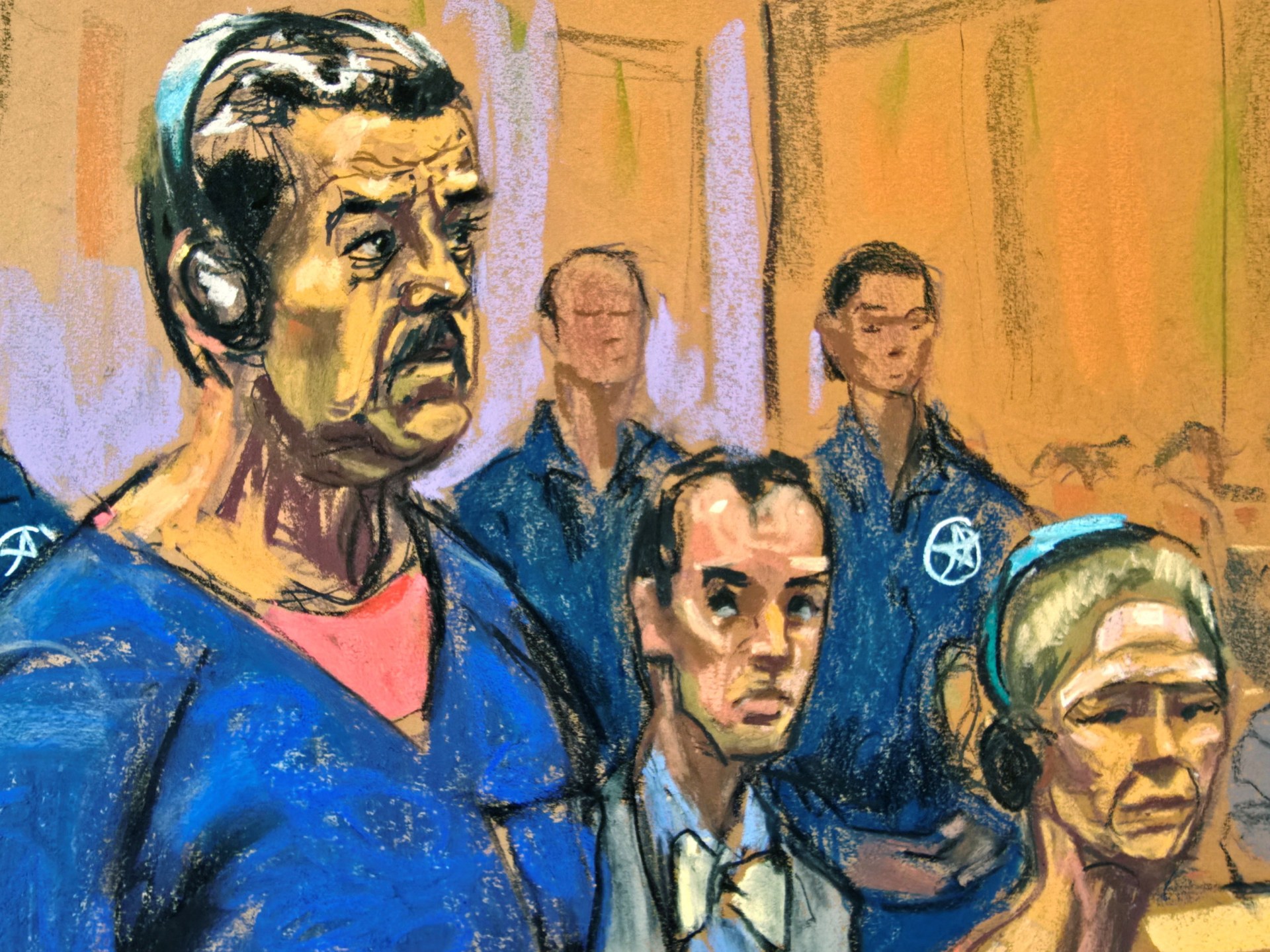
Maduro was indicted by the US Justice Department in 2020 on drug and gun charges. He made his first court appearance in New York on Monday after his abduction and professed his innocence, saying that he was “kidnapped”.
Another international law issue that arises with Maduro’s abduction is the immunity of heads of state and other high-ranking officials from prosecution and civil penalties abroad – a principle that has been affirmed by the International Court of Justice and previously acknowledged by Washington.
Advertisement
“So not only is the US extending enforcement jurisdiction without the consent of Venezuela, but the US is also grabbing up a high state official and saying we have the right to simply take this person out of their position and put them on trial in the US,” Satterthwaite told Al Jazeera.
International courts are an exception to head-of-state immunity. In 2024, the International Criminal Court (ICC) issued an arrest warrant for Israeli Prime Minister Benjamin Netanyahu over war crime charges in Gaza.
The US has imposed sanctions on ICC officials for investigating Israel.
The US position
That legal consensus, however, has not stopped US President Donald Trump’s aides and allies from arguing that the abduction of Maduro was a mere law enforcement operation, not an act of aggression against another country.
Republican Senator Tom Cotton likened US special forces abduction in Caracas to law enforcement officers arresting a suspected drug trafficker in the US, as he argued that the White House did not have to inform the US Congress of the attack.
“That’s not the kind of thing that you expect advance notice to Congress for,” Cotton told the Hugh Hewitt Show on Monday.
“Nor, for that matter, do I expect advance notice every time the executive carries out an arrest of a drug trafficker, whether it’s in Venezuela or in Arkansas.”
Hours after the operation on Saturday, US Vice President JD Vance also invoked Maduro’s indictment as the legal basis for the US attack.
“And PSA [public service announcement] for everyone saying this was ‘illegal’: Maduro has multiple indictments in the United States for narcoterrorism,” Vance wrote on X.
“You don’t get to avoid justice for drug trafficking in the United States because you live in a palace in Caracas.”
Republican Senator Mike Lee initially questioned the domestic legality of the military action without congressional authorisation on Saturday.
But he later said that US Secretary of State Marco Rubio told him that the violence was “deployed to protect and defend those executing the arrest warrant” – an explanation that appeared to satisfy the senator’s concern.
But Yusra Suedi, assistant professor in International law at the University of Manchester, stressed that the attack on Venezuela violates the UN Charter, which prohibits “the threat or use of force against the territorial integrity or political independence of any state”.
“A state cannot lawfully justify violating international law by citing its own domestic law. And this is a cardinal principle of international law,” said Suedi.
Advertisement
For his part, Ian Hurd, a professor of political science at Northwestern University, dismissed the notion that US forces were conducting a law-enforcement operation.
“It’s silly for the American government to purport that this is simply the execution of an arrest warrant,” Hurd told Al Jazeera.
“It would require, then, that you imagine that the Canadian government might issue an arrest warrant for Trump for fraud or sexual harassment and send the forces to bomb the White House to extract him to take him back to Canada for trial.”
He added that international law is unambiguous in saying that governments cannot use force against other countries to advance their goals.
“So it’s very clearly illegal under international law. It’s simply an overthrow of a government by a neighbour using military force,” Hurd told Al Jazeera.
Question of legitimacy
In the wake of the abduction of Maduro, some supporters of the move have argued that Maduro lacks legitimacy due to the alleged voter fraud that took place in the last election, which the opposition claims to have documented.
Even before the US raid, opposition figure Maria Corina Machado said removing Maduro would not amount to regime change because Venezuelans had already voted against the president.
But experts say Washington’s assessment of Maduro’s legitimacy is irrelevant to the illegality of the strike.
He was Venezuela’s head of state at the time of his abduction, a fact recognised by the US Justice Department in its 2026 indictment, which calls Maduro “Venezuela’s president and now de facto ruler”.
Satterthwaite, the UN rapporteur, said that while there are “serious concerns” with the 2024 elections, the US itself has treated Maduro as Venezuela’s leader.
In January, Trump sent his envoy Richard Grenell to meet Maduro for talks on accepting deportation flights of undocumented Venezuelans in the US.
“If we allowed one government to go around the world saying, ‘Well, this person is legitimate, this is not. And since he’s not, I’m going to go grab him,’ you can see what kind of chaos would ensue,” Satterthwaite said.
She added that the legitimacy of many governments across the world can be questioned over fraudulent elections, lack of elections or ascension to power via a coup. “That does not allow another individual government unilaterally to decide that it can go and grab up the head of that government,” she said.
Maduro’s government has been accused of major human rights violations, including arbitrary arrests of dissidents and torture.
“I, of course, would be in favour of measures of accountability for the [Venezuelan] government, but not in this reckless kind of Wild West manner that we’ve seen play out here,” Satterthwaite told Al Jazeera.
The Noriega case
Some defenders of the abduction of Maduro over US charges have claimed that the move has a legal precedent.
“Critics calling President Trump’s capture of Nicolas Maduro unprecedented and illegal have short memories. We’ve done this before, and the courts blessed it,” an associate professor of business law at Georgia College and State University wrote in a Wall Street Journal column.
Advertisement
He was referring to the US invasion of Panama and the seizure of its President Manuel Noriega in 1989-1990. Noriega stood trial and was convicted of drug charges in the US.
Satterthwaite said the capture of Noriega had its own legal issues under international law, and it is not entirely analogous to the abduction of Maduro.
“That also was illegal, and therefore doesn’t help us at all to make the comparison,” she told Al Jazeera.
The UN General Assembly had condemned the US invasion of Panama.
Satterthwaite said in the case of Panama, Washington attempted to make a jurisdictional argument by saying that Noriega was not the country’s leader, and that the US was acting with the consent of the proper head of state at that time, President-elect Guillermo Endara.
“It’s important to note that at that moment in Panama, the National Assembly there had actually declared a state of war against the US, so there was already an engagement between the two states,” Satterthwaite said.
“All of those things make this different, but I don’t think they make that first operation legal.”
Related News
What is Lebanon’s ‘gap law’ that attempts to end the financial crisis?
Ten found guilty of gender cyberbullying France First Lady Brigitte Macron
Alarms raised as Trump’s CDC cuts number of suggested vaccines for children