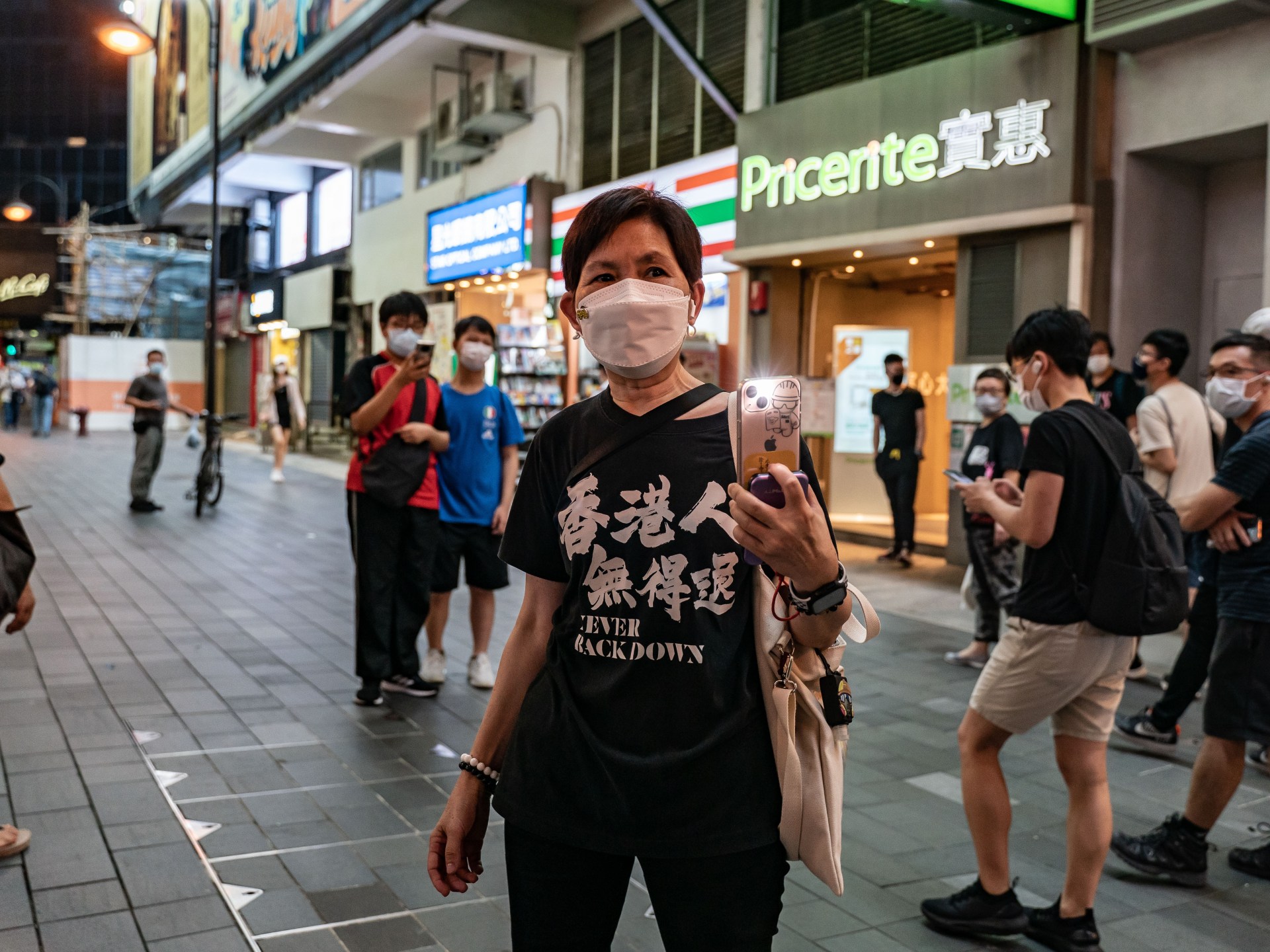

Hong Kong police are now empowered to require anyone suspected of violating the semi-autonomous city’s national security law to hand over passwords to their mobile phones or computers.
Officials will brief lawmakers on the new provisions on Tuesday, a government statement said. The measure, which took effect on Monday, is part of the national security law imposed by Beijing in 2020 following large, sometimes violent, pro-democracy protests in this Chinese territory.
- list 1 of 3Hong Kong begins national security trial for organisers of Tiananmen vigils
- list 2 of 3Why is the UK’s Keir Starmer in China and what does he want to achieve?
- list 3 of 3China warns Panama as Hong Kong firm contests ruling on canal ports
end of list
Hong Kong returned to Chinese sovereignty in 1997, but it retained a high degree of autonomy under the so-called “one country, two systems”. The move to curb rights following the 2020 protests has placed doubt on Hong Kong’s status as an international financial and business centre.
The city government gazetted the new amendments to the implementation rules of the national security law imposed by Beijing in 2020, using powers to bypass Hong Kong’s legislature.
Refusing to comply could lead to up to one year’s imprisonment and a fine of up to 100,000 Hong Kong dollars ($12,768), while providing false or misleading information could bring up to three years’ imprisonment and a fine of up to 500,000 Hong Kong dollars ($63,840).
The new amendments empower police to require a person under investigation suspected of endangering national security to provide any password or decryption method for electronic devices and to provide the police “any reasonable and necessary information or assistance”.
The imposition of the 2020 national security law, supplemented by a second component in 2024, has led to a marked decline in civil liberties in the former British colony returned to China in 1997, according to human rights advocates.
Advertisement
The new amendments also empower customs officers to seize items that are deemed to have “seditious intention”, regardless of whether any person has been arrested for an offence endangering national security because of the items.
Urania Chiu, a law lecturer in the UK researching Hong Kong, said the new provisions interfered with fundamental liberties, including the privacy of communication and the right to a fair trial.
“The sweeping powers given to law enforcement officers without any need for judicial authorisation are grossly disproportionate to any legitimate aim the bylaw purports to achieve,” Chiu told the Reuters news agency.
A Hong Kong government spokesperson said the amended rules conform to the city’s mini-constitution, the Basic Law, and its human rights provisions, and “will not affect the lives of the general public or the normal operation of institutions and organisations”.
According to the Security Bureau, a total of 386 people have been arrested for national security crimes so far, with 176 people and four companies convicted.
Hong Kong media tycoon Jimmy Lai was sentenced to a 20-year jail term in February for collusion with foreign forces and sedition, prompting international criticism.
Related News

Two killed in Oman by drones, several also fired at Saudi Arabia

Republic of Congo election: Who is running and what’s at stake?

Hungary’s Orban continues to block Ukraine loan at EU summit