
India’s exports increased by nearly 20 percent in November year-on-year, the country’s fastest growth in three years, driven primarily by exports to the United States and China.
The rise comes at a time when many countries are struggling to protect exports from the impact of steep US tariffs introduced by US President Donald Trump. Earlier this year, the US slapped an additional 25 percent tariff on India in retaliation for its continued purchases of Russian oil, Trump said, bringing total tariffs to 50 percent.
- list 1 of 3Mexico’s aerospace sector is growing. Will it be undercut in USMCA review?
- list 2 of 3Korea Zinc plans $7.4bn US minerals refinery with Washington’s backing
- list 3 of 3Why are French farmers objecting to EU-Mercosur trade deal?
end of list
The November rise in Indian exports also comes as China recorded a trade surplus of more than $1 trillion, in part reflecting how global trade flows are being reshaped as a result of the Trump trade wars.
The export figures, reported this week by India’s Ministry of Commerce and Industry, reflected resilient demand for Indian goods and a strategy of diversifying to new export markets, the ministry said, an approach other countries are also adopting as they look to reduce reliance on the US.
What were India’s exports in November?
India’s goods exports were valued at $38.13bn in November 2025, up about 19.4 percent year-on-year. This was a reversal of the 11.8 percent year-on-year decline in exports to $34.38bn that India recorded in October.
Imports, especially of gold, oil, and coal, also decreased by 1.88 percent, helping to shrink India’s goods trade deficit to about $24.5bn, its lowest level since June. In October, the trade deficit had ballooned to $41.68bn.
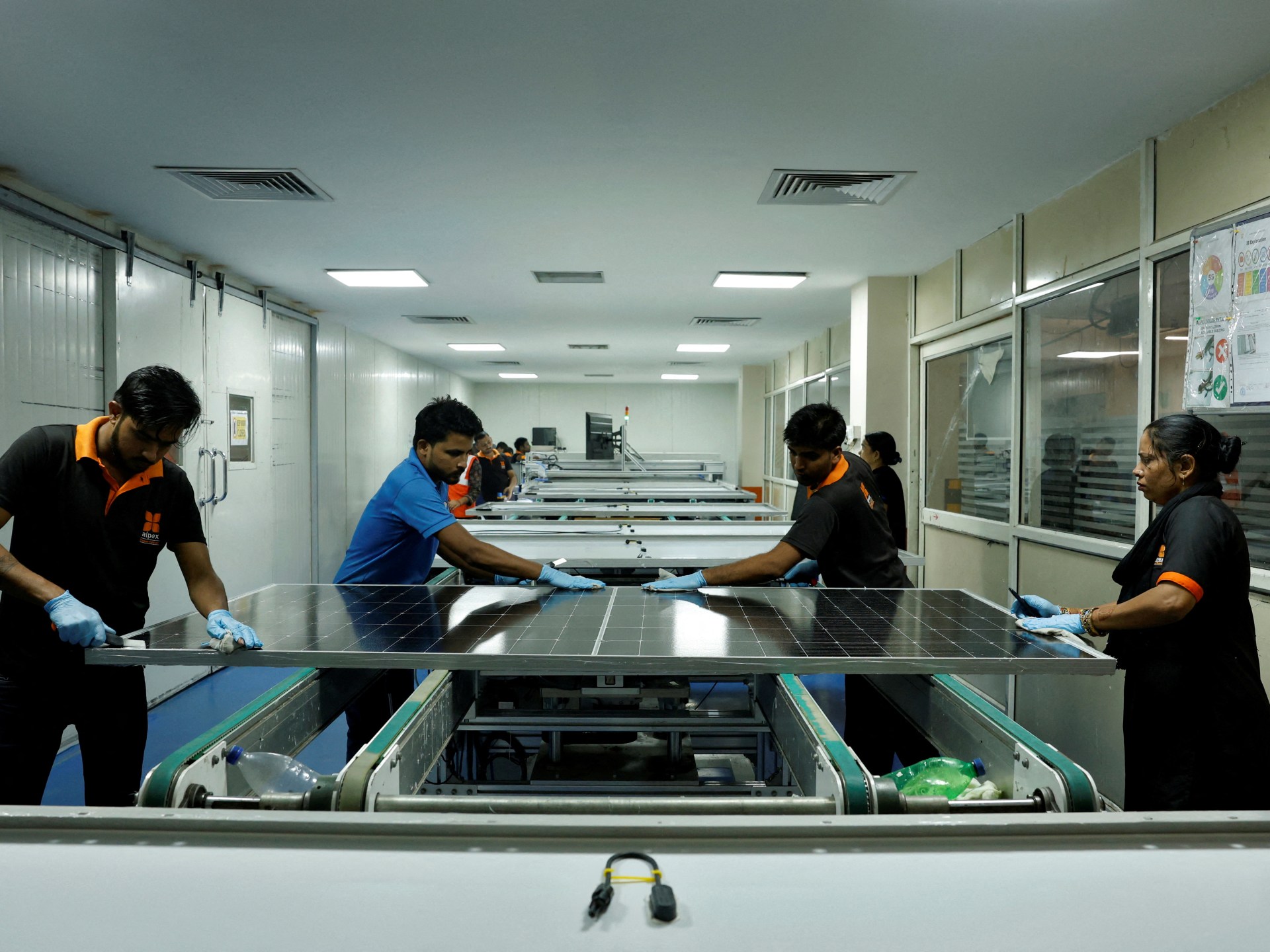
According to the Commerce Ministry, key drivers for strong exports included engineering goods, electronics and pharmaceuticals.
Where is India sending most of its exports now?
Despite the new tariffs, India’s exports to the US – its largest single destination – grew by 22 percent in November, reaching approximately $7bn.
Advertisement
The healthiest export sectors were engineering, electronics, jewellery and gems, and pharmaceuticals.
“India has held fort on the US exports despite tariffs,” Commerce Secretary Rajesh Agrawal said at a press briefing.
Meanwhile, shipments to China surged by 90 percent year-on-year to $2.2bn. China recorded notably higher Indian imports, with electronics and engineering goods seeing sizeable increases.
The Commerce Ministry added that exports to Spain, the United Arab Emirates and Tanzania were also driving growth.

Why are exports to the US still booming?
In part, November’s figures include Indian sales of goods that are not subject to US trade tariffs, Sambit Bhattacharyya, professor of economics at the University of Sussex in the United Kingdom, said.
“India’s exports of electronics and pharmaceuticals to the US increased, and these product categories are exempt from tariffs. Furthermore, tea, coffee, spices and other food items were also added to the exemption list, and all of them are experiencing steady growth.”
However, analysts also say continued healthy exports to the US signal that traders expect it to eventually relax tariffs on other goods, as the two countries are still working towards a trade deal.
In November, for example, New Delhi and Washington signed a long-term contract under which state-owned Indian companies IOC, BPCL and HPCL will buy 2.2 million metric tonnes of US liquefied petroleum gas (LPG) each year. That represents 10 percent of India’s total LPG imports.
Bhattacharyya said, “India is working with the US in securing a trade deal, and it is expected that average tariffs would come down and there will be more exemptions.
“Therefore, it is likely that there will be more concessions from the US side. It seems that US buyers remain optimistic about their Indian suppliers, and Indian exports remain competitive in the US market.”
Is India diversifying exports away from the US as well?
India has also resisted US pressure to open up sensitive sectors such as agriculture and dairy to US imports, insisting it will protect farmers and not “bow down” to tariff demands, while Trump is demanding greater market access.
In July this year, India and the UK signed the Comprehensive Economic and Trade Agreement under which tariffs have been reduced. Last year, India also signed the Trade and Economic Partnership Agreement with the European Free Trade Association countries – Switzerland, Norway, Iceland and Liechtenstein – under which they have linked markets in return for investment.
Advertisement
India is currently in talks with Mexico to counter tariff policies there and create new export corridors. Mexico’s Senate on Wednesday approved tariff hikes of up to 50 percent from January on imports from India and other countries, a move analysts say is aimed at appeasing Washington.
It is also holding trade talks with Oman.
“India would also be looking to diversify into Eurasian and Central Asian markets,” Sussex University’s Bhattacharyya said.
Why else are India’s exports high?
Bhattacharyya said exports were buoyed in November because the rupee was weaker.
“The rupee devalued against the dollar, which partially counterbalanced the negative effects of tariff on price competitiveness of Indian exports,” he said.
“What is reported is year-on-year growth, which is export figures for November 2025 compared to November 2024. November 2024 was the month of Red Sea crisis, which had a negative impact on exports to the US,” he added.
“Therefore, the November 2025 export growth figures may appear to be overly optimistic due to a low base.”

Which other countries are showing healthy exports despite US trade tariffs?
China’s exports maintained growth in 2025, enabling the country to record a trade surplus of more than $1 trillion.
Earlier in the year, the US imposed tariffs of 145 percent on Chinese goods before reducing them to facilitate trade negotiations. Beijing has weathered the standoff by increasing exports to non-US markets, however.
Strong demand from Europe, Southeast Asia and other Asian markets for electronics, electric cars and rare-earth metals, among others, have offset a decline in US-bound shipments caused by the tariffs war.
China’s exports to the European Union also saw strong growth, up an annual 14.8 percent in November year-on-year, and an 8.2 percent rise in exports to countries in Southeast Asia.
For the first 11 months of 2025, China’s goods surplus rose 21.7 percent year-on-year, with high-tech products driving much of the expansion. Shipments in this category grew 5.4 percent faster than overall exports.

Vietnam has also registered export increases in 2025, with its trade surplus with the US reaching $121.6bn over the same period, despite the 20 percent tariffs imposed on its goods by the Trump administration.
In November, Vietnamese exports to the US jumped 22.5 percent year-on-year, outpacing the 15.1 percent growth in shipments to other markets, according to official statistics.
Are other countries diversifying away from the US?
There has been increased momentum in multilateral and bilateral trade negotiations as countries seek alternatives to the US market.
Bhattacharyya said, “Countries are looking to diversify away from the US into Asian markets such as China, Japan and ASEAN. Trade deals is one way of ensuring trade and reducing trade uncertainty. Incentivising investments and opening up markets is also another way of securing trade.”
The EU has signed a trade deals with Latin American bloc Mercosur, Mexico and Indonesia. The deals include cutting or phasing out most tariffs on goods, widening access to markets for industrial and agricultural exports, as well as environmental and labour commitments.
Advertisement
The US’s northern neighbour, Canada, has also signalled its desire to strike new trade deals after coming under pressure from Trump’s tariff blitz.
In November, Canada and the UAE signed a Foreign Investment Promotion and Protection Agreement, designed to promote and protect investments between the two countries, while also agreeing to begin talks to secure a trade deal between themselves.
Canada’s Prime Minister Mark Carney has previously said Canada aims to double its non-US exports over the next decade.
Related News
Germany’s Merz meets Netanyahu under shadow of Israel’s war on Gaza

US Congress advances bill to nix Caesar Act sanctions on Syria
EU slams critical US security strategy, notes ‘changed relationship’