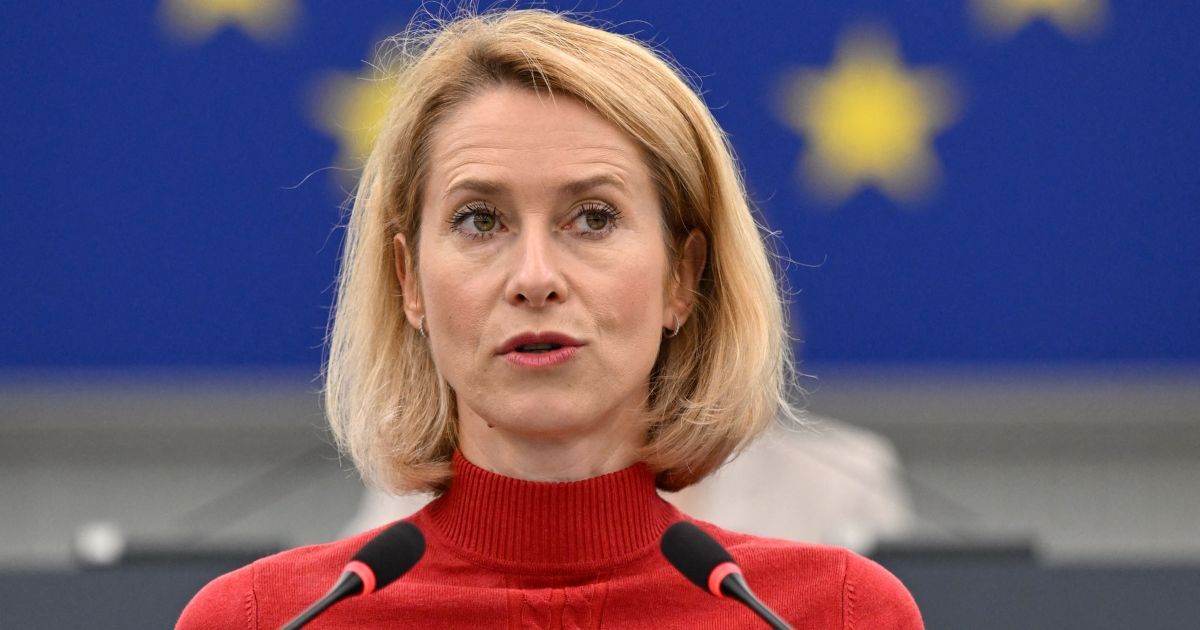

Israeli Foreign Minister Gideon Saar said this week he would suspend contact with the European Union’s foreign policy chief, Kaja Kallas, over reports that she compared Israel’s treatment of Palestinians with South Africa’s former apartheid system.
The diplomatic row follows reports by European news outlet Euractiv that Kallas made the remarks during high-level talks with Mexican officials in May. Citing unnamed officials, the outlet reported that the EU diplomat privately likened Israel’s policies in Gaza and the occupied West Bank to the racial segregation regime that ruled South Africa until the mid-1990s.
- list 1 of 3Fears for US-Iran deal as talks delayed by Israeli strikes on Lebanon
- list 2 of 3Israel continues attacks on Lebanon despite US-Iran deal
- list 3 of 3Can US-Iran peace ‘deal’ survive Israeli bombing of Lebanon?
end of list
So what does this row mean for relations between Israel and the EU? Here is what we know.
What happened?
In a post on X on Thursday, Saar said he had “no choice but to sever all contact” with the bloc’s high representative until she retracted what he described as a “blood libel” against Israel. Kallas responded on the social media platform, stressing the EU’s commitment to dialogue and to a two-state solution but making no attempt to deny the media report.
The failure to retract the comments did not go unnoticed by Saar, who concluded that silence “speaks for itself”.
The row comes as Israel faces ongoing legal proceedings in international courts over accusations of genocide and war crimes in Gaza. Despite deep internal divisions among member states, analysts say the diplomatic fallout from Kallas’s remarks will remain symbolic.
“The episode reflects a deeper structural problem: Kallas and the European External Action Service (EEAS) have increasingly been sidelined, caught between member states that retain sovereign control over foreign policy and a European Commission that has progressively expanded into geopolitical territory under [Ursula] von der Leyen,” Nele Anders, a Berlin-based analyst at the European Council on Foreign Relations (ECFR), told Al Jazeera.
Advertisement
The EEAS is the EU’s diplomatic service, headed by Kallas.
“EU-Israel relations will continue to be shaped by individual capitals, meaning that the relationship is fractured, but far from unravelling in any collective sense.”
What is the EU’s relationship with Israel?
The EU’s policy towards Israel has been marked by ambiguity, reflecting the challenge of upholding the bloc’s commitment to human rights while maintaining a special partnership.
As EU leaders gathered for the second day of a European Council summit to approve a new budget on Friday, Irish prime minister Micheal Martin told reporters the EU’s failure to take action against Israel reflected poorly on the bloc.
“The credibility of Europe is undermined by a failure to take a strong stance in terms of what has been a breach of international law … war crimes on a number of fronts,” he told reporters.
He also called Saar’s decision to sever ties with Kallas “unacceptable”.
Ireland has been among the most active proponents of EU-level measures against Israel, including, most recently, a proposal to sanction far-right Israeli government ministers Itamar Ben-Gvir and Bezalel Smotrich over allegations of degrading treatment of pro-Palestinian activists detained by Israeli forces on board a Gaza-bound aid flotilla.
The EU has so far been unable to reach the unanimous agreement needed to approve the sanctions, however. A deadlock also thwarted attempts to approve a proposal on restricting trade with the settlements, which are considered illegal under international law as they are on Palestinian-owned land.
Has the EU taken any action against Israel?
Since Israel accelerated its illegal settler project in the West Bank following the start of its war on Gaza in October 2023, the EU – which formally supports a two-state solution – adopted limited sanctions against specific settler organisations in 2024 and again in May this year.
Yet, the EU-Israel Association Agreement – the framework that provides the legal basis for relations between the EU and Israel – still stands despite much pressure. Signed in 1995 and active since 2000, the pact positions the EU as Israel’s largest trading partner and establishes cooperation on areas including investment, research, innovation and education.
Ireland, Spain and Slovenia have led efforts within the EU to suspend this agreement, but these have so far stalled due to resistance from countries like Germany, Italy, Hungary and the Czech Republic.
United Nations experts have also called on the EU to suspend the agreement, citing a ruling by the International Court of Justice (ICJ) stating that member states must refrain from assisting Israel in maintaining an illegal situation in the occupied Palestinian territory.
Advertisement
Anders, at ECFR, said measures such as the suspension of the Association Agreement require unanimity, “meaning any single member state effectively holds a veto”. But, “Germany’s political weight also ensures it can readily assemble a blocking minority even in areas where qualified majority voting applies.”
The targeted sanctions approved by the bloc “are far from the broader measures that some member states have pushed for, and they enjoy wider political support because they are narrowly targeted”, Anders explained.
“On any more action, the political will does not exist in key member states such as Germany, and that is unlikely to change at [the current Brussels] summit.”

German Chancellor Friedrich Merz distanced himself from Kallas’s remarks, reaffirming once again Berlin’s position as a staunch Israeli ally. “I explicitly do not share this choice of words,” he told reporters on the sidelines of the summit in Brussels.
Armin Laschet, chair of the German Bundestag’s Foreign Affairs Committee, described the EU official’s remarks as “anti-Semitic outbursts”, arguing that they discredited European foreign policy.
Felix Berenskotter, lecturer in international relations at King’s College London, UK, said Germany’s foreign policy has been characterised by a strong solidarity with Israel. “This is not something the government is questioning,” he told Al Jazeera. “What has changed is a closer scrutiny of what exactly this commitment to Israel means.”
“The German government has come to the conclusion that Israel’s actions are not supporting its security in many ways,” Berenskotter continued. “But [it] is also very careful not to lecture or say anything that sounds like it is telling Israel what to do. So it has been careful with criticising Israel openly, but does this behind closed doors.”
By contrast, leading EU nations France and Italy – also among Israel’s staunchest allies in the bloc – have recently stepped out of line. In September, France joined a flurry of countries moving to formally recognise Palestinian statehood. Spain, Norway and Ireland also recognised Palestinian statehood last year, with Madrid also imposing sanctions on Israel for its war on Gaza.
Earlier this month, France and Italy both instructed prosecutors to examine the conduct of Ben-Gvir, Israel’s far-right national security minister, with respect to the treatment of their nationals during the interception of an aid flotilla bound for Gaza.
So, could relations between Israel and the EU sour further?
Despite occasional strong reactions by EU member states, however, Berenskotter said it is unlikely that the diplomatic row between Saar and Kallas is the harbinger of a more profound crisis between Israel and the EU.
Instead, he argued the spat could be seen as a “deliberate strategic intervention of Israel in EU internal debates and dynamics”. The EEAS has come under scrutiny after Germany and France called its role into question for competing with national diplomatic services.
Advertisement
“Kallas is locked in a power struggle with the commission president, von der Leyen, about EU foreign policy leadership,” Berenskotter said, adding her comments may have been used by Israel “to undermine a body in the EU that has moved towards a more critical position.”
“The Israeli government is very good in spotting how to pick sides and intervene in political debates that have an impact on Israel,” he said. “One needs to ask: how were these remarks leaked?”
Related News

Five Indian air force staff killed as transport plane crashes in Assam
Israel takes control of Hebron’s Ibrahimi Mosque: What next?
Pakistan says ‘final, agreed upon’ text of Iran war ceasefire deal reached