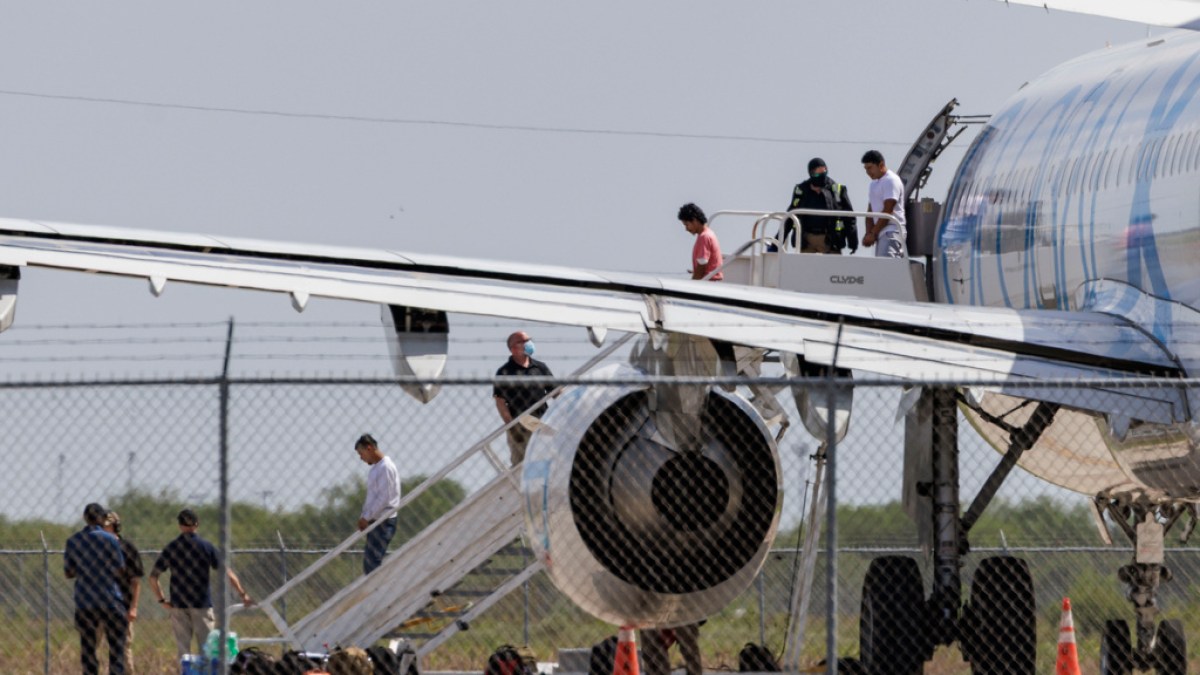

The South American nation of Paraguay has announced it will receive non-citizens expelled from the United States as part of President Donald Trump’s mass deportation push.
Paraguay’s Ministry of Foreign Affairs said in a statement on Tuesday that it will receive an initial group of 25 Spanish-speaking deportees, starting on Thursday.
- list 1 of 3Costa Rica to accept 25 deportees per week under Trump deportation effort
- list 2 of 3Legal groups condemn arrival of a dozen deportees from US to Uganda
- list 3 of 3Fifteen South American people deported from the US arrive in DR Congo
end of list
“Each case has been evaluated individually, in full respect of national sovereignty, immigration laws, and international law,” the statement reads.
Paraguay is one of the latest in a growing list of countries to participate in “third-country” deportations from the US. Such third-country agreements pave the way for the US to send immigrants to countries they have no ties to.
The Trump administration has approached dozens of countries to take part, despite concerns about human rights conditions in some of the proposed destinations.
Costa Rica, El Salvador, the Democratic Republic of the Congo (DRC), Eswatini (formerly known as Swaziland) and South Sudan are among the countries that have accepted such deportations, in some cases signing multimillion-dollar deals to accept and imprison deportees.
The scheme is part of an aggressive effort under Trump to restrict migration to the US.
As of February, Democratic lawmakers in the US estimated that more than $40m has been awarded to foreign countries in contracts, as an incentive for accepting deportees.
Robert Alter, an official at the US Embassy in Paraguay, praised the agreement in a statement, saying it was a testament to Washington’s close relationship with Paraguay.
Advertisement
He also sought to assuage concerns about the legality of the deportations.
“These migrants do not have pending asylum applications in the United States,” the statement said. “The intention of this collaboration is to facilitate the safe and orderly return of these individuals to their countries of origin.”
Advocacy groups have accused the Trump administration of using the threat of third-country deportations as an intimidation tactic.
In the high-profile case of Kilmar Abrego Garcia, the Trump administration has publicly insisted on deporting the Salvadoran man to an African country, despite Abrego Garcia’s willingness to go to Costa Rica – and Costa Rica’s pledge to accept him.
Critics point out that some of the third-country destinations are unstable. South Sudan, for instance, faces one of the world’s largest displacement crises, as ongoing fighting risks plunging the country into a full-scale war.
In the DRC, another third country, a conflict continues to simmer between government forces and Rwanda-backed rebels.
Last week, a group of 15 deportees from South American countries were sent from the US to the DRC, despite the fact that the US State Department warns of “civil unrest” in the area.
Some third-party countries have also faced internal pushback to their agreements with the Trump administration.
The Uganda Law Society and the East Africa Law Society, for instance, have pledged to challenge local third-country deportations after a dozen deportees arrived from the US earlier this month.
They argued that the deportations were an “undignified, harrowing and dehumanising process” that reflected a system of “transnational repression”.
The Associated Press news agency has previously reported that the Trump administration is seeking similar arrangements with 47 additional countries.
Related News

JD Vance expects ‘positive’ US-Iran war talks as he departs for Pakistan

World reacts to Strait of Hormuz reopening amid US-Iran conflict
Celebrations in Lebanon as 10-day ceasefire with Israel begins