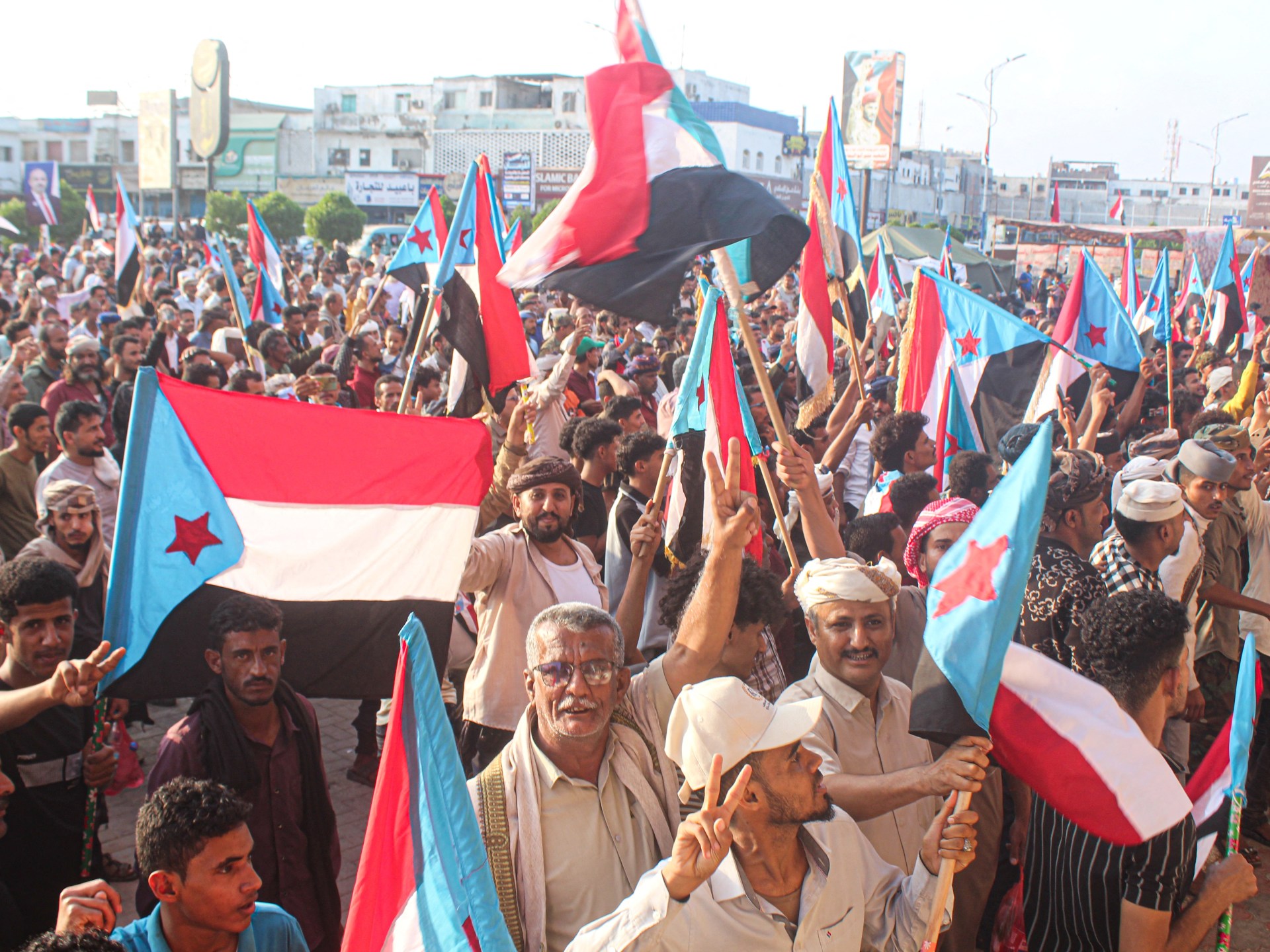

Saudi Arabia has publicly called on Yemen’s main southern separatist group to withdraw from two eastern provinces they seized this month, in a move that threatens to deepen divisions within the governing coalition opposed to the Houthi rebels.
Saudi Arabia’s Ministry of Foreign Affairs issued the demand on Thursday, describing military operations by the Southern Transitional Council (STC) as an “unjustified escalation” after the group took control of the oil-rich Hadramout and al-Mahra governorates earlier in December.
- list 1 of 2UN chief Guterres condemns Houthi detention of 10 more UN staff in Yemen
- list 2 of 2Yemen’s government, Houthis agree to exchange thousands of prisoners
end of list
“The kingdom stresses the importance of cooperation among all Yemeni factions and components to exercise restraint and avoid any measures that could destabilise security and stability, which may result in undesirable consequences,” the Foreign Ministry warned.
Saudi Arabia added that meditation efforts were under way, aimed at having the STC’s forces return to “their previous positions outside of the two governorates and handover the camps in those areas” to the National Shield Forces.
Riyadh said it remained hopeful the separatists would pull back “in an urgent and orderly manner” to restore stability.
The STC, which has previously received military and financial backing from the United Arab Emirates (UAE), moved swiftly into the two provinces in early December, seizing key oil facilities, government buildings and border crossings with minimal resistance.
The group also took over the presidential palace in Aden, the temporary seat of Yemen’s internationally recognised government.
Advertisement
Saudi Arabia and the UAE have both backed the government against Iran-aligned Houthis during Yemen’s civil war since 2015. The STC is part of a broader coalition backed by Saudi Arabia, called the Presidential Leadership Council, which represents the country.
While the two Gulf powers sent a joint delegation to Aden on December 12 to negotiate a resolution, those efforts have so far failed to produce a breakthrough.
Saudi Arabia shares a 684km (425-mile) border with Hadramout and views the province as vital to its national security, while Oman has similar concerns about al-Mahra on its frontier.
Both governorates host important trade routes and energy resources that the STC considers essential for establishing an independent southern state.
The separatist group was formed in 2017 to restore South Yemen, which existed as an independent country between 1967 and 1990.
Its leader, Aidarous al-Zubaidi, holds a seat on Yemen’s Presidential Leadership Council but has increasingly acted independently of the government he nominally serves.
Instead of withdrawing, the STC has expanded operations into neighbouring Abyan province and declared that its ultimate goal was to seize the Yemeni capital Sanaa from the Houthis. Al-Zubaidi recently told supporters that the south stands at “a critical and existential juncture” requiring work to build “the institutions of the future South Arabian state”.
Analysts warn the escalation could unravel Yemen’s fragile truce and benefit the Houthis, who have controlled northern Yemen, including Sanaa, since 2014.
Related News

Hamas confirms killing of senior commander in Israeli strike in Gaza
Cambodia warns displaced people, tourist hotspots at risk from Thai bombs

Australia police responding after gunshots reported at Sydney’s Bondi beach