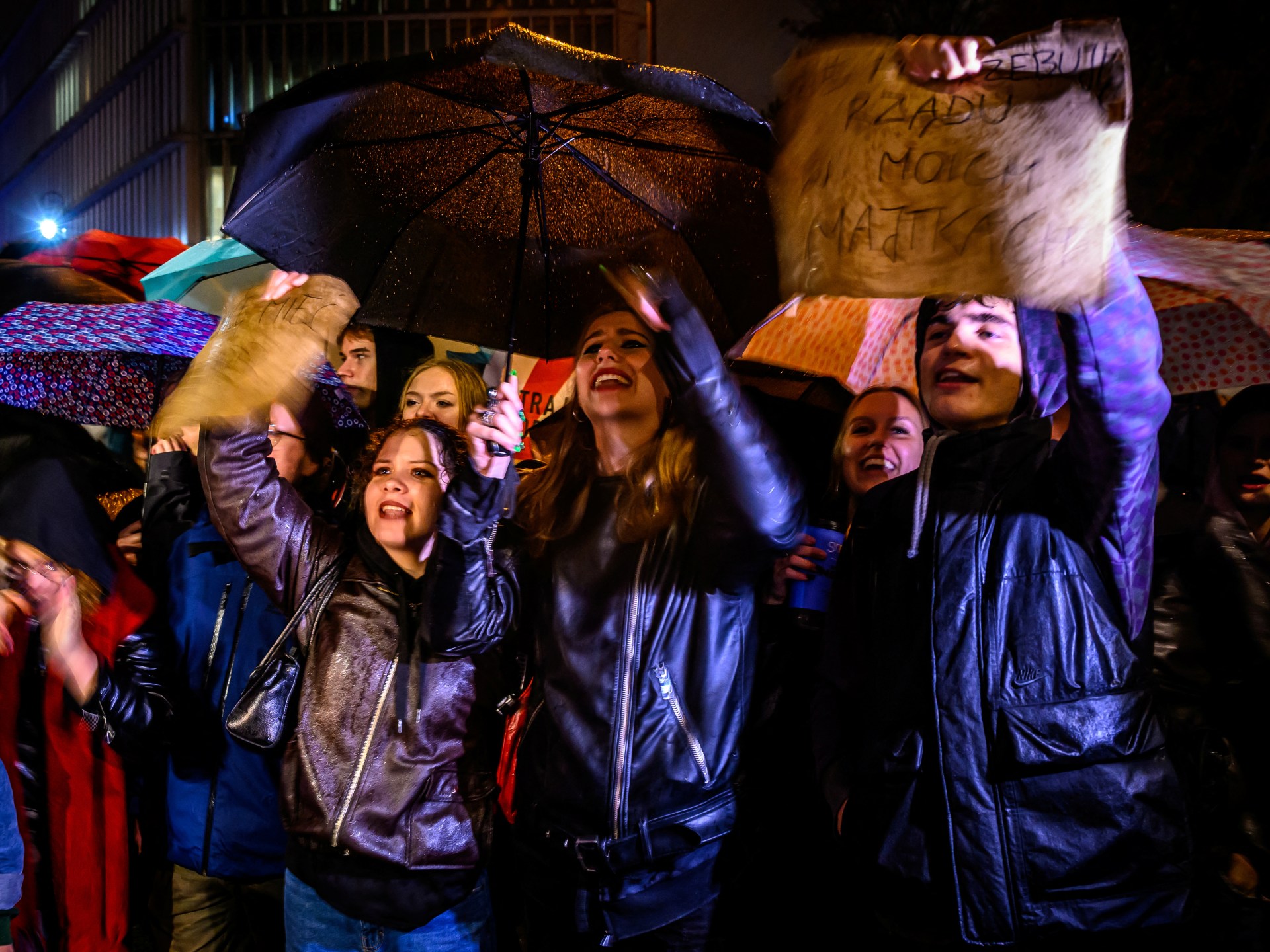

Thousands of people have protested in more than 20 towns and cities across Poland, calling for access to free and legal abortion services.
Demonstrators gathered on the sixth anniversary of a near-total abortion ban imposed by Poland’s highest court.
- list 1 of 4A look at some of the world’s toughest abortion laws
- list 2 of 4How women are resisting Poland’s abortion ban
- list 3 of 4Poland’s ban on abortion forces many to seek help in Germany
- list 4 of 4Women call for tougher EU stance on Poland’s abortion laws
end of list
Currently, abortion is only legal in Poland when a pregnancy results from a criminal act like rape or incest, or when it threatens the life or health of the mother.
Prime Minister Donald Tusk’s government promised to liberalise abortion laws ahead of its 2023 election victory, but divisions within the coalition have slowed progress.
The demonstrations come days after parliament passed two bills that would ease abortion restrictions in the mostly Catholic country, but are likely to be vetoed by Poland’s conservative President Karol Nawrocki.
Passing the draft laws now, a year before the next parliamentary election, is a case of “token gestures” rather than a genuine effort to reform abortion law, said Zofia Marcinek of the Abortion Dream Team, a reproductive rights activist group in Warsaw.
She said the liberal government knew the draft laws stand no chance of withstanding Nawrocki’s veto, and has merely tried to create the impression of taking action because it needs women’s support to win elections next year.
In the capital, Warsaw, about 1,000 protesters demonstrated in front of parliament despite rain.
“Over the last six years, nothing has really changed,” said 36-year-old Emilia Niemiec, who manages the AboTak abortion centre, which provides women with access to resources, including pills, and a space to be able to seek support or carry out a pharmacological abortion.

Restrictive abortion laws have been in place in Poland since 1993, with Polish women leading calls for the legalisation of abortion ever since. In 2016, nationwide demonstrations took place, with women donning black as a sign of protest.
Advertisement
But rather than being relaxed, Poland’s abortion laws were tightened further, banning abortions of foetuses with congenital defects in 2020 under the national-conservative Law and Justice (PiS) government.
Despite the laws, abortions remain common in Poland, with the overwhelming majority carried out by women at home using pills obtained from outside the country. Women who undergo abortions, including by taking pills, do not face criminal responsibility under Polish law. But people helping them, including doctors and family, can potentially be prosecuted.
Polish hospitals performed 573 abortions in the first half of 2026, compared with 452 in the whole of 2022 before Tusk came to power, according to data from the National Health Fund. But activists say tens of thousands of abortions happen yearly outside of hospitals.
Campaigners organising Thursday’s protests are claiming the Tusk government has betrayed Polish women – and that Tusk’s claims that women’s access to abortion has improved during his administration have actually complicated getting care for some women.
“The government’s promises act as a type of disinformation,” Marcinek said. “Women getting pregnant hear the prime minister say that everything is OK, that there is access to abortion, and then they end up in the hospital and see that is not the case. So they come to us when it’s very late and very complicated and expensive to help them.”
Related News

‘They told me to go back to my country’: Inside the UK’s wave of racism

Trump-Xi summit: What’s on the agenda, why it matters

Epstein, Iran and ‘drain the swamp’: Have Republicans shifted before vote?