
The United States administration is intensifying its build-up of a vast array of military assets in the Middle East, as President Donald Trump says Iran has “10 to 15 days at most” to agree a deal over its nuclear programme and stock of ballistic missiles.
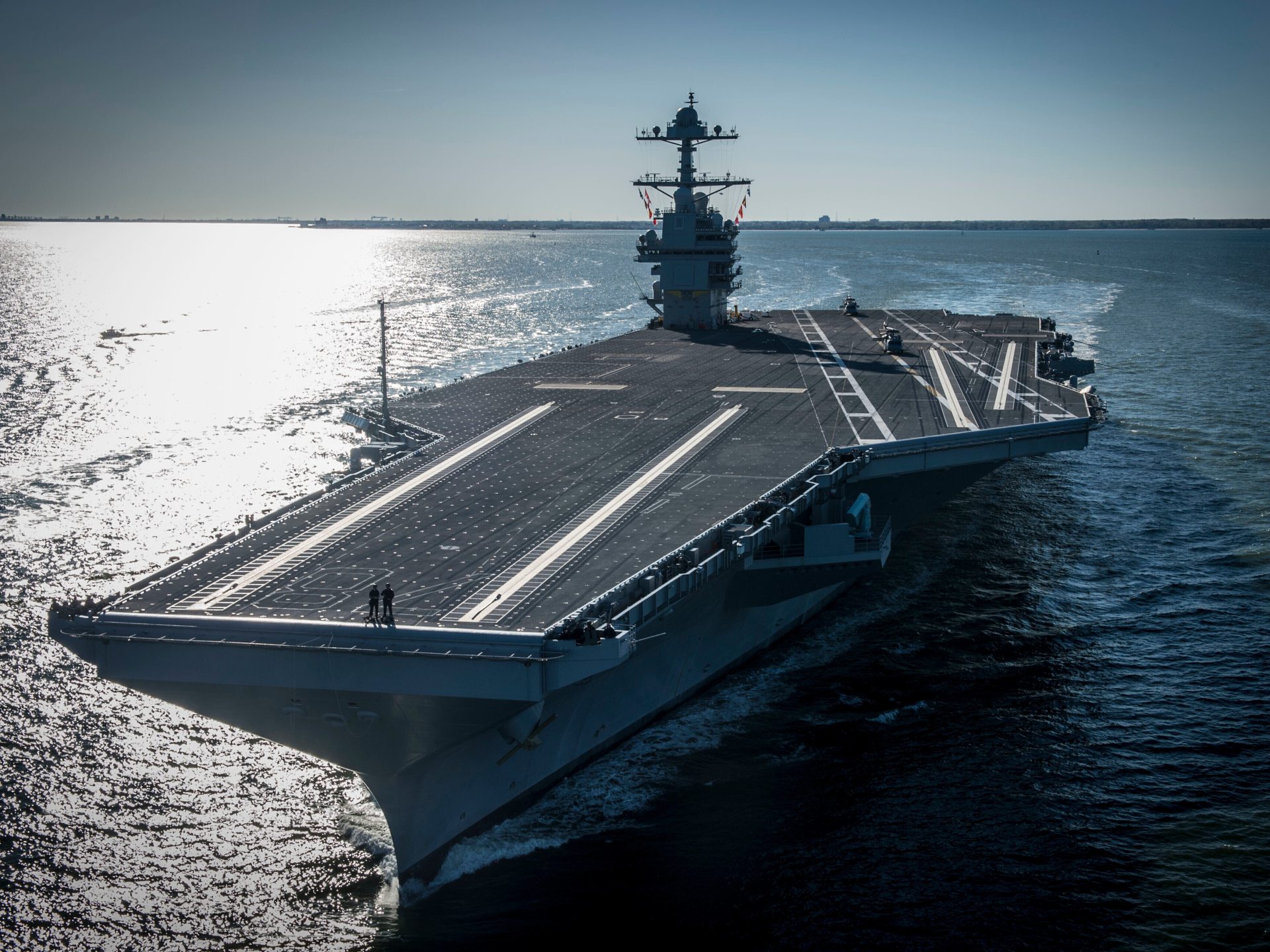
As well as the world’s largest aircraft carrier, the USS Gerald R Ford, which is reportedly joining the Abraham Lincoln carrier strike group in the Arabian Sea, key force multipliers such as E-3 Sentry Airborne Warning and Control System (AWACS) aircraft have been deployed.
end of list
In a letter to the United Nations Security Council, Iran said that while the country does not seek “tension or war and will not initiate a war”, any US aggression will be responded to “decisively and proportionately”.
“The United States would bear full and direct responsibility for any unpredictable and uncontrolled consequences,” it said.
Here is what we know about the recent US deployment of military assets in the Middle East – which has also led to a dispute with the United Kingdom over the use of its joint military base in Diego Garcia.
What air power assets has the US deployed to the Middle East?
According to open-source intelligence analysts and military flight-tracking data, the US appears to have deployed more than 120 aircraft to the region within the past few days – the largest surge in US airpower in the Middle East since the 2003 Iraq war.
The reported deployments include E-3 Sentry Airborne Warning and Control System (AWACS) aircraft, F-35 stealth strike fighters and F-22 air superiority jets, alongside F-15s and F-16s. Flight-tracking data shows many departing bases in the US and Europe, supported by cargo aircraft and aerial refuelling tankers, a sign of sustained operational planning rather than routine rotations.
Advertisement
F-22s and F-35s previously escorted B-2 stealth bombers during Operation Midnight Hammer, the US military strikes on Iranian nuclear sites Trump ordered in June 2025 during the 12-day conflict between Iran and Israel.
“Watch any movement by B-2s. That would indicate a possible replay of ‘Midnight Hammer’,” Mark Cancian, a retired Marine Corps colonel and senior adviser with the Washington-based Center for Strategic and International Studies think tank, told Al Jazeera.
This latest wave was preceded several weeks ago by the arrival of Air Force F-15E Strike Eagles. US Central Command said on social media at the time that the fighter jet “enhances combat readiness and promotes regional security and stability”.
What role could Diego Garcia and the UK play?
Attention has also focused on Diego Garcia, the joint UK-US military base in the Indian Ocean’s Chagos Islands, which is capable of hosting long-range US strategic bombers, including B-2 aircraft.
The remote base has historically served as a launch point for major US air campaigns in the region.
However, Diego Garcia is a British sovereign territory leased to Washington, meaning London must approve its use for offensive operations. According to reports in UK media, Prime Minister Keir Starmer has indicated to Trump that the US cannot use British airbases – including Diego Garcia and RAF Fairford in the UK, which is home to the US’s heavy bomber fleet in Europe – for strikes on Iran, as this would be in breach of international law.
Trump retaliated by withdrawing US support for the UK’s decision to transfer the Chagos Islands to Mauritius, announced last year.
On Wednesday, the US president said Starmer was “making a big mistake” in the agreement to transfer sovereignty of the archipelago.
“DO NOT GIVE AWAY DIEGO GARCIA!” Trump wrote in a post on Truth Social, saying the base could be called upon in any future military operation to counter a potential attack from Iran.

The USS Gerald R Ford, the world’s largest aircraft carrier, is currently being redeployed from the Caribbean to the Middle East.
The carrier and its accompanying strike group are expected to arrive in the region in the coming weeks.
On Wednesday, it briefly transmitted its location off the coast of Morocco, suggesting it is transiting the Atlantic towards the Strait of Gibraltar and will then go into the Mediterranean.
Advertisement
This is the same vessel that previously supported US military operations in Venezuela, including missions conducted under Operation Southern Spear.

The USS Gerald R Ford will join the USS Abraham Lincoln carrier strike group, which recent satellite imagery shows is operating in the Arabian Sea off the coast of Oman, positioning US naval power within striking distance of Iran.
The US Navy also has multiple guided-missile destroyers in the region equipped with advanced air defence and ballistic missile interception systems. These multi-role vessels can carry and launch Tomahawk cruise missiles capable of striking land targets deep inside Iran, alongside their anti-submarine and fleet defence missions.

How is Iran responding?
Iran has publicly warned that it will view any military strike by the US as a serious provocation.
Tehran has also moved ahead with its own planned military activities. It announced and began joint naval exercises with Russia in the Sea of Oman and northern Indian Ocean on Thursday. These are intended to enhance maritime cooperation and signal deterrence amid rising US pressure.
As part of these manoeuvres, Iranian authorities issued a Notice to Airmen (NOTAM) for rocket launches over southern Iran on Thursday from 03:30 to 13:30 GMT and temporarily closed parts of the Strait of Hormuz, a strategically vital shipping route, during live-fire drills.
Meanwhile, Russian Foreign Minister Sergey Lavrov also warned that a US strike on Iran would have serious repercussions, underscoring the risk of escalation if hostilities spread.
Satellite images published by the Reuters news agency on Thursday showed that Iran has recently built a concrete shield over a new facility at a sensitive military site and covered it in soil, experts say, advancing work at a location reportedly bombed by Israel in 2024.
Images also show that Iran has buried tunnel entrances at a nuclear site bombed by the US during Israel’s 12-day war with Iran last year, fortified tunnel entrances near another, and has repaired missile bases struck in the conflict.

Analytical reports also suggest that Iran has built a multilayered defence centred on mines, missiles, submarines and drones with the intent of slowing down the US forces.
Some analysts say Iran may seek to avoid an immediate full-scale confrontation, but this may be difficult.
“The Iranians have, over the past six months, quietly taken additional steps to move critical assets further underground,” Vali Nasr, a professor of international affairs and Middle East Studies at Johns Hopkins University, said during a roundtable discussion hosted by the CSIS Middle East Program this week
“They are going to be unpredictable,” he said. “But I think they could go big at the beginning, or they might want to drag the United States into a protracted situation.
Advertisement
“You hit a tanker, or you hit an oil facility, or you hit an American ship, and then it’s up to President Trump to decide whether to escalate further. And it can go beyond that.
“We are in a scenario where this might get out of control very quickly,” Nasr added.
Is the US likely to attack Iran?
According to experts, it is a very real possibility.
“The United States is doing all the things that it would do if it were going to conduct some sort of attack,” Cancian told Al Jazeera. “It has moved aircraft into the area, two aircraft carriers, plus enablers like AWACS.”
Barbara Slavi, distinguished fellow at Stimson Center, agreed with this assessment. “It seems that the Trump administration has decided that it is going to attack Iran again, and I presume in conjunction with the Israelis,” she said.
“What the objectives are, we have yet to see. Can it be contained? Will others be drawn in? These are all really important questions, and we don’t have answers.”
Is this a similar situation to what we saw earlier this year in Venezuela?
A build-up of US military assets in the Caribbean, close to Venezuela, which began in September 2025, led to multiple strikes on Venezuelan boats that the US claimed – without proof – were carrying drugs. It culminated in the dramatic January 3 raid on Caracas by US forces and the abduction of then-President Nicolas Maduro, who now faces trial on guns and drugs charges in New York.
“The build-up [in the Arabian Sea] has similarities, but one key difference is the strategic context,” Cancian said.
“Unlike the Venezuela raid, there hasn’t been a large deployment of Special Operations Forces, and Iran’s geography, far inland and heavily defended, makes a quick ground raid unlikely.
“If there are strikes, I would expect long-range missile attacks against security forces such as the Islamic Revolutionary Guard Corps. Strikes against nuclear facilities are also possible, but missiles like Tomahawk can only damage above-ground facilities,” he added.
Secretary of State Marco Rubio is reportedly planning to travel to Israel on February 28 to meet with Israeli Prime Minister Benjamin Netanyahu, a State Department official said.
Last summer, the US carried out air strikes on Iran’s nuclear facilities even as senior American diplomats were scheduled to meet with their Iranian counterparts in ongoing talks.
Related News

Heavy gunfire heard in Guinea’s capital, Conakry

UK’s Mandelson asked to cooperate in Epstein probe by US Congress
Ex-UK Prince Andrew arrested amid Epstein scandal