
President Donald Trump has suggested the United States could take over Cuba, but on amicable terms.
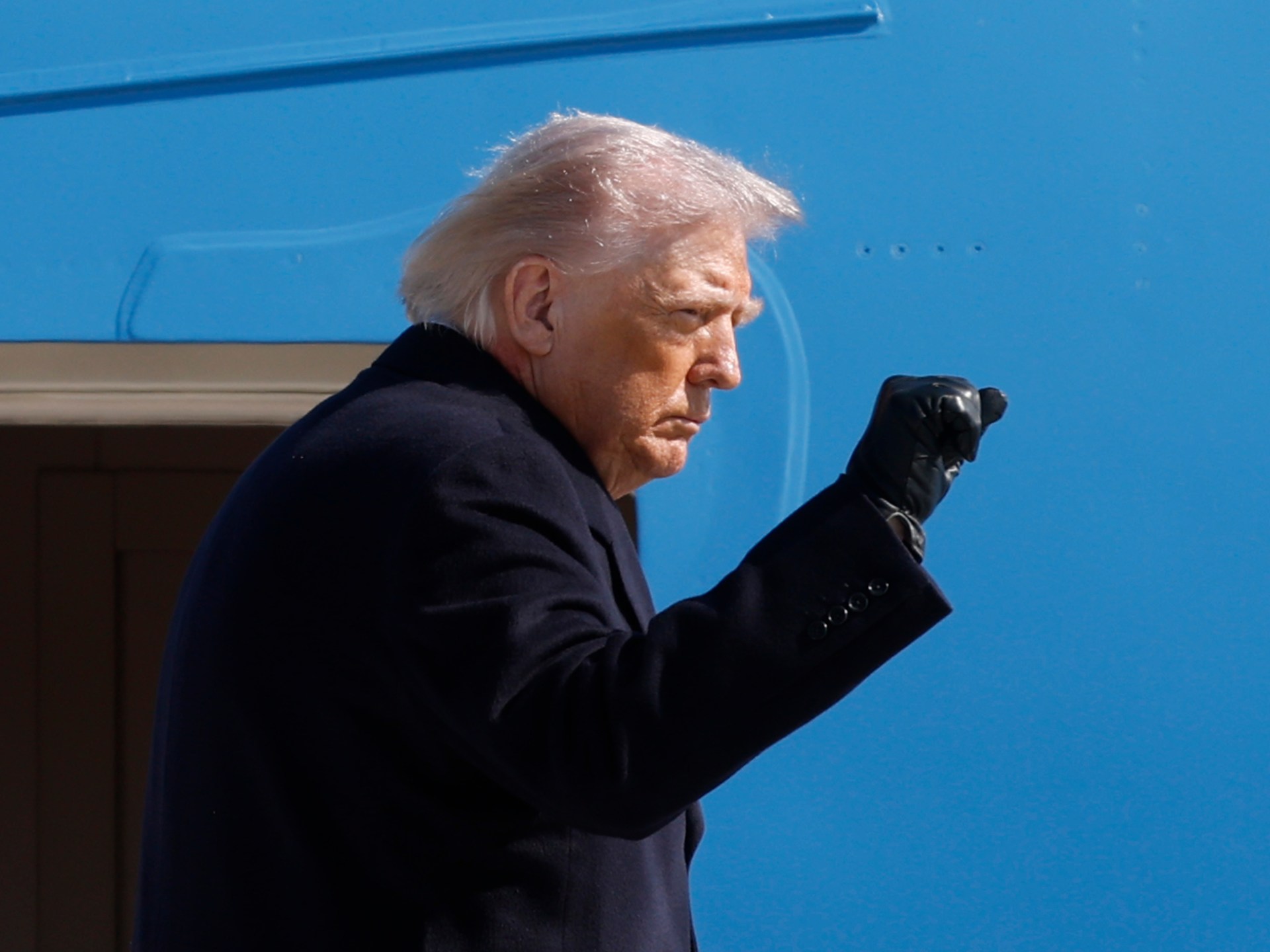
The statement on Friday came as Trump was preparing to board his presidential helicopter, Marine One, on the White House lawn en route to Texas.
- list 1 of 3Trump U-turn: Is Venezuelan oil really available to Cuba again?
- list 2 of 3How US economic warfare pushed Cuba to humanitarian collapse
- list 3 of 3Cuba says speedboat attackers from Florida planned to destabilise country
end of list
Approaching the media scrum, Trump took questions about the tense relations the US has with countries like Iran and Cuba, two countries where he has suggested he would like to see new governments.
In Cuba’s case, Trump suggested a transition that would be “very positive for the people who were expelled or worse”.
“The Cuban government is talking with us, and they’re in a big deal of trouble, as you know. They have no money. They have no anything right now, but they’re talking with us,” Trump told reporters.
“And maybe we’ll have a friendly takeover of Cuba. We could very well end up having a friendly takeover of Cuba.”
Trump has been pushing for regime change on the communist-led Caribbean island over the last two months, using economic and diplomatic pressure.
In Friday’s remarks, Trump reiterated his stance that Cuba is “a failing nation” teetering on collapse.
“Since I’m a little boy, I’ve been hearing about Cuba, and everybody wanted to change, and I can see that happening,” Trump said.
He added that Secretary of State Marco Rubio, a Cuban American known for his hawkish stance, is leading the initiative.
“Marco Rubio is dealing on it and at a very high level, and you know, they have no money. They have no oil, they have no food, and it’s really right now a nation in deep trouble. And they want our help.”
Advertisement
Increasing pressure on Cuba
The US has long had strained relations with Cuba, an island just 145 kilometres, or 90 miles, from its shores. Since the 1960s, the US has imposed a full trade embargo on the island, weakening its economy.
But tensions have accelerated since January 3, when Trump authorised a military operation to abduct and imprison Venezuelan President Nicolas Maduro, a close ally of Cuba.
An estimated 32 Cuban soldiers were killed in the attack, alongside Venezuelan military personnel.
In the aftermath, Trump ratcheted up pressure against the island, publicly speculating that its government is “ready to fall”.
On January 11, he announced that no more Venezuelan oil or money would flow to Cuba. Then, on January 29, he issued an executive order threatening tariffs on any country that supplies oil directly or indirectly to the island.
Cuba’s energy grid largely relies on fossil fuels to generate electricity, and the United Nations has warned of the potential for an imminent humanitarian “collapse” on the island if supplies are not restored.
A panel of UN human rights experts also cast doubt this month on Trump’s stated rationale that Cuba constitutes an “unusual and extraordinary threat” to US national security, due to its relations with China, Russia and other US rivals.
The fuel blockade, they explained, served primarily as “an extreme form of unilateral economic coercion” that violated international law.
“There is no right under international law to impose economic penalties on third States for engaging in lawful trade with another sovereign country,” they wrote in a statement.
Trump’s vision for a ‘growing nation’
The Trump administration, however, has made little secret of its desire to spread US influence, particularly in the Western Hemisphere.
In his inaugural speech in 2025, Trump pledged that the US “will once again consider itself a growing nation”, including through the expansion of its territory.
Since delivering that address, Trump has proposed to “own” Gaza and “run” Venezuela, while pressuring countries like Greenland, Canada and Panama to cede sovereignty over their lands.
He has repeatedly referenced 19th-century expansionist policies like manifest destiny and the Monroe Doctrine to justify some of these efforts. He even married his personal brand to the latter, calling his plans for the Western Hemisphere the “Donroe Doctrine”.
During his State of the Union address this week, he touted his military action in Venezuela as a success and announced that more than 80 million barrels of Venezuelan oil had been transferred into the US government’s possession.
Advertisement
“We’re also restoring American security and dominance in the Western Hemisphere,” Trump told the crowd.
The Cuban government, however, has repeatedly denounced Trump’s campaign against the island as evidence of US imperialism.
On January 30, for instance, Cuban President Miguel Diaz-Canel accused Trump of attempting “to strangle the Cuban economy” with the fuel blockade.
“This new measure reveals the fascist, criminal, and genocidal nature of a cabal that has hijacked the interests of the American people for purely personal gain,” he wrote on social media.
Just this week, Diaz-Canel’s government announced there had been a deadly shootout with a Florida-tagged speedboat close to its shores.
The US government has denied responsibility. But Cuba has described the boat as part of an “infiltration for terrorist purposes”.
Loosening restrictions?
Already, there have been signs that the US might seek to ease some of the pressure on Cuba, while maintaining its stiff opposition to the island’s communist government.
Earlier in February, the Trump administration announced $6m in humanitarian aid to the island, to be distributed through proxies like the Catholic Church, not the local government.
And on Wednesday, the US Department of the Treasury revealed it would “implement a favorable licensing policy” for the resale of Venezuelan oil to Cuba, barring any transaction with the Cuban government or its military and intelligence services.
Critics have argued that a humanitarian crisis in Cuba could trigger consequences for Trump, who has campaigned on cracking down on immigration and slashing government spending.
Cuba has seen multiple waves of migration to the US, the most recent during the COVID-19 pandemic, when nearly 2 million people fled the island due to economic instability and political repression.
Diaz-Canel, meanwhile, repeated on Friday that his government would defend itself from any outside threat.
“Cuba will defend itself with determination and firmness against any terrorist or mercenary aggression that seeks to undermine its sovereignty and national stability,” he said.
Related News
Trump set to deliver second term’s first State of the Union: What to expect

Twelve Palestine Action activists granted bail
Ramadan 2026: Fasting hours, suhoor and iftar times around the world