
As the United States-Israeli war on Iran approaches its fourth week after unleashing chaos across the Middle East, foreign ministers from Arab and Muslim countries have convened for urgent discussions in Saudi Arabia.
Talks were held on Wednesday as Iran was targeting several energy facilities across Saudi Arabia, the United Arab Emirates and Qatar in retaliation against Israel’s strike on the South Pars gasfield, Iran’s biggest source of energy. That attack came during a week marked by Israeli assassinations of top Iranian security official Ali Larijani, Basij paramilitary commander Gholamreza Soleimani and intelligence chief Esmail Khatib.
The meeting of top diplomats in Riyadh was aimed at mustering a common response to Iran’s increasing retaliation against US assets and infrastructure in the region, which not only threatens regional stability but is also causing disruptions to the global economy.
So what happened in Riyadh? How might these countries deal with Iran? And is Iran likely to listen?
Who was at the Riyadh meeting?
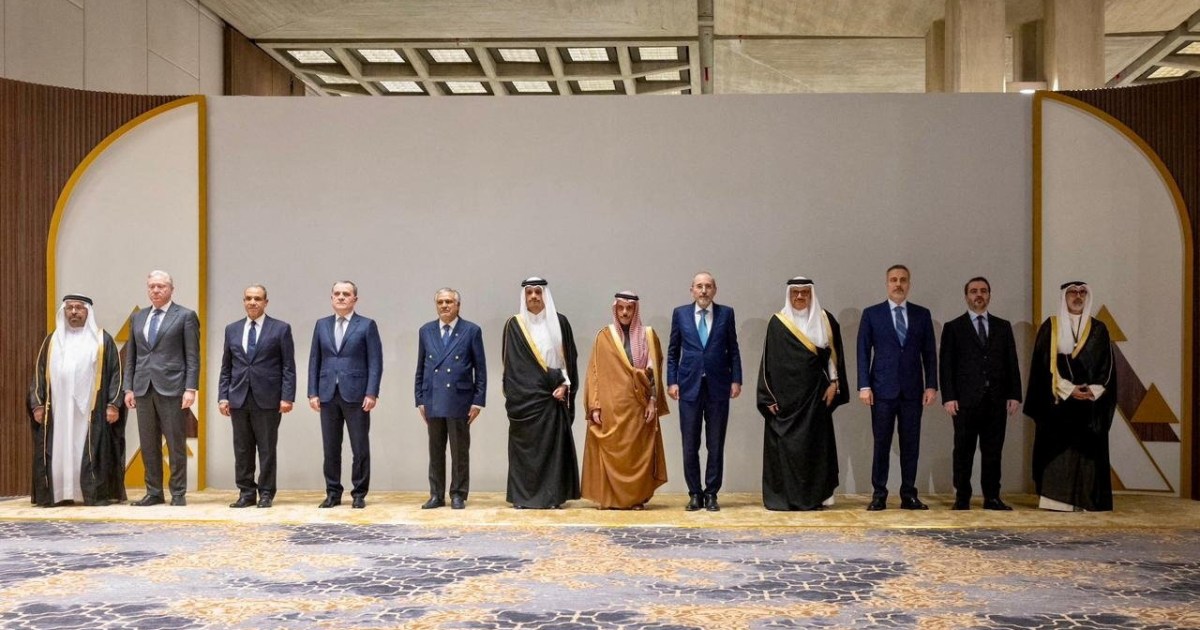
A joint statement issued on Thursday confirmed that foreign ministers from Qatar, Azerbaijan, Bahrain, Egypt, Jordan, Kuwait, Lebanon, Pakistan, Saudi Arabia, Syria, Turkiye and the United Arab Emirates attended the meeting on Wednesday.
All these countries have been impacted by the war, whether in terms of direct attacks from Iran, secondary threats from falling debris, dwindling energy supplies or looming mass displacement if the war continues.
Lebanon, in particular, has suffered heavy casualties since Hezbollah began strikes on Israel on March 2 in retaliation for its killing of Iranian Supreme Leader Ali Khamenei on the first day of the war two days earlier. Israel has carried out strikes in Lebanon that have killed at least 968 people in less than three weeks and has also launched a ground invasion in southern Lebanon.
Advertisement
What was decided in Riyadh?
The main takeaway from the meeting was that the 12 countries, which have broadly been sympathetic to Iran in the past, now assert “the right of states to defend themselves”, citing Article 51 of the United Nations Charter on defensive action.
They issued a collective condemnation of “deliberate Iranian attacks” with ballistic missiles and drones that have struck a range of targets, including residential areas, water desalination plants, oil facilities, airports and diplomatic positions.
Foreign ministers called on Iran to:
- Halt its attacks.
- Stop “provocative actions or threats” aimed at its neighbours.
- Cease supporting, financing and arming pro-Iran proxy groups based in Arab states.
- Refrain from actions or threats aimed at blocking the Strait of Hormuz or threatening maritime security in the Bab al-Mandeb strait.
They also condemned Israeli attacks on Lebanon and what they described as Israel’s expansionist policies in the region.
The meeting yielded a unified response to Iran’s increasingly unpredictable behaviour. But the joint statement was vague about how countries would follow this up.
What happens next?
Speaking early on Thursday after the meeting finished, Saudi Foreign Minister Faisal bin Farhan Al Saud did not elaborate on when his country might act to rein in Iran. “Do they [the Iranians] have a day, two, a week? I’m not going to telegraph that,” he said.
However, he left little room for doubt that Saudi Arabia and other Gulf states will act if necessary, adding that they have “very significant capacities and capabilities that they could bring to bear should they choose to do so”.
Emphasising his country’s right to defend itself, he said he hoped Iran had got the message and its leaders would “recalculate quickly and stop attacking their neighbours”.
But he added: “I am doubtful they have that wisdom.”
The Saudi foreign minister said that while the war would eventually come to an end, it will take time to restore relations with Iran because trust has been “shattered”.
Saudi Arabia’s relations with Iran have historically been rocky, but the two countries embarked on a Beijing-brokered rapprochement three years ago.
Reporting from Tehran, Al Jazeera’s Ali Hashem said the Saudi response “could be read as the end of the beginning of the Iranian-Saudi normalisation that started just a few years ago”.
How is Iran likely to respond?
With much of its leadership gone, the question of who is calling the shots in Iran is unclear.
New Supreme Leader Mojtaba Khamenei, who has not been seen in public since he was appointed to succeed his assassinated father, had never held government office before taking the top job.
Advertisement
Late on Wednesday, his official Telegram channel read: “Every drop of spilled blood comes at a price, and the criminal murderers of these martyrs will soon have to pay it.”
According to Iranian government figures, 1,444 people have been killed in US-Israeli strikes on Iran so far, with 18,551 injured.
Iran’s Islamic Revolutionary Guard Corps (IRGC) issued a statement saying: “Operation True Promise 4 against oil facilities associated with the US in the region was conducted with strength,” dedicating it to Khatib and “martyrs of the intelligence community”.
The statement, cited by Iran’s IRGC-affiliated Tasnim news agency on Thursday, said Iranian forces had responded to the “deceiving and lying enemy” that had targeted energy facilities in the country, referring to an Israeli strike on South Pars.
It added that it did not “wish to harm the economies of friendly neighbouring countries” but it had “entered a new phase of warfare” to defend Iran’s infrastructure.
Commenting on the escalation, Al Jazeera’s Hashem said: “It’s not any more the Iran that we know. There’s a new leadership, there’s a new mentality and the main issue is that Iran is now in the middle of a war.”
Related News
Argentina officially withdraws from World Health Organization, following US
US Embassy in Baghdad, Iraq targeted with missile, hits helipad

Iran-linked hackers hit medical giant Stryker in retaliatory cyberattack