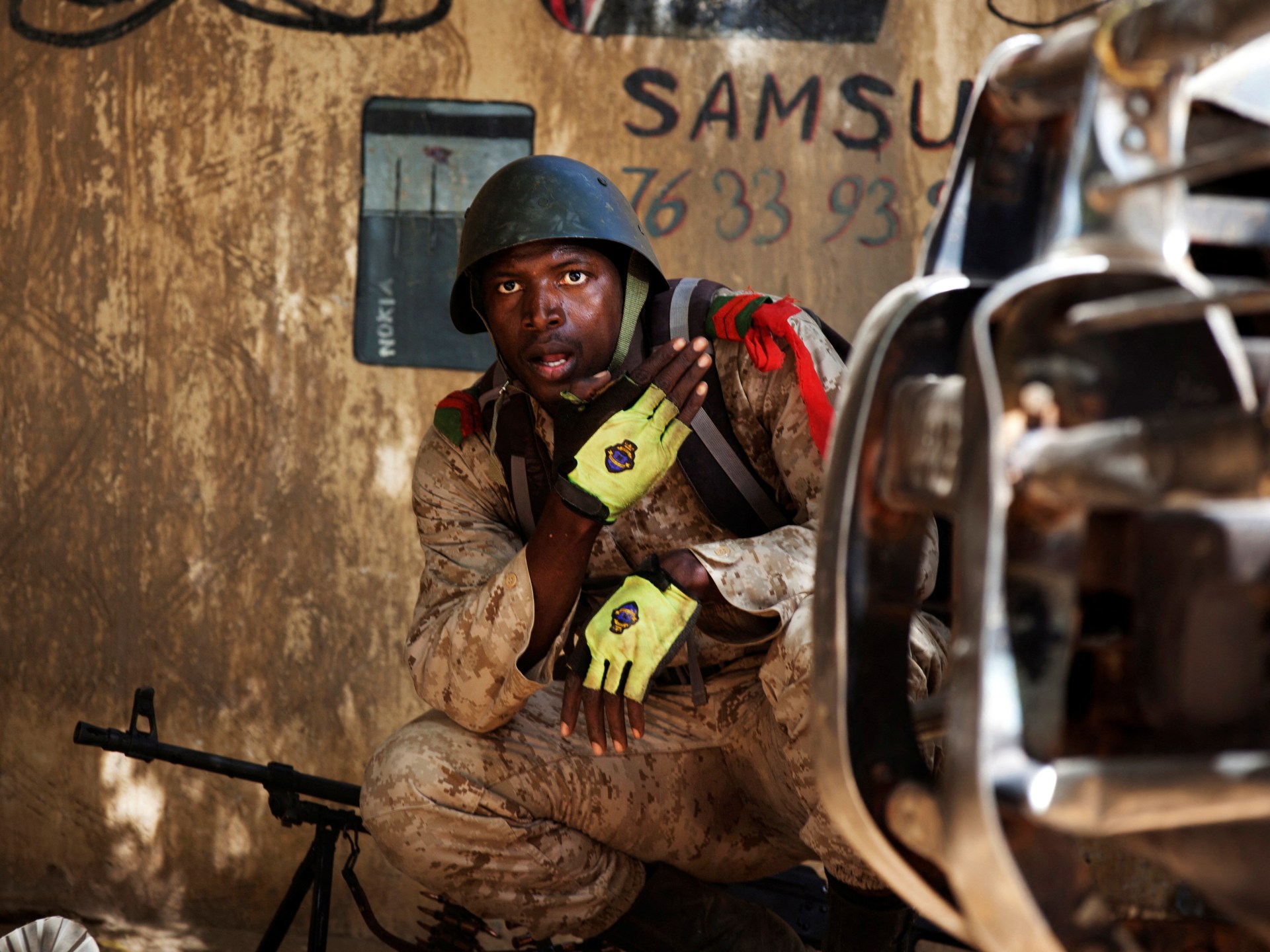

Armed groups in military-run Mali have launched renewed coordinated attacks in several towns across the country.
The assaults on Saturday targeted army positions, including a base used by its troops and Russian forces.
- list 1 of 3After battling armed attacks, Mauritania attempts to revive tourism
- list 2 of 3Satellite images show 10 places where water is disappearing globally
- list 3 of 3Armed attack on airport in Niger’s capital kills 11 soldiers, 2 civilians
end of list
A separatist Tuareg-led group and a regional al-Qaeda affiliate claimed responsibility for the attacks, which took place more than two months after the capital, Bamako, and several other locations were targeted in a coordinated assault by the same groups.
Here’s what to know:
Where did the attacks take place?
In an initial statement, the Malian army confirmed attacks on five positions: in Aguelhok, Anefis and Gao in the north; Sevare in central Mali; and Kenieroba in the south.
The army later said the situation was “totally under control”, adding that 20 “terrorists” were killed in Sevare and six in Gao. One pro-government fighter was killed in Gao and four others were wounded, it said.
In a separate statement later on Saturday, the army said it had also repelled attacks in the central towns of Konna and Somadougou with the help of Africa Corps, a Russian-backed paramilitary group.
Videos posted on the Africa Corps’ Telegram channel on Sunday purported to show a drone attack targeting a rebel position in Anefis and a Russian soldier on top of a building at a base in Aguelhok. The footage could not be independently verified.
In Kenieroba, a major prison complex where members of Mali’s political opposition are held reportedly came under attack.
Who was behind the attacks?
A spokesperson for the Tuareg-dominated rebel group, the Azawad Liberation Front (FLA), told the Reuters news agency it was involved in the attacks.
Advertisement
The al-Qaeda-linked group Jama’at Nusrat al-Islam wal-Muslimin (JNIM) also claimed responsibility, saying in a statement it had attacked and taken control of at least seven positions held by the army or pro-government fighters. The claims could not be independently verified.
Who are these groups?
JNIM was formed in 2017 as a coalition between the Saharan branch of al-Qaeda in the Islamic Maghreb and Malian armed groups Ansar Dine, Katina Macina and al-Mourabitoun.
It is led by Iyad Ag Ghali, who founded Ansar Dine in 2012, and has fighters across the border areas of Mali, Niger and Burkina Faso.
JNIM’s main goal is to capture and control territory and to expel Western influences in its region of control. Some analysts suggested that JNIM may be seeking to control major cities and, ultimately, to govern the country as a whole.
The FLA was formed in 2024 from a coalition of separatist forces in northern Mali. Led by Alghabass Ag Intalla, it is engaging in the latest in a series of rebellions by the Tuareg fighting for self-determination and independence.
While often at odds, fighters from the two groups or their predecessors have also partnered on occasion to fight common enemies, namely Mali’s government and its allies.
In late April, they were behind a series of coordinated attacks that targeted locations across Mali and killed Defence Minister Sadio Camara.
What is Mali’s security situation?
Since gaining independence in 1960, Mali has experienced alternating cycles of political stability and instability, punctuated by rebellions, financial woes and military coups.
In 2012, ethnic Tuareg separatists, allied with fighters from an al-Qaeda offshoot, launched a rebellion that took control of the country’s north.
But the al-Qaeda-linked fighters swiftly pushed out the Tuareg rebels and seized key northern cities, triggering French military intervention in early 2013 at the request of the government.
In September 2013, Ibrahim Boubacar Keita was elected as Mali’s president. Under his government, the United Nations brokered a peace deal between the government and northern Tuareg groups fighting for an independent Azawad in 2015.
Keita was deposed in a military coup in August 2020 after months of mass protests over severe economic woes and the poor security situation.
In September that year, retired colonel and former Defence Minister Bah Ndaw was sworn in as interim president and coup leader Assimi Goita as vice president to lead a transitional government.
In May 2021, Goita seized power in a second coup and pledged to restore security. His government cut ties with Mali’s former colonial ruler, France, and expelled French forces and UN peacekeepers.
Advertisement
In December 2021, Goita invited the Russian mercenary group Wagner to support the military government in its fight against armed groups.
In June last year, Wagner said it would withdraw from Mali after more than three and a half years deployed there, but Russian mercenaries have remained in the country under the banner of the Africa Corps.
Alex Vines, the Africa programme director at the European Council on Foreign Relations, told Al Jazeera the recent attacks have squeezed the control of Malian authorities into “securitised enclaves and corridors”.
“This has not improved overall security,” he said, noting that armed groups in the country have been coordinating their military action rather than competing with each other.
“In this context, foreign military support has limited success,” he added.
Related News
‘Will not leave’: Is Israel killing the US-Iran MOU by staying in Lebanon?
Trump administration vows to ‘disable’ International Criminal Court
Police attack Cockroach activists as thousands march on Indian parliament