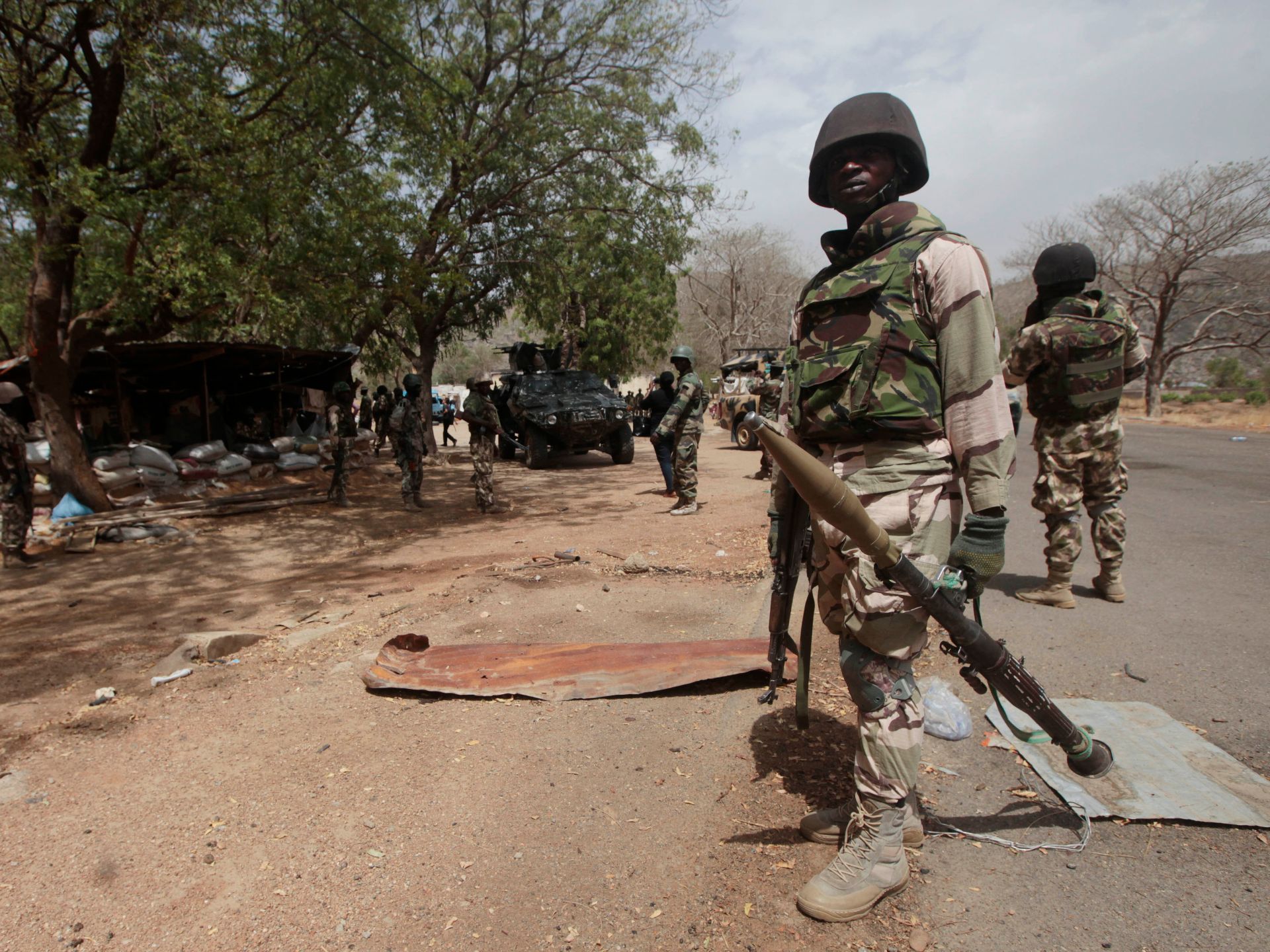

Boko Haram fighters are using the artificial intelligence chatbots of Big Tech companies to help build more powerful bombs, plan attacks and solve problems during combat, according to research by the University of Cambridge.
Researchers interviewed 27 former members of Boko Haram’s two factions – the ISIL affiliate in West Africa Province (ISWAP) and Jama’at Ahl as-Sunnah lid-Da’wah wa’l-Jihad (JAS). A number of members described using Sam Altman-led OpenAI’s ChatGPT, Anthropic’s Claude, Google’s Gemini, Elon Musk’s Grok, Mark Zuckerberg’s Meta AI and China’s DeepSeek as a routine source of technical and military advice before, during and after attacks.
- list 1 of 4Real Madrid stars appear to hide Ceuta solidarity message
- list 2 of 4Israeli double-tap strike kills 15-year-old and paramedic in Gaza
- list 3 of 4India summons Pakistani diplomat after incident in Arabian Sea
- list 4 of 4Moment Kash Patel’s senate hearing takes bizarre turn
end of list
Meanwhile, exclusive material obtained by Al Jazeera reveals how supporters of the wider ISIL (ISIS) movement are sharing instructions on bypassing AI safety controls and obtaining weapons-related information. Researchers at Tech Against Terrorism infiltrated a pro-ISIL technical forum where supporters instructed one another on how to use AI and circumvent its safety restrictions.
The findings come amid growing concern over ISIL’s adoption of emerging technologies. In February, United Nations officials warned the Security Council of increased use of advanced AI by ISIL and its affiliates. At the same time, researchers and several of the technology industry’s most prominent figures have warned that increasingly powerful AI systems are advancing faster than safeguards, raising concerns that unchecked advances in AI are making it easier for armed groups to exploit the technology.
Advertisement
“There is nothing we haven’t received an answer on,” a former ISWAP commander told the researchers.
From a projector to the battlefield
Deep inside a rebel stronghold in northeastern Nigeria, former fighters described a strikingly organised and sophisticated system for putting the technology to use.
According to the Cambridge research, operatives travelled to ISWAP-controlled territory to teach senior members how to use AI. Fighters were selected and assembled in rooms around laptops and projectors and shown how to query chatbots and circumvent the safeguards designed to prevent them from answering dangerous requests.
“The white guys came and taught us,” one former commander recalled. “They assembled the top people in a room and used a projector to show how it works on a big screen.”
The trainers supplied laptops equipped with privacy and encryption tools, while accounts and paid subscriptions to multiple AI platforms were set up for members, according to former fighters cited in the study. Respondents repeatedly identified the wider ISIL movement as the source of their AI training.
What followed, the research suggests, went far beyond occasional use of ChatGPT by individual fighters. Both ISWAP and JAS established dedicated AI units staffed by people with specialist operational knowledge, including engineers, weapons specialists and bomb-makers. One former JAS commander described a specialised unit of 23 people working from a solar-powered room, where its members answered questions, analysed information and trained senior commanders gathered around a laptop.
“‘[Ask] how can I build a bomb?’ and then it tells you how,” explained a former Boko Haram commander. “It is like a human robot. We used it a lot.” Another former member was similarly enthusiastic: “God has helped us, and so will AI.”
Often, according to the study, bomb-makers would keep laptops beside them, each time returning to the chatbot when they encountered a problem while they assembled explosive devices.
Building bombs with AI
Antonia Juelich, who authored the Cambridge study, told Al Jazeera roughly 10 of the 27 people interviewed discussed the use of AI in relation to explosives, including attempts to make bombs more powerful and recover explosive material from military ordnance.
But what Juelich found most concerning was not simply that fighters could obtain information about weapons – much of that has long been available in manuals and online. AI could instead respond to the specific problem in front of them.
Advertisement
She pointed to accounts of fighters asking AI how to improve explosives using the limited materials they already had available. Rather than searching for generic instructions, they could tell the chatbot what materials they had, ask questions and return with follow-ups when they encountered problems. This gave them something closer to a technical expert available 24 hours a day, tailoring its answers to the materials they had and the bomb they were trying to build.
Some of the other striking accounts concern unexploded military ordnance, where ISWAP had sought to recover explosive material from bombs and other munitions that failed to detonate, according to the Cambridge research. During one earlier incident described in the report, fighters disagreed over how to deal with an unexploded bomb. After they approached and handled it, the device exploded, reportedly killing 40 people. Former members said AI was now being consulted for guidance on recovering military-grade explosives from unexploded ordnance dropped or fired by opposing forces, which could then be repurposed in the group’s own devices.
AI was also reportedly used to adapt commercially available drones to carry and drop explosives onto targets.
‘Just ask Grok’
The bomb-making accounts were only one part of the story, with former fighters describing AI reaching into almost every stage of combat. In one account, a fighter entered combat with a camera strapped to his chest, transmitting images back to camp. A commander uploaded them to ChatGPT, used it to analyse the situation and relayed new instructions to fighters on the front line.
AI was also reportedly consulted when fighters encountered unfamiliar weapons. In one instance, commanders asked one of the group’s so-called AI specialists how to operate newly acquired firearms. His response suggested how routine the technology had become: “Just ask Grok,” referring to Elon Musk’s AI chatbot.
In another account, fighters turned to AI after government forces dug trenches around bases to stop motorcycle assaults. A former commander said fighters had seen motorcycles jumping obstacles in films and consulted AI as they tried to replicate the idea. He claimed 18 fighters died during repeated attempts to master the technique, before eight eventually succeeded and later crossed the trenches during an attack following a consultation with AI.
AI was also used to rethink how many fighters were sent into battle. One former ISWAP fighter said the group lost 60 men after deploying about 200 in one operation. He said commanders subsequently asked AI if smaller, more coordinated groups could be more effective in battle.
The technology was still being consulted after the fighting ended. Former members described returning from unsuccessful operations, telling AI what tactics they had used and asking why they had failed. Footage was also reportedly uploaded for analysis as fighters sought ways to change their approach for the next attack.
‘Removing the speed limiter’
Evidence reviewed exclusively by Al Jazeera suggests attempts to exploit AI extend into the wider ecosystem of ISIL supporters around the world.
Advertisement
Tech Against Terrorism researchers, who gained access to a pro-ISIL online technical forum, found users discussing how to obtain weapons-related information and circumvent AI safety guardrails – restrictions designed to stop chatbots from providing dangerous information.
One supporter compared the process to modifying a car. “It’s like removing the speed limiter of the car,” the user wrote. “The car still works but now it’s become more useful and it can go way faster than the manufacturer intended.”
Lucas Webber of Tech Against Terrorism said researchers were seeing increasing discussion of how to “jailbreak” AI systems – the term commonly used for attempts to make models ignore their safeguards.
“This is the tip of the iceberg,” he said.
Juelich acknowledged the difficulty of regulating AI when many questions can have legitimate uses. Researchers and journalists, for example, may ask about military tactics. But requests for help making bombs, she said, fall much more clearly outside companies’ rules and should be caught by their safety guardrails. “They are jailbreaking, circumventing the restrictions,” she said, adding that as AI becomes more powerful, the industry needs to be more heavily regulated.
Major AI companies say they have safeguards designed to prevent such misuse. OpenAI prohibits its systems from being used for terrorism, violence and weapons development, while Anthropic and Meta say they use classifiers and other safeguards to identify and block dangerous requests. xAI also prohibits attempts to circumvent its safeguards. OpenAI, Anthropic, Google, xAI, Meta and DeepSeek have been contacted by Al Jazeera for comment on the findings.
The new evidence and research come as Anthropic chief executive Dario Amodei has urged AI companies to slow the development of their most advanced models to give safety checks time to catch up, while calling for independent evaluations and common safety standards.
But the administration of United States President Donald Trump has taken a markedly different approach, claiming that US AI companies must be free to innovate without “cumbersome regulation” and pursuing what it calls a “minimally burdensome” national framework.
That leaves the companies themselves playing a significant role in deciding where their systems draw the line – even as researchers and many within the industry warn about the risks posed by increasingly capable models.
The Cambridge interviews with former Boko Haram members largely describe AI use during 2023 and 2024, and Juelich believes this makes the findings more concerning given how rapidly the technology has advanced since then.
She told Al Jazeera she was concerned about what the same fighters might now be capable of achieving with the more advanced AI systems available in 2026.
“I worry about where this is heading,” Juelich said.
Related News
Poland, Ukraine accuse Russia of ‘escalation’ after strikes near border

EU states to raise game as Arctic becomes strategic geopolitical frontier

‘Barrel bomb mufti’ Ahmad Hassoun handed life sentence in Syria trial