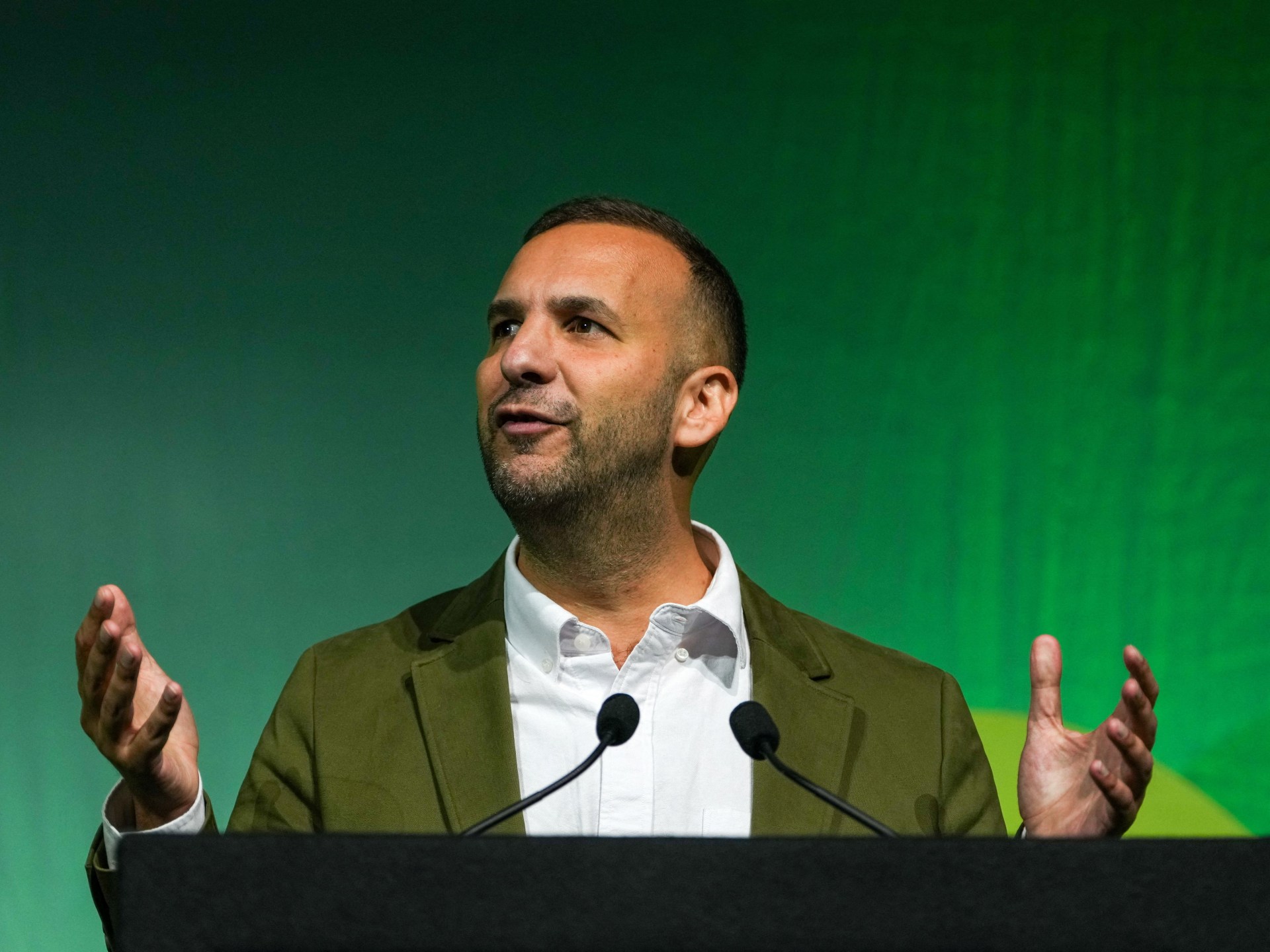

The United Kingdom’s Green Party has voted to define Zionism as a form of racism, drawing condemnation from the Israeli government.
In a binding vote held at the party’s conference over the weekend, members voted to usher in the new definition as well as a series of other strongly pro-Palestine policies.
- list 1 of 4Israel lashes out as UK’s Green Party formally defines Zionism as ‘racism’
- list 2 of 4Ireland refuse handshake with Israel and don armbands in Nations League tie
- list 3 of 4‘Did he know?’: Why Israel is rejecting an October 7 reckoning
- list 4 of 4Netanyahu’s fight to own the election narrative
end of list
However, just as the resolution has drawn international criticism, it has also proved internally controversial with four of the party’s five members in parliament opposing it.
Israel on Monday banned party leader Zack Polanski from the country just a day before the politician faces a by-election as he runs in the London constituency that former Prime Minister Keir Starmer represented.
Zionism emerged as a political ideology in the late 19th century. It called for the creation of a Jewish homeland at a time of rising anti-Semitism and persecution of Jews in Europe. Theodore Herzl, an Austro-Hungarian journalist considered the father of political Zionism, originally proposed an independent and colonial Jewish state in either Palestine or Argentina.
Here’s what we know about what the Greens have said:

What is the resolution?
The Greens endorsed the motion to equate Zionism with racism by a vote of 1,022 to 813.
In addition, the party restated its “commitment to Palestinian liberation” and called for the “establishment of a single democratic state throughout historic Palestine”.
Advertisement
The party also recommitted to its support of Palestinians’ right of return as well as to the Boycott, Divestment, Sanctions movement against Israel.
“The real, material, manifestation of Zionism has been the historic and ongoing dehumanisation, displacement, dispossession, disenfranchisement and destruction of Palestinians,” a Green Party statement said.
A significant number of party members, including four of its five MPs, were against parts of the resolution, exposing divisions within the party.
Codeputy leader Rachel Millward said in a post on X that while the party is committed to “stop the genocide”, the term Zionism means “different things to different people, … so I personally do not think the policy helps us do the work we all want to”.
Meanwhile, Polanski, who is Jewish and was away campaigning during the vote, told journalists afterwards that if Zionism equates to the displacement of Palestinians, “that is clearly racist.”
Polanski said he, however, did not support the reference to a single Palestinian state and external entities should not decide what a future state would look like.
How has Israel responded?
Israel has accused the party of legitimising “terrorism”, and senior officials equated it to anti-Semitism.
“The Greens have adopted not only the green of Hamas, but also its ideology: the elimination of the State of Israel through armed struggle,” the Israeli Ministry of Foreign Affairs wrote on social media.
Israeli President Isaac Herzog said it would “deliberately endanger Jews and Israelis everywhere”. Opposition leader Yair Lapid said the party was “racist”.
The Green Party has rejected equating criticism of Israel with anti-Semitism and reiterated its stance against “any form of discrimination or harassment”.
“We know there is no conflict between supporting the rights of Palestinians and the rights of Jewish people,” Polanski and other senior party members said in a statement on Sunday.
Has Zionism been equated to racism before?
Yes. In 1975, the UN General Assembly passed a resolution that “determines that Zionism is a form of racism and racial discrimination”.
The vote was sponsored by the Soviet bloc and the Arab League. It passed after 72 countries, largely from the Middle East and Africa, voted for it. Israel and 34 other countries – chiefly from the West – were against it. Thirty-two other countries abstained.
Just a year before, at the 1974 General Assembly, Palestinian leader Yasser Arafat had given his “olive branch” speech at the General Assembly.
Advertisement
About the same time, African countries opposing the apartheid regime in South Africa, which was increasingly allying with Israel, had resolved separately that the Israeli government was “racist” and both had an “imperialist origin.”
Also, in 1975, at the first international women’s conference, held in Mexico City, attendees decided there would be no international peace outside the “elimination of foreign occupation, Zionism, apartheid” and all other forms of “racial discrimination”.
However, the General Assembly vote proved controversial. Chaim Herzog, then-Israeli ambassador to the UN and later president, told the assembly in a speech that it was “based on hatred, falsehood and arrogance” and proceeded to rip up copies of the resolution in front of the audience.
The US too accused the UN of making “anti-Semitism international law”.
In December 1991, the US, under President George HW Bush, stepped up a campaign to revoke the resolution with Bush declaring at the UN that equating Zionism with racism “is to reject Israel itself” and to “challenge its right to exist”.
Israel also insisted it would not participate in the Madrid Peace Process to continue negotiations between Israel and Palestinian leaders if the resolution was not cancelled.
After much pressure from the US, an overwhelming majority of countries voted for its revocation – 111 to 25, including European and African countries.
Who else equates Zionism with racism?
Jewish Voice for Peace, the American anti-Zionist and pro-Palestinian advocacy group, has also named Zionism as a movement that creates a “racist hierarchy with European Jews at the top”.
In a February statement, the group reiterated its stance against what it called the “colonial ideology” of Zionism’s founders.
Similarly, in the United Kingdom, an employment tribunal in 2024 backed anti-Zionist activist and professor David Miller, who was earlier sacked from his post at the University of Bristol in 2021 for his views that the movement was “inherently racist”.
Related News

Poor storage or sabotage? Series of explosions in Syria raises fears
Election debate cancelled in Brazil, bomb scare outside Supreme Court
Somali pirates killed five crew members on hijacked tanker, officials say