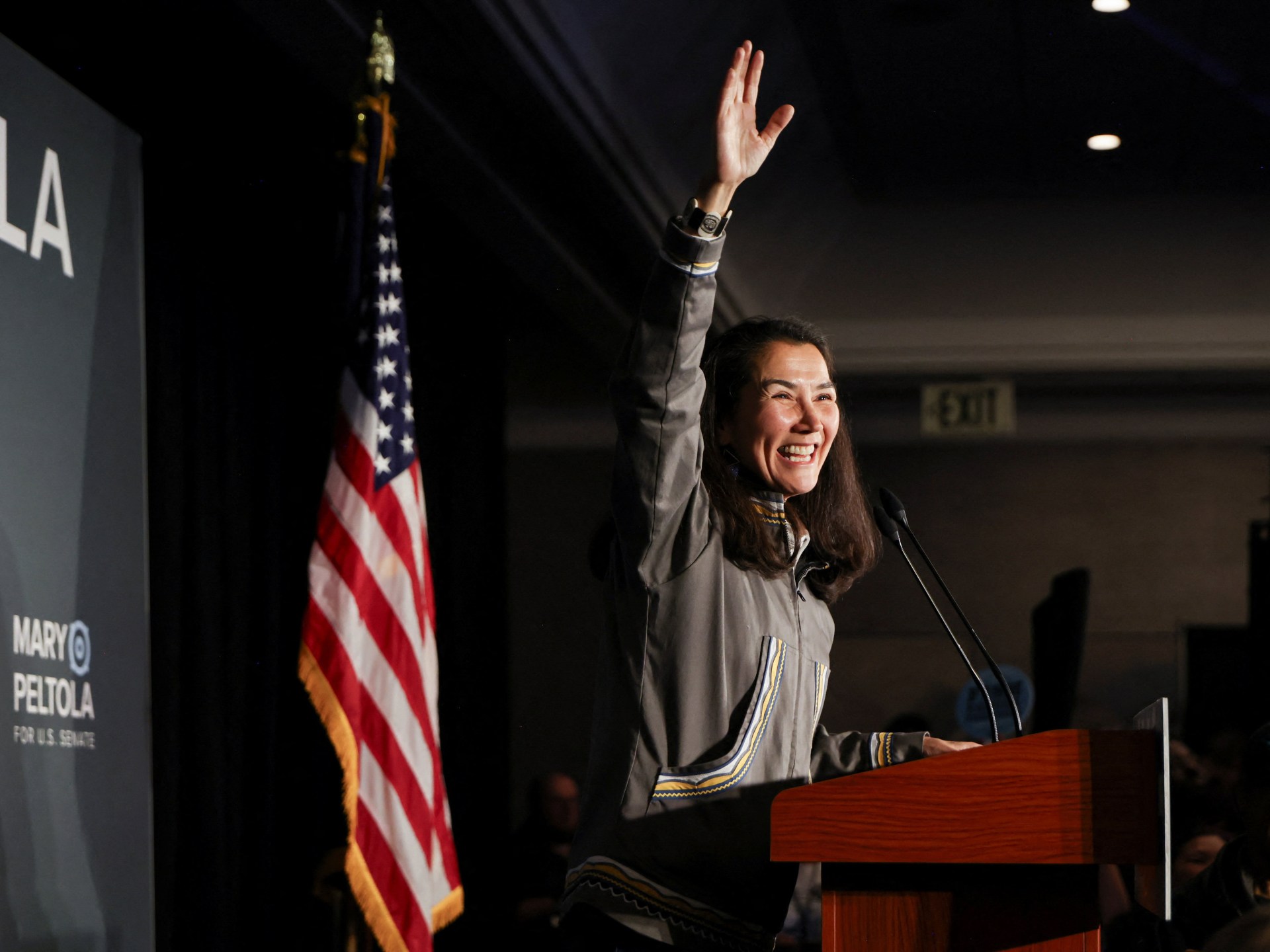

Democrat Mary Peltola has won the United States Senate seat in Alaska, unseating two-term Republican Senator Dan Sullivan. It is the Democrats’ first US Senate win in the state in more than a decade.
As of early Wednesday, The Associated Press news agency’s count gave her 50.1 percent of first-choice votes against Sullivan’s 45.8 percent, with an estimated 99 percent of votes counted.
- list 1 of 3Alaska’s two ‘Dan Sullivans’: How common is ballot stacking, does it work?
- list 2 of 3What is ranked-choice voting and how does it work in US elections?
- list 3 of 3Sullivan vows to honour Alaska race outcome, US judge dismisses DOJ lawsuit
end of list
Clearing the 50 percent mark matters. Alaska uses ranked-choice voting, so a candidate who wins a majority of first-choice votes is elected outright, with no further rounds of counting.
The vote has been closely watched, not just because it is the last Senate race to be called in the midterm elections, but because of a Republican legal challenge to the election over the listing of two candidates with nearly the same name – Republican Dan Sullivan and independent Daniel Sullivan. The legal challenge was thrown out just days before the election.
The Trump administration alleged that Peltola’s campaign had deliberately recruited the second Dan Sullivan to divide Republican votes in the state – a practice known as “ballot stacking“.
But on Tuesday, it was clear that even if the “official” Dan Sullivan had received all the votes of his namesake, he would not have gained enough to beat Peltola.
Peltola’s win brings Democratic control of the Senate to 56 seats, against the Republicans’ 44.
Who is Mary Peltola?
Peltola, a Yup’ik Alaskan, became the first Alaska Native to be elected to Congress when she won a special election for the state’s sole House of Representatives seat in 2022. She served from September 2022 to January 2025, losing her re-election bid in 2024.
Advertisement
On the Senate campaign trail this year, she played down her Democratic label, which remains unpopular in the state, and focused on local issues such as energy jobs, border security and gun rights.
Scott Lucas, a professor of international politics at University College Dublin’s Clinton Institute, told Al Jazeera that Peltola is viewed as a “safe pair of hands”.
“Alaska is a very small population, with a very, very large landmass, so it’s very important that you try to build up, across that large landmass, ties and community ties,” he said. “Peltola was seen as someone who had represented Alaska’s interests very well.”
Lucas described her as “a pragmatist, very much in that centre line of Democratic politics”. “Not too provocative, doesn’t really play identity politics,” he said. “She didn’t play on the idea this is all about Native Americans, even though she happens to be a Native American.”
Sullivan, by contrast, “was tarnished because he was there on Trump’s ticket, as it were”, Lucas said, though “he was very much a local candidate”. “Had the Trump administration done a better job on the issues, then I suspect Sullivan holds his seat,” he added.
Why was this race so tense?
For one, it was the last Senate seat to be counted.
But also, there were two Dan Sullivans on the ballot.
In late May, Dan J Sullivan, a retired teacher from Petersburg, entered the race. On June 15, the state elections division removed him from the ballot. It said he had chosen the name to cause confusion with the senator, and pointed to his use of a political consultant who had previously worked for Peltola.
The courts reversed that decision. A superior court judge ruled he was eligible, and the Alaska Supreme Court upheld that ruling on June 29. The two candidates appeared on the ballot as “Daniel J Sullivan Jr”, with no party affiliation, and “Dan S Sullivan”, Republican and incumbent. The retired teacher finished in the top four of the August primary, earning a place on the November ballot.
Republicans claimed he was a decoy. The New York Times later reported that Peltola campaign staff and Democratic operatives had worked to get him to contest. At Trump’s urging, the Department of Justice (DoJ) sued to delay certification if Senator Sullivan lost and to separate ballots cast for his namesake. Federal Judge Sharon Gleason dismissed the case on November 1. The DoJ said it would appeal.
Lucas said this kind of “ballot stacking” – backing a minor candidate to pull votes from a rival – is not uncommon, and both parties have engaged in it in the past. If the second Sullivan had taken 2 percent of the vote, he explained, he could have pushed the incumbent below the 50 percent mark and forced a ranked-choice count. “You drain enough support from the Republican that you give yourself a better chance of winning,” he said.
Advertisement
In the end, he said, “I don’t think it made that much of a difference.” AP’s count gave Daniel J Sullivan Jr 1.7 percent, and Peltola won more than 50 percent of the vote.
Peltola is the first Democrat to represent Alaska in the Senate since Sullivan unseated Mark Begich in 2014. Her win is not a deciding factor in which party controls the chamber – Democrats already had enough seats to control the Senate – but Lucas said it is “significant in a wider context”.
Alaska is the latest in a string of Republican strongholds to switch to Democrats.
On election night, Democrats flipped seats in North Carolina, South Carolina, Ohio, Texas, Kansas, Iowa and Maine. Later-arriving counts then confirmed that Mississippi had flipped, electing its first Black senator in 150 years, and now Alaska has taken the tally to nine.
Texas went Democratic for the first time since 1988, and Kansas for the first time since 1932.
“Alaska was one of the seats that it was thought that the Democrats might win,” Lucas said. “So that in itself is not as surprising as, say, Mississippi, which is really, really surprising. South Carolina was quite a surprise as well. But still, it reaffirms the extent of this Democratic surge.”
Those wins also give Democrats a buffer. Senators serve six-year terms, with about one-third of the 100 seats contested every two years, so the seats won this month will not be on the ballot again until 2032. By holding seats in states they would not normally carry, Democrats can make it much harder for Republicans to retake the Senate in 2028.
Finally, the win brings Democrats closer to the magical two-thirds majority. They now hold 56 seats, which Lucas called “a pretty good majority when even the most optimistic analysts regarding the Democrats were looking at 53 seats at most”. They will still need Republican support on issues to secure the two-thirds majority needed to overturn a presidential veto in both chambers.
A two-thirds vote in the Senate is needed to convict an official in an impeachment trial. The more seats Democrats hold, the fewer Republicans they need to win over to reach that threshold. For now, Lucas said, “They cannot pass legislation because Trump can veto it. So they still have to try to work with Republicans if they want to get any legislation across.”
What happens next?
Lucas expects the new Democratic majorities to propose legislation and hold hearings on accountability, “whether that be with respect to AI and technology, whether it be with respect to the Epstein case”, or the wealth of Trump and his family, including through cryptocurrency. “Meanwhile, the Republicans are a fractured party,” he said.
In North Carolina, South Carolina and Texas, Trump’s inner circle imposed candidates on the party, and all three were lost. Democrats, by contrast, “went for more organic candidates, and Mary Peltola was one of them”, Lucas said.
“Diversity has become a bad word with the Trump camp,” Lucas said. “It’s interesting that in this very diverse election, you have your first US Muslim senator, you have your first US openly gay man in the Senate, and you have two Native American women who have won: Peggy Flanagan in Minnesota, and then Peltola. In this case, it was the party with the diversity of candidates that did better.”
Advertisement
Lucas predicts “a fairly chaotic couple of years, primarily because of the executive”, with Democrats needing to “show that they can provide some at least potential for stability” before the 2028 presidential race. Rising health insurance premiums and disputes about data centres, which have proved unpopular in part because of the drain they impose on local resources, are among the next tests.
“This isn’t really a right-versus-left issue any more,” he said. “This is an issue of who governs effectively when they’re in office.”
Related News

Cameroon sets date for twice-delayed legislative and local elections

Russia’s land gains in Ukraine dwindle as its diesel reportedly goes unsold

Guatemalan lawmaker and three police officers killed in armed attack