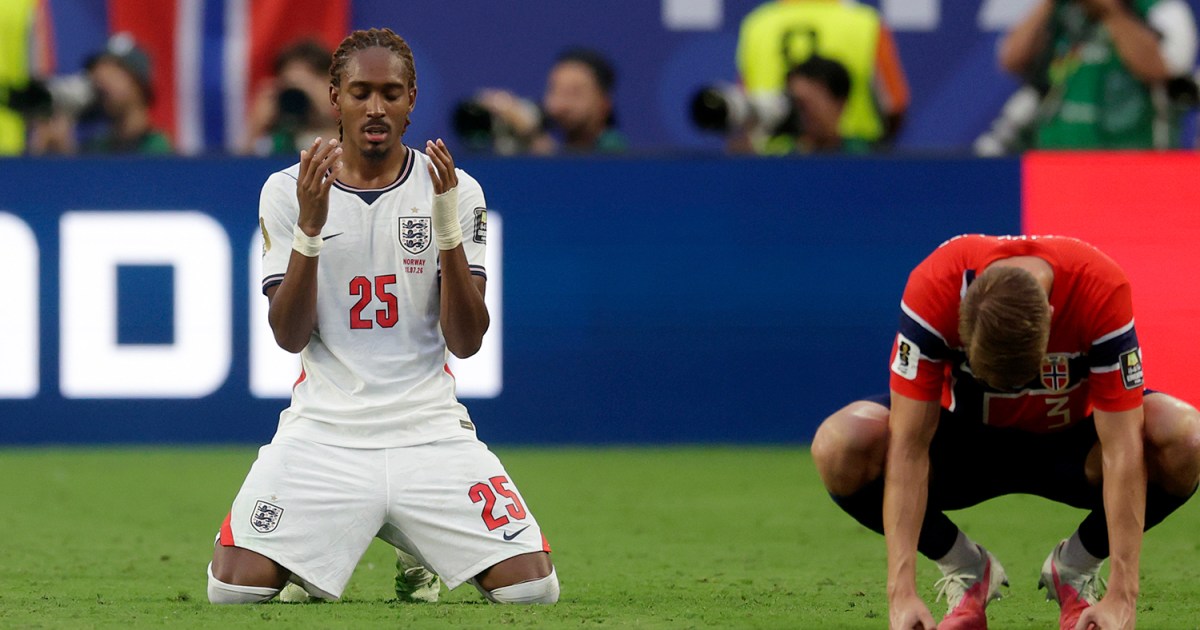

London, United Kingdom – Djed Spence kneeled on the pitch and raised his hands skyward to thank God after England beat Norway in the World Cup quarterfinal.
The July 11 match set up Wednesday’s semifinal date with England’s archrivals Argentina. For millions watching, it was the first time an England international had offered Muslim prayers on the field, on the biggest stage in football.
- list 1 of 4‘Support every Arab team’: In New York, the World Cup unites all Arab fans
- list 2 of 4Who will win the 2026 FIFA World Cup? Here’s what AI predicts
- list 3 of 4Jude Bellingham Station unveiled ahead of World Cup semi-final
- list 4 of 4Mexico: Football Without Fear
end of list
“Being the first Muslim player to represent the Three Lions, it meant everything. Something I’ve always wanted as a kid. But what makes me happy is a lot of kids can look at it and be inspired. I feel it’s bigger than me and it’s great for generations to come,” the 25-year-old England defender said late last year.
![Zain Gondal says he feels represented now England has its first jersey-wearing Muslim player [Courtesy of Zain Gondal]](https://www.aljazeera.com/wp-content/uploads/2026/07/20819192-d4b5-4013-ac5a-dea5c1c0bf9f-1-1784109521.jpg?w=770&resize=770%2C513&quality=80)
Spence sustained a broken jaw against Chelsea in May 2026, and has worn a carbon-fibre mask during this tournament.
Spence’s rise this World Cup – coming off the bench, absorbing pressure from his manager, growing into his place in defence – has made him the first Muslim to represent England’s senior men’s team. Germany, France and Spain, England’s closest European rivals, have had Muslim internationals for years. For England, this milestone feels long overdue to many.
“When I found out he was Muslim, I just liked him even more,” said Zain Gondal, a 23-year-old England fan in London who has followed Spence’s run closely. He has a soft spot for Muslim players because “you can see yourself a bit in them”.
Advertisement
“Every time [Spence is] playing, he’s come on. He’s defended really well … I thought he was amazing.”
‘He’s a role model’
Riz Rehman, an ex-footballer, whose brother Zesh Rehman was the first Muslim footballer to play in the English Premier League, knows the road that led here better than most.
He spent 15 years at the UK’s Professional Footballers’ Association (PFA) building the scaffolding – prayer rooms, Ramadan education for staff, breaks to open fast – that men like Spence walk into today.
He met Spence through that work at the defender’s club, Tottenham Hotspur, sitting with him during Ramadan after his return from injury.
“He’s new to the faith,” Rehman said, explaining that Spence converted to Islam a couple of years ago. “He’s a role model, and he must continue doing what he’s doing, having a good character and keep inspiring others.”
![Riz Rehman, an ex-footballer who mentors young players, pictured with Djed Spence [Courtesy of Riz Rehman]](https://www.aljazeera.com/wp-content/uploads/2026/07/Riz-and-Djed-1-1784109511.jpg?w=770&resize=770%2C513&quality=80)
The two exchanged numbers; Rehman has messaged him before and after matches since.
“I don’t think this changes him as a person whatsoever. If anything, it will actually bring him even closer to his religion,” said Rehman.
“Djed’s England journey is about more than just football. It’s a reminder to young Muslim players and families across the UK that your faith and religion doesn’t limit ambition; it can only strengthen it,” he said.
“It is also important we don’t place the expectations of an entire community on one player’s shoulders. There are always people out there looking for faults in others, but we need to remember that everyone is on their own faith journey and Djed is no exception.”
There are others who are only getting to know Spence and his footballing prowess.
Shabna Zaheer, who founded The Scene, a South Asian-led collective focused on creating inclusive, alcohol-free spaces for the community, has screenings across London this World Cup, drawing crowds of over 200 to a venue in Brixton.
She had not followed Spence closely before. “I didn’t actually know he was a revert until I saw the photo of him … putting his hands up,” she said. “We’ve never seen an English footballer do that.”
The recognition arrived tangled with dread. “I just hope it goes well, because a lot of us also get a bit nervous when we see someone do that, for what the media might bring towards them.”
She has reason to worry because after an article about her screenings recently went viral on Facebook, the comments mostly told Muslims to “integrate” and to go to the pub if they wanted to socialise.
![Fans watch a match at an event organised by The Scene, a collective which offers alcohol-free settings [Courtesy of Shabna Zaheer]](https://www.aljazeera.com/wp-content/uploads/2026/07/IMG_9809-1-1784109516.jpg?w=770&resize=770%2C513&quality=80)
Daniel Bennett, The Scene’s creative director, sees hope despite the nervousness.
Advertisement
Representation matters at a time when Muslims and minorities are often discussed “through the lens of division or controversy”, he said, pointing to the racist abuse directed at Marcus Rashford, Jadon Sancho and Bukayo Saka after the 2020 Euro final. “I’m not going to pretend like this milestone moment will suddenly change everything.”
Gondal agreed the limits are real, and points past football entirely.
“The way that people view minorities is because they’re quite frustrated with how the country is at the moment. But that’s all to do with politics; football can’t really fix that,” warned the young England fan. “It’s on the politicians to make the country better, because they’re the ones, like [Reform UK leader] Nigel Farage, forcing these opinions onto others.”
‘Football’s a game for everyone’
Bennett and Rehman focus on what a Muslim international might change in the wider culture. But Mark Overall, a goalkeeping scout and coach, brings it back to who actually gets scouted and picked in the first place.
He remembers a Southall youth team he coached in 2014 training through Ramadan. Players ran hill sessions without food or water – a formative experience of his career. He was impressed and inspired by that group’s work ethic. Yet he has watched older scouts pass over Asian and Muslim players for what he bluntly called, no good reason.
“If they had a choice between a white, Christian player and someone from India or Pakistan, they’d always go for the white lad. There is a little bit of racism still at the grassroots level and even at the academy level, mostly by the older scouts,” he said.
![Mark Overall, a goalkeeping scout and coach, is impressed by Muslim players who can fast during Ramadan and compete [Courtesy of Mark Overall]](https://www.aljazeera.com/wp-content/uploads/2026/07/IMG_0444-1-1784109514.jpg?w=770&resize=770%2C513&quality=80)
But Spence’s solid run in England’s World Cup campaign gives him reason to be cautiously optimistic.
“It changes the mindset that anyone can make it to any level … it doesn’t matter what your beliefs are. Football’s a game for everyone,” said Overall.
The moment has even produced its own folk footnote.
UK singer-songwriter Ben Cipolla has written the tribute song “Total Eclipse of Djed Spence” charting the player’s journey from a loan spell at French club Rennes to the England shirt, playing on his surname for a nod to the 80s hit “Total Eclipse of the Heart”.
Spence’s story has already travelled well beyond the pitch.

Related News
A safe space for Gaza women: A sanctuary to speak, heal and share amid war
VIDEO: World Cup Day 17: Messi breaks record; DR Congo and Algeria advance

What now as Israel rejects Trump’s 15-point plan for Gaza?