
Islamabad, Pakistan – On Monday morning, the United States Navy began escorting commercial vessels through the Strait of Hormuz. By Tuesday afternoon, the operation had been paused.
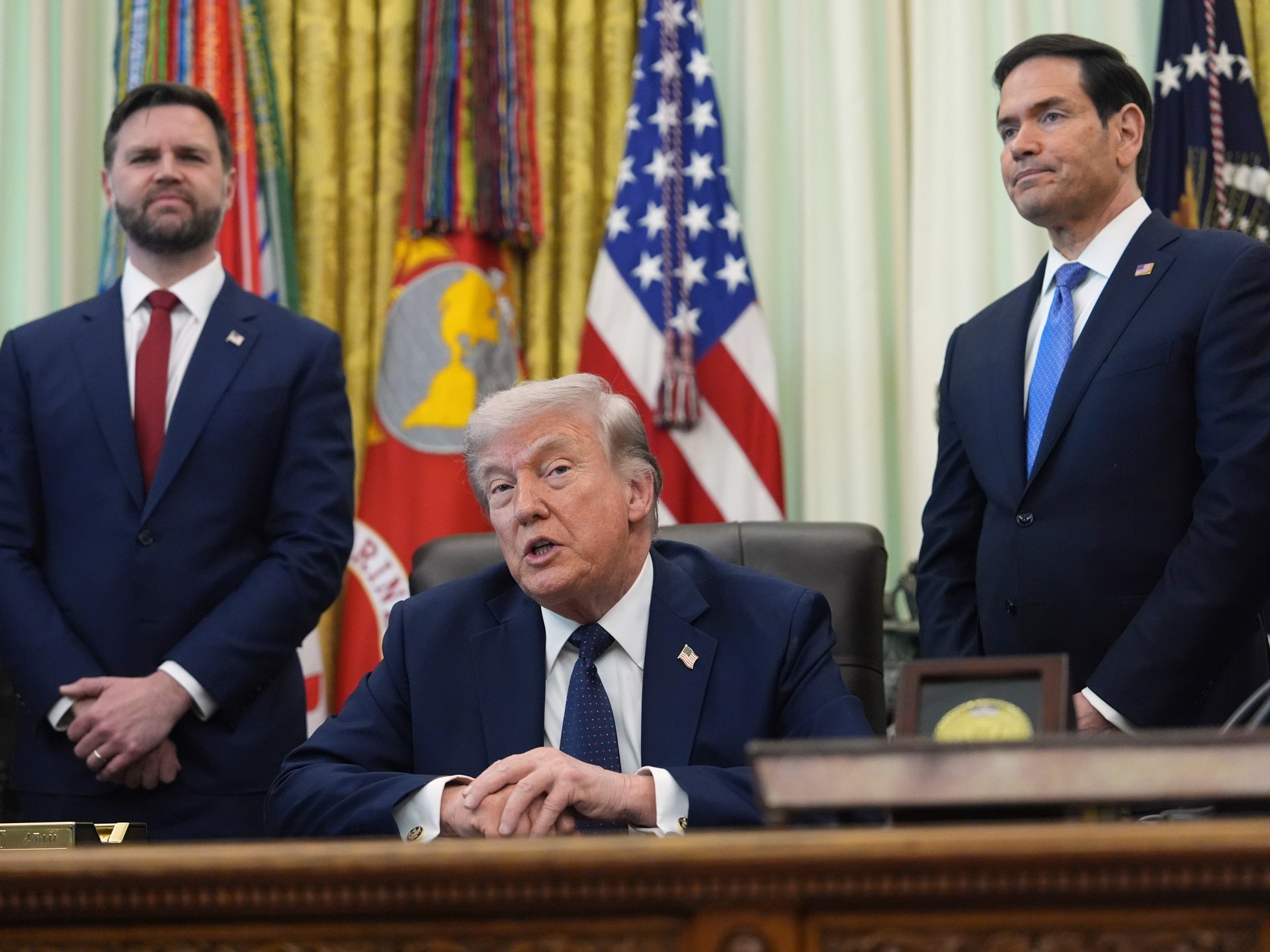
President Donald Trump announced the reversal on Truth Social, citing the “request of Pakistan and other Countries” and “great progress” towards a “complete and final agreement” with Iran.
- list 1 of 4Iran offers Hormuz deal without nuclear talks, as it seeks broader buy-in
- list 2 of 4Trump calls Iran’s leadership ‘fractured’. Is it, and who’s in charge?
- list 3 of 4Iranian Foreign Minister Araghchi arrives in China for talks
- list 4 of 4Iran war day 68: Trump talks about progress in talks; Rubio says war ‘over’
end of list
Earlier on Tuesday, US Secretary of State Marco Rubio declared that Operation Epic Fury, the air and naval campaign launched on February 28, was “concluded”.
What Washington now sought, he said, was a “memorandum of understanding for future negotiations”.
For weeks, that is precisely what Iran has been demanding.
In proposals passed on to the US through Pakistan, Iran has in recent weeks sought multistage negotiations, with a preliminary deal aimed at ending the war, and negotiations on the White House’s demands that Tehran end its nuclear programme pushed for later.
Trump and his administration resisted, with the US president insisting that getting Iran to give up its nuclear programme was central to any deal with Tehran.
Now, the US appears to have come around to accepting Iran’s demand, say experts. On Wednesday, the Reuters news agency and the US publication Axios reported that the US and Iran were close to agreeing to a one-page MoU to end the war, even though there have been no detailed negotiations on Tehran’s nuclear programme.
Seyed Mojtaba Jalalzadeh, an international relations analyst based in Tehran, said the week’s diplomatic signals reflected a sober reassessment in Washington of what was achievable.
Advertisement
“Moving towards a memorandum of understanding, a framework for future talks, is a good, viable and important first step to solve the immediate problem,” he told Al Jazeera.
Shift amid fraying ceasefire
Pakistani officials close to the country’s efforts to mediate peace between the US and Iran told Al Jazeera that Islamabad’s role as an intermediary had intensified in recent days, with senior officials in direct communication with both sides. Details of those exchanges remain closely held.
On Wednesday afternoon in Islamabad, Pakistani Prime Minister Shehbaz Sharif responded to Trump’s announcement of the pause in the operation to open the Strait of Hormuz, naming Saudi Arabia’s Crown Prince Mohammed bin Salman as a partner who prodded the US president to suspend the military mission in the waterway.
Pakistan, Sharif wrote on social media, was “very hopeful that the current momentum will lead to a lasting agreement that secures durable peace and stability for the region and beyond”.
Just 24 hours earlier, that optimism would have appeared misplaced.
Since the weekend, an already fragile ceasefire between the US and Iran appeared to be fraying.
Iran’s Islamic Revolutionary Guard Corps (IRGC) allegedly launched missiles and drones at the United Arab Emirates on Monday and Tuesday, the first such attacks since the April 8 truce. An oil facility in Fujairah was struck, wounding three Indian workers. Iran denied involvement.
The US and Iran each claimed they had hit the other’s ships, and each denied the other’s claims of success.
Washington, however, declined to escalate. Joint Chiefs of Staff Chairman General Dan Caine said the incidents remained “all below the threshold of restarting major combat operations”. US Defense Secretary Pete Hegseth said the ceasefire “certainly holds”.
The central question is whether the US has, implicitly, accepted Iran’s core demand: end the war and settle the Strait of Hormuz first, with the nuclear programme to follow.

Rubio’s Tuesday briefing suggests a sharp departure from Washington’s initial position.
At the outset, the US outlined four objectives: destroy Iran’s ballistic missile capabilities, dismantle its navy, sever support for armed proxies, and ensure Iran never obtained a nuclear weapon.
A 15-point proposal delivered to Tehran via Pakistan in late March went further. It called for dismantling nuclear facilities at Natanz, Isfahan and Fordow, handing over highly enriched uranium to the International Atomic Energy Agency (IAEA), and permanently prohibiting nuclear weapons development.
Advertisement
By contrast, Rubio declared the military phase over. Nuclear material, he said, “has to be addressed” and is “being addressed in the negotiation”, but he declined to elaborate.
What Washington now seeks is an MoU, a framework defining “the topics that they’ve agreed to negotiate on” and “the concessions they are willing to make at the front end”.
That marks a significant shift from March.
In early April, he warned that “a whole civilisation will die tonight” if Iran did not yield. This week, he called for an agreement to be “finalised and signed”.
Rubio also offered a revised account of the campaign’s outcomes, arguing it had destroyed the “conventional shield” behind which Iran concealed its nuclear programme.
The framing sidesteps the question of enriched uranium still buried underground and effectively redefines the war’s purpose.
The shift has not gone unnoticed in Tehran. When Trump launched Project Freedom — the mission aimed at escorting stranded ships through the Strait of Hormuz — on Sunday, Iran’s Foreign Minister Abbas Araghchi posted on X that “there’s no military solution to a political crisis”, calling it “Project Deadlock”. Within 48 hours, it was paused.
Jalalzadeh said the reversal reflected a reality Washington had been slow to acknowledge.
“The balance of deterrence is currently skewed in Iran’s favour, and I think this reality is slowly sinking in in Washington,” he told Al Jazeera.
Andreas Krieg, associate professor at King’s College London’s School of Security Studies, described the shift as a limited but meaningful concession.
“Washington has accepted that the simultaneous resolution of the war, Hormuz, and the nuclear file in one final package is not currently feasible,” he told Al Jazeera. “Diplomatically, this is a concession to Tehran.”
Gaps that remain
Iran’s position has remained consistent.
After submitting a 14-point proposal to Pakistan on April 30, later transmitted to Washington and described by Trump as “better” than expected, Iranian Ministry of Foreign Affairs spokesman Esmaeil Baghaei made the sequencing explicit.
“At this stage, we do not have nuclear negotiations,” he said.
The proposal calls for ending the war within 30 days, lifting the US naval blockade, releasing frozen Iranian assets, paying reparations, removing sanctions and establishing a new mechanism governing the Strait of Hormuz. Nuclear talks are deferred.
Iran received a US response via Pakistan on Sunday. Neither side has disclosed its contents.
Significant gaps remain. Rubio made clear that Washington’s definition of “opening the strait” diverges from Tehran’s.
“Under no circumstances can we live in a world where we accept that this is normal, that you have to coordinate with Iran, you have to pay them a toll in order to go through the Straits of Hormuz,” he said.

Iran’s proposal, however, calls for a “new mechanism governing the strait”, language Washington is likely to interpret as precisely such an arrangement.
Jalalzadeh said Hormuz remains the most unresolved issue, not only between the two sides but within Iran itself.
Advertisement
“Neither side has a good offer on the table because even the Iranians do not yet know how they want to administer it,” he said.
Still, several deadlines are now converging, and none favours any delay.
Araghchi arrived in Beijing on Wednesday for talks with Chinese Foreign Minister Wang Yi, his first visit to China since the war began in February.
He said, according to Iran’s state-affiliated ISNA news agency, Tehran would “only accept a fair and comprehensive agreement” in negotiations with the US.
The trip comes eight days before Trump’s scheduled summit with President Xi Jinping on May 14 and 15. US officials have openly pressed China to lean on Tehran to open up the strait.
But Beijing’s willingness to act as a pressure mechanism on Iran is constrained by its own confrontation with Washington, say analysts.
Last week, China’s Ministry of Commerce ordered domestic companies to defy US sanctions on five Chinese oil refineries buying Iranian crude oil, invoking for the first time a law allowing Beijing to retaliate against what it considers unlawful foreign sanctions.
China absorbed more than 80 percent of Iran’s shipped oil in 2025, according to analytics firm Kpler.
Gulf states are applying pressure from a different direction. Saudi Arabia’s Ministry of Foreign Affairs, in a statement on Tuesday, expressed concern over the “current military escalation” and explicitly backed Pakistan’s mediation efforts.
![Iran's FM Abbas Araghchi published this image on Wednesday on his Telegram channel of him meeting with his Chinese counterpart Wang Yi in Beijing China [Abbas Araghchi/Telegram].](https://www.aljazeera.com/wp-content/uploads/2026/05/FM-Araghchi-1778038420.jpg?w=763&resize=763%2C441&quality=80)
Riyadh called for the Strait of Hormuz to be restored to its pre-February 28 state and demanded the safe, unconditional passage of ships, a position that mirrors Washington’s stated demands and sits at odds with Tehran’s insistence on a new governing mechanism for the waterway.
On Wednesday, in Beijing, Araghchi spoke by telephone with Saudi Foreign Minister Prince Faisal bin Farhan Al Saud, according to Iran’s state news agency IRNA.
The two sides reviewed the latest regional developments and emphasised the continuation of diplomacy and cooperation among regional countries to prevent further escalation.
The approaching Hajj pilgrimage adds a separate constraint. With roughly 1.8 million Muslims expected to converge on Mecca from around May 25, including Iranian pilgrims, any escalation during that period would carry severe political costs for all parties.
Krieg said the converging deadlines made some form of agreement more likely without guaranteeing its substance.
“Washington wants to maintain military pressure but not burn the diplomatic path. In the language of negotiations, such a move is more of a limited confidence-building measure than a strategic concession,” Krieg said.
“The timetable increases the chances of a limited deal, but lowers the chances of a grand agreement.”
Related News

UK counterterrorism police investigate arson attack at former synagogue
Democrats up in Virginia, but US voters may pay price for redistricting war
Israel continues attacks on Lebanon despite extension of ceasefire