From education to housing protests, Palestine’s flag spreads across Europe
 04 November 2026
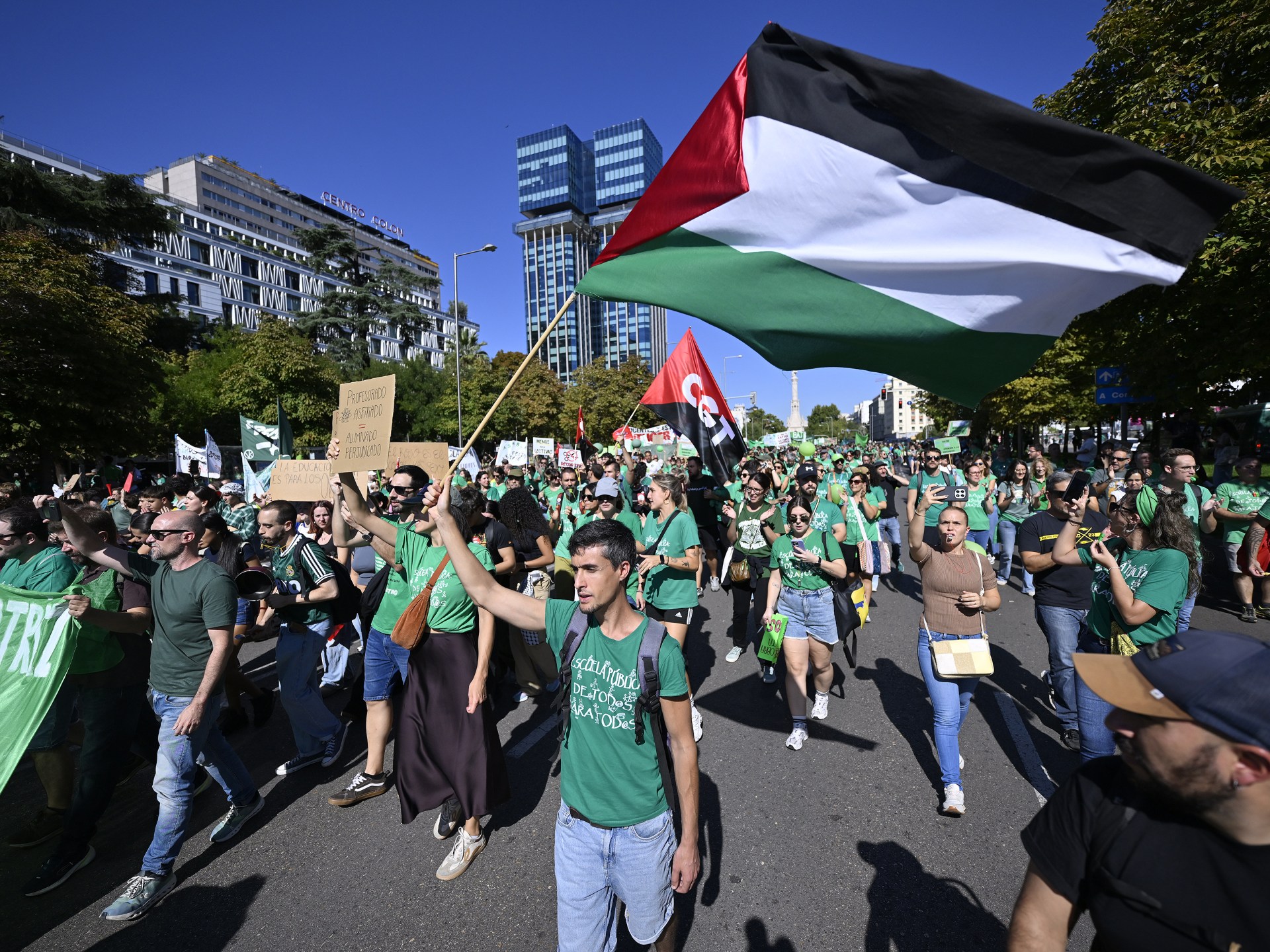

The Palestinian flag and traditional keffiyeh scarf have been regular appearances at recent demonstrations across Europe over housing, education and the cost of living.
Palestinian symbols were also displayed in Northern Ireland, where a decades-old standoff risked reigniting historic grievances.
- list 1 of 3Israel uses ‘battlefield evidence’ to prosecute Palestinians abroad
- list 2 of 3Israel’s ties with Europe are fraying. Can its election change that?
- list 3 of 3‘They try to break us’: Pro-Palestine activists in Czech custody
end of list
Kenny Pierre Agboton, from the Free University of Brussels for Palestine platform, says the use of the Palestinian flag in demonstrations is a nod to anti-colonialism and anti-repression struggles.
“From climate change to liveable Earth, the Palestinian issue becomes the crossroad for every fight we have, at least in Western Europe,” he told Al Jazeera.
He said that engaging in a political struggle is a political choice that values education over “giving arms to the military”.

His association is in contact with like-minded groups at other universities in Belgium and “we usually give one flag to each association” during nationwide demonstrations.
Across the border, France is witnessing nationwide rallies that began over faults within the education system.
High school students, backed by university and teacher associations, trade unions and some politicians, are demanding more affordable, higher-quality education, upgraded schools, smaller classes and more teachers. And some have done so while carrying the Palestinian flag or wearing the keffiyeh.

Alice Cohen-Morzadec, spokesperson for the French Student Union and a regular protester, views the flag as a symbol of the daily struggles in the occupied West Bank and Gaza and broader global inequalities.
Advertisement
“As young people, high school or university students, we know that these demonstrations are not just about our own situation; it is about a global system that is organising attacks on our rights,” she said. “It is a broader movement against world capitalism and colonialism system.”
Some politicians support using the symbols, too.
Nelson Mandela wore the keffiyeh in 1990. In 2006, then-Spanish Prime Minister Jose Luis Rodriguez Zapatero of the Socialist Workers’ Party briefly wore one after a young Palestinian reportedly placed it around his neck.

“What’s wrong with a citizen taking to the streets with a Palestinian flag?” said Mario Furore, an Italian member of the European Parliament from the Five Star Movement, which belongs to The Left parliamentary group. “Should we really be outraged by this, when the Israeli government is accused of genocide in Gaza and continues to massacre Palestinians in the West Bank? We mustn’t make the mistake of relativising everything,” he said.
“Since October 7, 2023, Israeli operations have caused tens of thousands of Palestinian deaths, nearly 80,000 according to some estimates. This fact alone should put things into perspective.”
But the anti-colonial messaging of the students or the realpolitik of some politicians does not resonate in every country with a protest movement.
Fatos Lubonja, an activist and writer who spent 17 years in prison during Albania’s communist rule, said he is one of the few who has carried the Palestinian flag or worn a keffiyeh during anticorruption demonstrations in his Muslim-majority country over the past four months.

He said that in Albania, some see the Palestinian struggle alongside issues related to Muslims. And Muslims are equated with the Ottoman Empire.
“We were liberated from the Ottomans. The Ottomans were considered as occupiers with whom we lived with a long time. The narrative was that we were coming back to Europe, returning to our roots,” he said.
“Being a Muslim for Albanians during communism means you had to be emancipated, that we wanted to be [a] Westerner, part of NATO. That is why Albanians, even today, are very pro-American and, of course, being pro-American means you also have to be pro-Israel,” he said.
Advertisement
Seeing the Palestinian cause and flag waved at European demonstrations is not to everyone’s liking, especially since some violent protesters have also brandished Palestinian symbols.
Palestinian writer and researcher Waddah Abu Jamea, writing in Al Majalla magazine in October, described discomfort watching on.
“Palestinians consequently find themselves expected to condemn the thief while thanking the student or academic who raises their flag. They watch as the flag’s original meaning disappears behind a cacophony of competing causes and agendas. They see it enlisted in struggles over identity, immigration, religion and security. At the same time, their own story, like the Palestinians’ collective national cause, fades into the background amid the growing politicisation of solidarity,” he wrote.
“The flag has crossed borders, but those borders remain closed off to Palestinians. It has entered universities and institutions while schools in Gaza have been destroyed, depriving Palestinian children of access to education. It flies above demonstrations in Paris, while Palestinians in the West Bank are denied the freedom to carry it in protest against killing, imprisonment, and siege.”
Some sent blunter messages to the student protesters.
Janine di Giovanni, a journalist and the head of The Reckoning Project, which documents war crimes, was visiting the West Bank on October 18 when she posted about the French protesters on her Facebook page.
She said that as she lives in Paris and has worked in Palestine for more than 30 years, she understands the root of the European protests.
“But I am writing this from the West Bank, where I document what is happening to Palestinian families during the olive harvest,” she wrote. “Every day there is violence. … So I ask you, gently: please don’t link your struggle to Palestine.”
“Not because yours doesn’t matter, but because they are not the same. Palestinians are fighting for something more basic: the right to live freely and safely on their own land. When the two are conflated, it blurs what is happening here and gives those who already misunderstand both causes an easy excuse to dismiss them, or to see only violence. Fight for your future. It is worth fighting for. But let Palestine’s story be told on its own terms.”
Related News
Israel political deadlock leaves Netanyahu’s future hanging in the balance

Brazil’s Lula and Bolsonaro debate policy proposals before run-off
Israel kills or wounds Palestinian every 90 minutes in Gaza since ceasefire