Spain braces for nationwide walkout as anger over housing, costs boils over
 10 November 2026
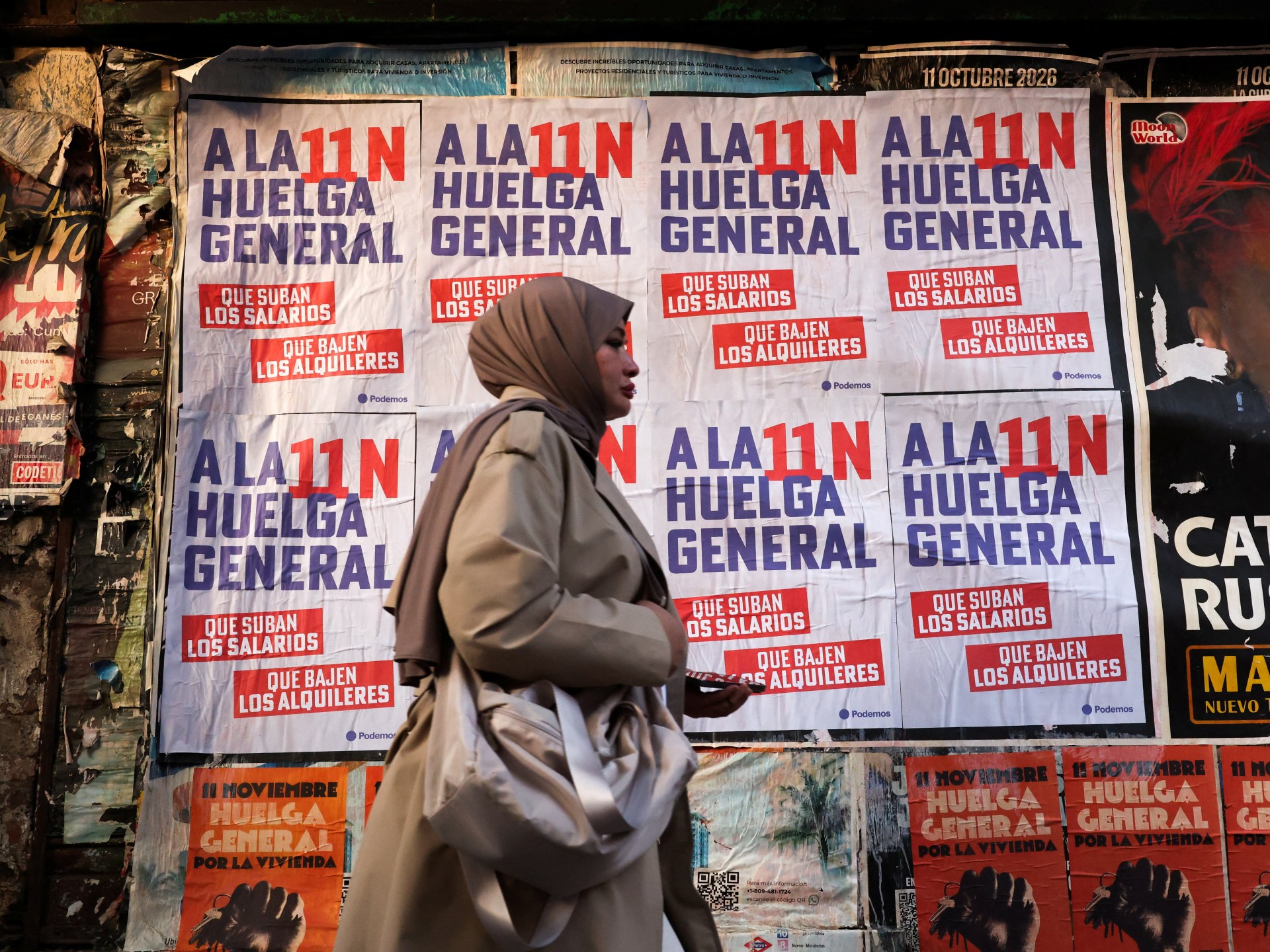

Spain is bracing for a nationwide general strike over soaring rents and the cost of living, as a deepening housing crisis fuels social unrest weeks before a crucial election.
The 24-hour walkout due to begin at midnight on Wednesday was called by Spain’s two biggest unions – the Comisiones Obreras (CCOO) and Union General de Trabajadores (UGT) – under their slogan: wages, housing, prices. The last time the pair called a general strike was in 2012 when the country was engulfed in an austerity crisis.
- list 1 of 3‘What’s wrong with citizens taking to the streets with a Palestinian flag?’
- list 2 of 3Why are Europe’s governments struggling to respond to growing protests?
- list 3 of 3Hundreds of thousands protest across France over high cost of living
end of list
The protest will disrupt transport, schools, healthcare and other public services across Spain. Flight cancellations and delays are also expected, while public transport in major cities will operate at reduced capacity.
Schools, hospitals, shops and other services could also face closures or reduced staffing, although minimum services will be maintained in essential sectors.
The action follows the September eviction of an 87-year-old, who has since passed away, from her home in Madrid, after her corporate landlord increased the rent. Images of Maricarmen Abascal being forcibly removed on a stretcher struck a nerve. The moment led to nationwide demonstrations and encampments in a wave of protests that also fuelled a political crisis, prompting the government to call the November 29 snap elections.
Wednesday’s strike could help the government bring the housing crisis back to the centre of the political debate, said Luke Stobart, a political analyst who writes about social movements and politics in Spain.
Advertisement
“(Socialist Prime Minister Pedro) Sanchez has been famous for taking risks in the past, and he’s often been quite successful when he’s taken them. And he knows that if you have a general strike before elections, that will force everyone to talk about housing. And that is happening – it is helping to keep housing at the centre of the debate in the run-up to the elections,” Stobart said.

The country has 750,000 fewer homes than it needs, according to the Bank of Spain, which estimates that the gap could exceed one million by 2028.
Rents have rocketed to an average of 1,176 euros ($1,318) per month, and the average salary of a young person is 1,190 euros ($1,333), according to data collated by the Spanish Youth Council.
Many struggling to make ends meet are forced to live in overcrowded shared flats or stay with their parents.
Spain is not alone, as other European nations witness weekly mass protests over costs and living conditions.
While Sanchez has not explicitly endorsed the strike, he praised collective action as the driving force behind the country’s social gains.
“Your eight-hour working day. Your pension. Your public healthcare. None of this fell from the sky. They were collective achievements. We will not let anyone take them away from us,” the prime minister said in a video message on Monday.
He believes his government has more to offer on social policies than political opponents.
But his Spanish Socialist Workers’ Party (PSOE) has suffered in recent months over its handling of the migration crisis in Ceuta. It is also plagued by a series of corruption scandals involving Sanchez’s inner circle and family members.
Recently, a deadly train crash in early November gave the opposition, the conservative Popular Party (PP) and far-right Vox, an opportunity to shift the national debate towards transport safety and what they described as government incompetence.
The crash, which occurred on the same railway line as another deadly accident less than a year earlier, killed 69 people. Transport Minister Oscar Puente, a senior PSOE figure and close ally of Sanchez, resigned.

The PP is ahead in opinion polls and could form a government with Vox, a prospect that would bring a far-right party into Spain’s national government for the first time since the end of Francisco Franco’s 1939-1975 dictatorship.
Advertisement
Both opposition parties have dismissed the strike as politically motivated, accusing unions of targeting the opposition ahead of the election. They have also criticised its timing, coming a day after the state funeral for the victims of the train accident.
Stobart said the strike has multiple layers, with different left-leaning groups putting forward a different narrative.
Some are critical of the government. These include Basque unions ELA and LAB, Galicia’s CIG, and Spain’s CGT, which have accused the regional and national governments of failing to tackle housing speculation.
“It’s not clear whether the big trade union leaders and the government are going to be able to control the narrative,” Stobart said, warning that the protests could develop into a broader wave of social unrest, as seen in France and Italy, potentially backfiring on the government.
Related News
Election deniers lose races for governor in key US swing states

F1 champion Lewis Hamilton visits Gaza border

Thousands of Israelis rally against Netanyahu gov’t days before election