Israeli soldiers are also settlers in West Bank: Al Jazeera investigation
 10 November 2026
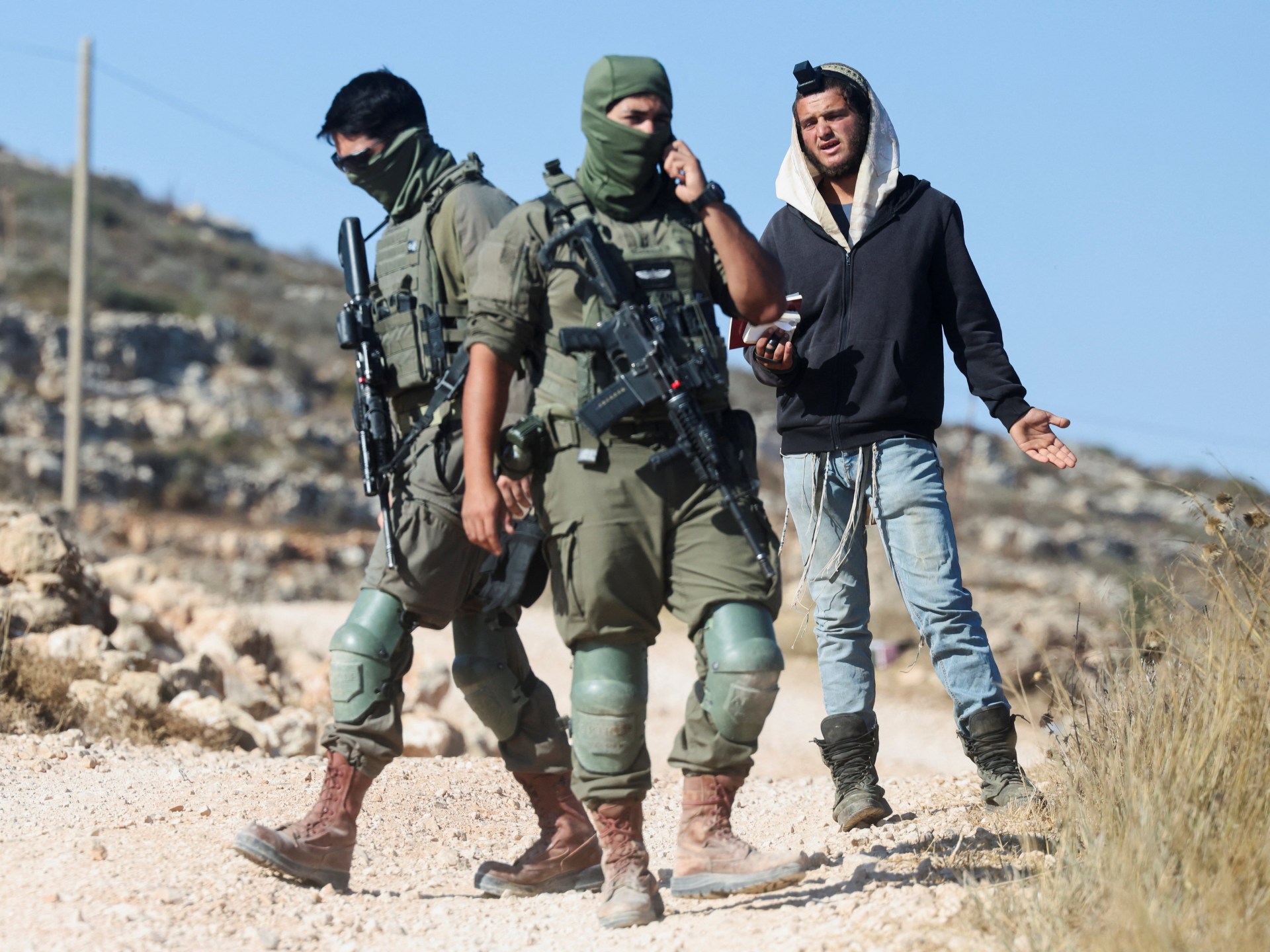

Israeli settlers carrying out pogroms in the occupied West Bank often also then return dressed in military uniforms to impose orders on Palestinian victims, blurring the lines between violent attackers and security forces Israel claims uphold the law, an Al Jazeera investigation has found.
The incidents captured in the investigation bolster the evidence presented by many Palestinian communities, international and Israeli human rights groups, activists and journalists pointing to institutional Israeli backing for settlers who have attacked, burned and taken over entire villages.
A particularly stark example played out in the village of Tal, southwest of Nablus.
Through facial matching and local testimonies, the investigation identified Yitzhak Levi Filant, a settler from Yitzhar known locally as “Yaqoub”. Filant was documented assaulting farmers in civilian clothing, only to return to the same village wearing a military uniform, carrying a military-issued weapon and issuing orders to residents.
Filant was placed on the United States sanctions list in August 2024 under President Joe Biden before President Donald Trump’s administration removed him from the list in early 2025.
Abbas Melhem, director of the Palestinian Farmers Union, told Al Jazeera that this duality is a daily reality. “When the farmer says, for example, to a settler: ‘I will call the army,’ the settler tells him: ‘There is no need for that.’ He goes to his car, then puts on his military uniform and returns and tells him: ‘I am the army!'” Melhem said.
Advertisement
“The army in the West Bank and the settlers are two sides of the same coin, and they serve the same goal planned and implemented by the Israeli government through this system,” Melhem added.
Lethal dual identities
The investigation documented deadlier manifestations of this overlap in Hebron. On March 7, a settler named Nahman encroached on Palestinian land near the Susya settlement and summoned reinforcements. An off-road vehicle soon arrived with the brothers Shem Tov and Luria Luski. Luria Luski, who has appeared in military uniform in other footage, opened fire. The attack killed Amir Shanaran, a resident, and severely wounded his cousin.
Shanaran’s father recounted the harrowing scene to Al Jazeera. “The first two shots in the air, bang, and then he came to my nephew, hit him with the muzzle of the rifle in his face here. I came and tried to defend my nephew. Shem Tov came and hit me in my head with the stick. I fell,” the father stated. “My late son, may God have mercy on him, Amir, came. He came to defend me. He pushed the settler away from me. He shot him on the spot,” he added.
Israeli attacks in the West Bank have escalated rapidly since October 7, 2023, and the Hamas-led attacks on southern Israel. They were followed by Israel’s genocidal war on Gaza.
According to the Al Jazeera investigation, 14 of 63 Palestinians killed by settlers since October 7, 2023, were shot by individuals serving in the army or wearing military uniforms.
Additional footage showed soldier Bezalel Talia raiding Palestinian homes and detaining residents while simultaneously running a training camp for settler youth involved in attacks on villages.
Institutional cover
This coordination is structurally supported by the Israeli military’s Regional Defence battalions, known as Hagmar. These units have expanded sixfold since 2023, shifting their core function from guarding settlements to backing settler operations. Assaf Surya, the battalions’ deputy commander in Hebron, acknowledged in an interview with Israeli media that most Hagmar members are settlers serving in the reserves.
Mohannad Mustafa, an expert on Israeli affairs, told Al Jazeera that the force’s mission has fundamentally changed. “Because it enjoys political support and it was originally armed in order to be a tool in the colonial settlement project in the West Bank, … therefore, it was armed by the army, and it was armed by the Israeli Ministry of National Security, and it was supported politically, and it was supported economically also and financially by the Israeli government,” Mustafa said.
Advertisement
“Part of the idea of defending the settlements now has become geographical expansion, expelling the Palestinians from their lands and restricting them,” Mustafa explained.
Gideon Levy, a writer and journalist at the Israeli newspaper Haaretz, analysed the deliberate nature of this integration. “The settlers made the decision to enter into the Israeli army and specifically in the units stationed in the West Bank,” Levy noted to Al Jazeera. “We have seen gradually and systematically an increasing number of commanders who are settlers themselves.”
Systemic impunity
The investigation revealed that weapons flow through both official military service and government facilitation: National Security Minister Itamar Ben-Gvir has said that at least 120,000 civilian weapon licences have been issued to settlers during the current government’s tenure. Training occurs at settlement firing ranges, such as the Ma’on settlement facility.
Amir Daoud from the Colonization and Wall Resistance Commission highlighted the severe security implications: “This is also what happened over the past years, that many security officers who were working for many years in security apparatuses and resigned or retired from them, joined settler militias and made a lot of information available to settler militias in order to use it against the Palestinians.”
This militarised network has enabled settlers to seize control of about one-fifth of the West Bank and force the displacement of 118 Palestinian communities under the current government of Prime Minister Benjamin Netanyahu.
During these operations, official forces frequently do not intervene.
“A farmer was killed by a settler weeks ago, and again, the army was there, and the army remained standing idly by and did not help the farmer and did not hold the killers accountable, and they were not brought to justice,” Levy said of an incident in Yasuf.
Melhem agreed.
“Most of the olives that were stolen this year – and we are talking so far about around 50 tonnes – were with the participation of the army, and … much of these olives were transported in the military cars themselves,” he noted.
Itamar Avneri, a founding member of the Israeli grassroots movement Standing Together, told Al Jazeera the Netanyahu government “encourages the settlers and encourages the Israeli army and gives them a blank cheque in order to commit these crimes and escape any punishment”.
According to Avneri, “a large number of soldiers in the army participate in the attacks because they believe that there is no partner on the other side.” These soldiers, he added, “know that they will escape punishment”.
Accountability remains virtually nonexistent. The Israeli human rights organisation Yesh Din reported that 93.6 percent of settler criminal cases opened by police since 2005 have been closed without indictments.
“I was surprised that they investigated 7 percent of the cases,” Levy said. “If the Israeli soldier shoots a dog tomorrow and if the settler shoots the Palestinian, I believe that the soldier who shot the dog will be brought to justice quicker than that settler who shot targeting the farmer.”
Advertisement
For the family of Amir Shanaran, though, that distinction between a soldier and settler has already lost all meaning. They both carry the same weapons, receive the same protection and mean the same thing to Palestinian communities: violence, displacement, destruction and far too often death.
Related News
Russian bombing of Ukrainian aid centre kills 24 people: Zelenskyy
Houthis threaten Saudi Arabia’s Aramco facilities and airports
Russia’s Lavrov to discuss US war and regional security during Tehran visit